Engineering Correlation-Driven Magnetism by Atomic Substitution in Metal-Free Phenalenyl-Based Two-Dimensional Polymers
Shiru Yang, Xin Guo, Jing Wang, Bin Shao, Xu Zuo

TL;DR
This paper explores how atomic substitution in metal-free 2D polymers can control magnetic properties through electronic correlations and sublattice symmetry.
Contribution
The study introduces a framework for tuning magnetism in metal-free 2D polymers via atomic substitution, linking electronic correlation and sublattice symmetry.
Findings
Sublattice-asymmetric substitution with boron or nitrogen induces spin-polarized semiconducting phases.
Uniform substitution preserves symmetry and results in nonmagnetic metallic states.
Electronic correlations and sublattice symmetry are shown to be independently tunable parameters.
Abstract
Metal-free two-dimensional (2D) polymers built from open-shell π-conjugated units offer a promising platform for realizing correlation-driven magnetism without transition metal elements. Here, we present a systematic first-principles study of phenalenyl-based 2D polymers that elucidates how atomic-level chemical substitution controls magnetic order through the interplay of electronic correlation and sublattice symmetry. Combining density functional theory with an effective tight-binding and Hubbard model analysis, we show that atomic substitution with boron or nitrogen on phenalenyl building blocks acts as a sublattice-resolved tuning knob for both the ratio of on-site Coulomb interaction to inter-site hopping (U/t) and the relative on-site energies of the two sublattices. Sublattice-asymmetric substitution with boron or nitrogen breaks sublattice equivalence and drives the system from…
Genes, proteins, chemicals, diseases, species, mutations and cell lines named across the full text — each resolved to its canonical identifier and authoritative record.
Click any figure to enlarge with its caption.
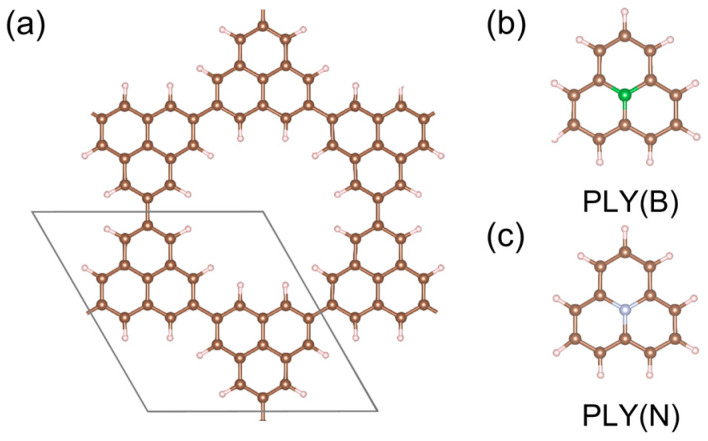 Figure 1
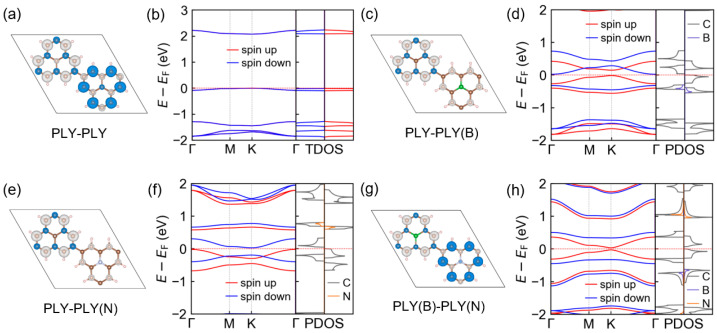 Figure 2
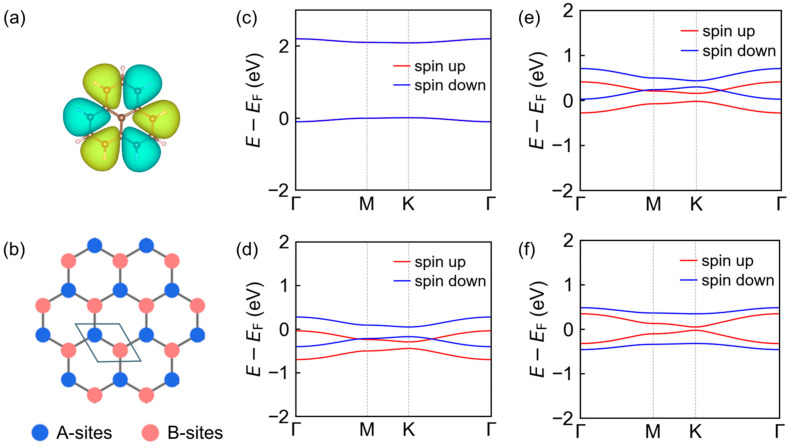 Figure 3
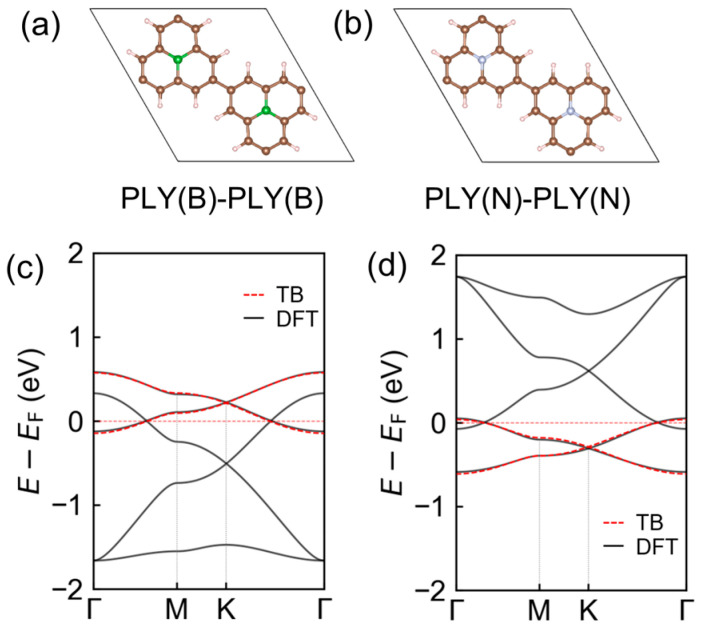 Figure 4
Peer Reviews
No public reviews on file for this paper yet. If you reviewed it on a platform where reviews are public (OpenReview, ICLR, NeurIPS, ICML), you can paste yours below so the community can read it here.
Videos
No videos yet. Explain this paper in a talk, walkthrough, or lecture? Add one.
Taxonomy
Topics2D Materials and Applications · Covalent Organic Framework Applications · Surface Chemistry and Catalysis