Insights into Accelerated MRI Protocols for Pediatric Brain Assessment in Emergency Cases
Josef Gabriel Kendel, Benjamin Bender, Georg Gohla, Andrea Bevot, Till-Karsten Hauser, Ulrike Ernemann, Christer Ruff

TL;DR
This paper evaluates two fast MRI protocols for pediatric brain imaging in emergencies, showing they can provide useful images quickly.
Contribution
The study demonstrates the clinical feasibility of two accelerated MRI protocols for pediatric emergency brain imaging.
Findings
GOBrain and Deep Resolve Swift Brain protocols can complete a multi-contrast MRI in minutes.
Both protocols show potential for triage and emergency imaging in pediatric cases.
High-resolution protocols may still be needed for subtle pathologies.
Abstract
Two accelerated magnetic resonance imaging (MRI) protocols for pediatric brain imaging, GOBrain and Deep Resolve Swift Brain, developed by Siemens Healthineers (Erlangen, Germany), were evaluated in a series of clinically relevant pediatric cases at 3 Tesla. Pediatric patients are particularly prone to motion, may be uncooperative, and often require sedation, especially in emergency settings. Consequently, there is a persistent clinical demand for fast brain MRI protocols that provide diagnostically sufficient image quality while minimizing examination time. Contemporary turbo spin-echo (TSE)-based clinical protocols commonly integrate parallel imaging (PI) and simultaneous multi-slice (SMS) techniques to achieve substantial reductions in scan time. Recent advances in three-dimensional volumetric encoding, compressed sensing, and deep learning (DL)-based reconstruction have further…
Genes, proteins, chemicals, diseases, species, mutations and cell lines named across the full text — each resolved to its canonical identifier and authoritative record.
Click any figure to enlarge with its caption.
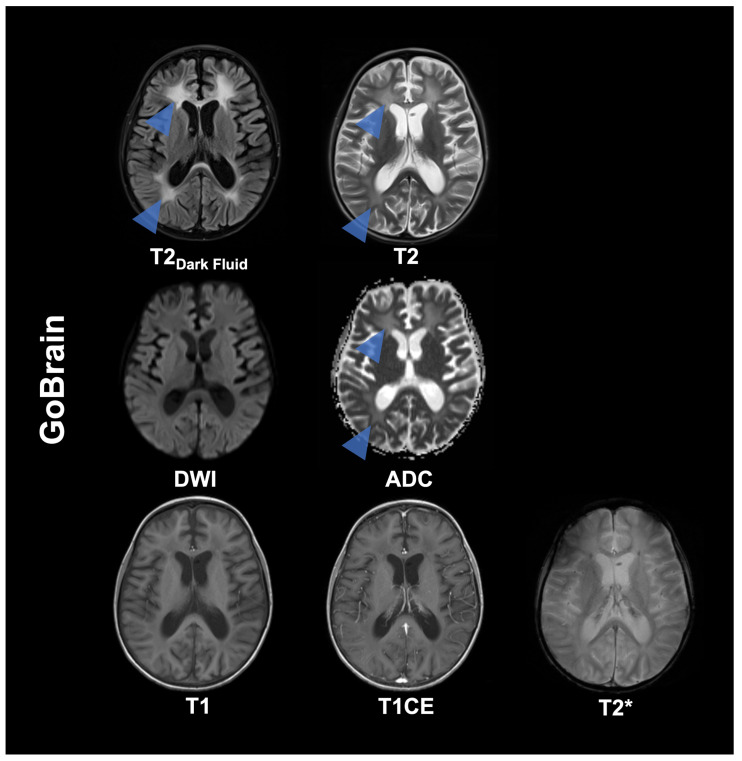 Figure 1
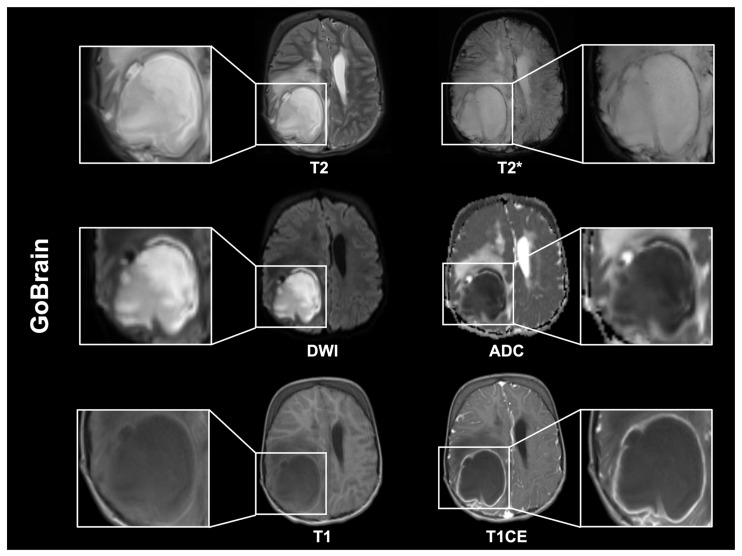 Figure 2
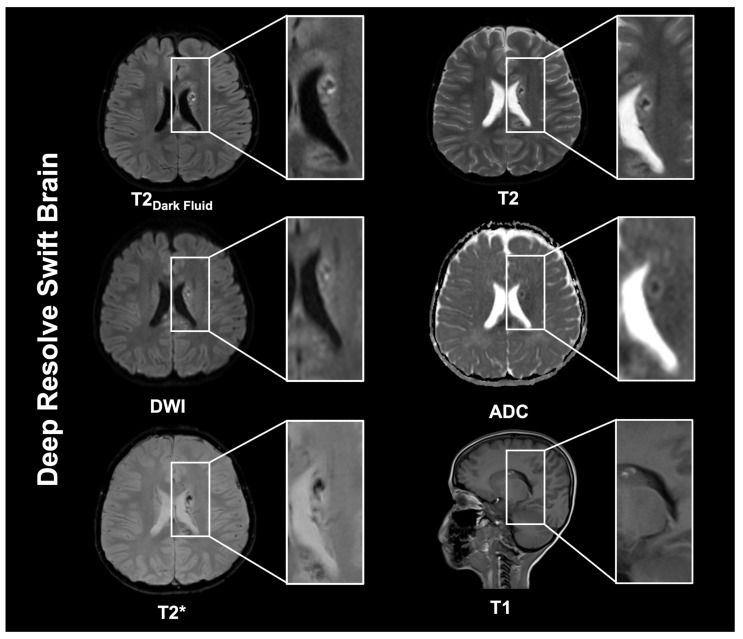 Figure 3
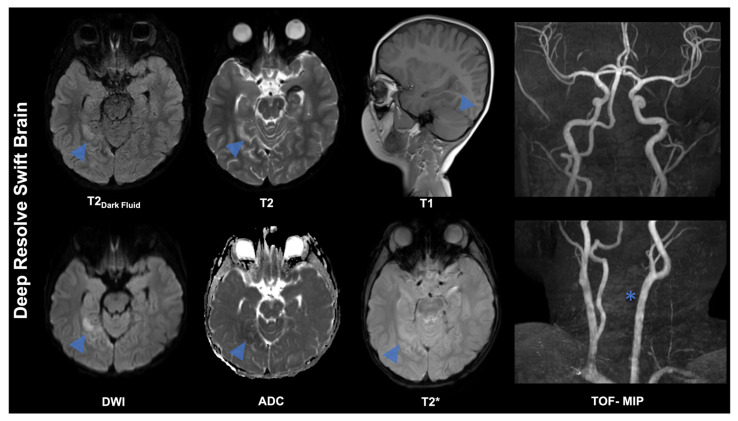 Figure 4
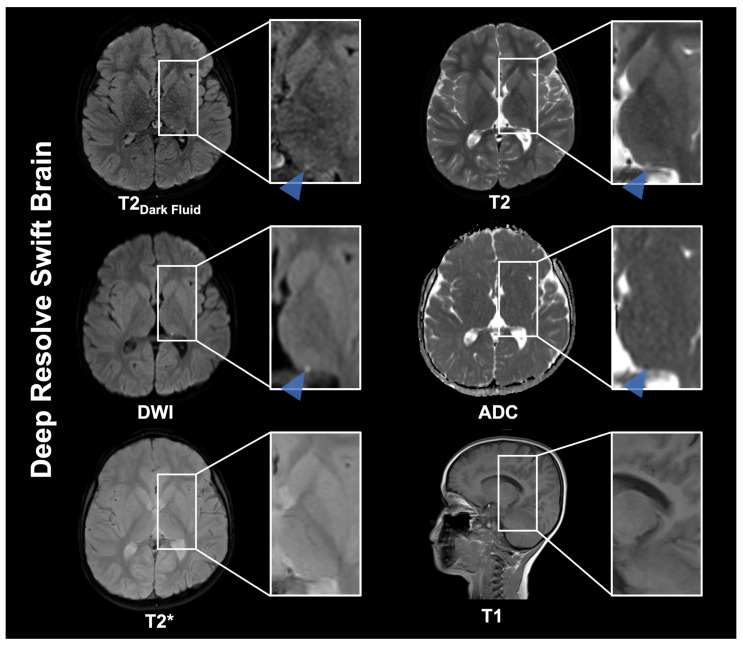 Figure 5
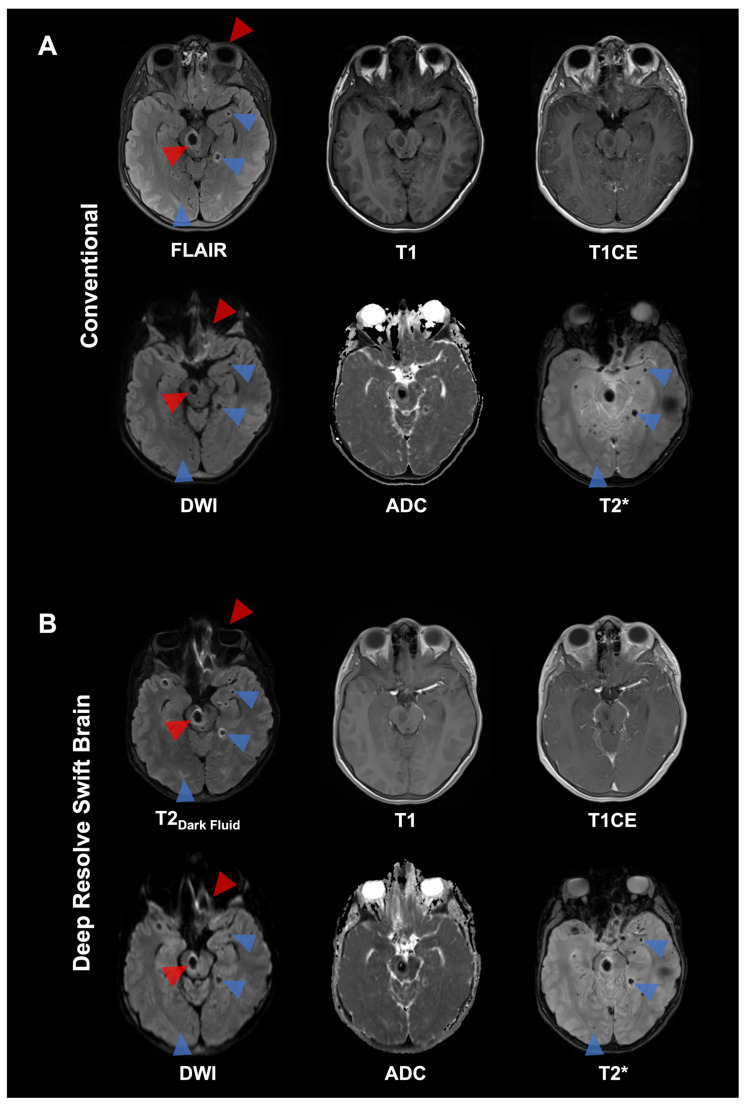 Figure 6
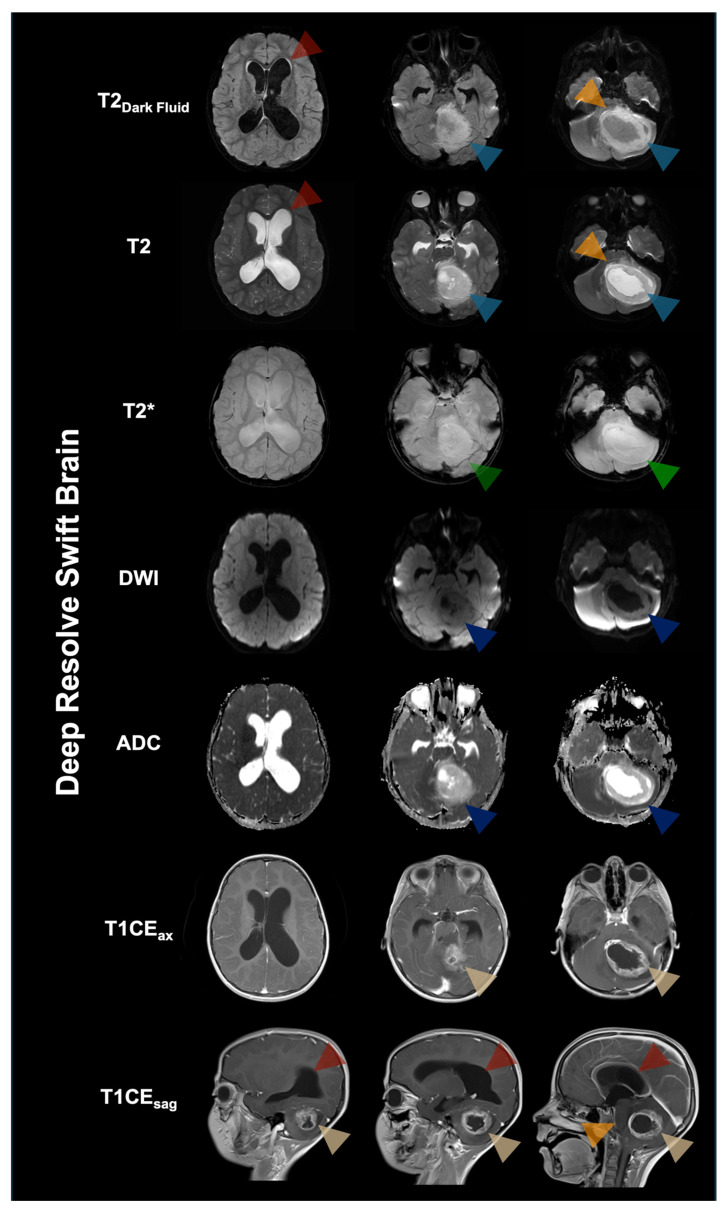 Figure 7
Peer Reviews
No public reviews on file for this paper yet. If you reviewed it on a platform where reviews are public (OpenReview, ICLR, NeurIPS, ICML), you can paste yours below so the community can read it here.
Videos
No videos yet. Explain this paper in a talk, walkthrough, or lecture? Add one.
Taxonomy
TopicsAdvanced MRI Techniques and Applications · Infectious Encephalopathies and Encephalitis · Atomic and Subatomic Physics Research
The reference list from the paper itself. Each links out to its DOI / PubMed record.
- 1Ramaiah R. Bhananker S. Pediatric procedural sedation and analgesia outside the operating room: Anticipating, avoiding and managing complications Expert Rev. Neurother.20111175576310.1586/ern.11.5221539491 · doi ↗ · pubmed ↗
- 2Griswold M.A. Jakob P.M. Heidemann R.M. Nittka M. Jellus V. Wang J. Kiefer B. Haase A. Generalized autocalibrating partially parallel acquisitions (GRAPPA)Magn. Reson. Med.2002471202121010.1002/mrm.1017112111967 · doi ↗ · pubmed ↗
- 3Pruessmann K.P. Weiger M. Scheidegger M.B. Boesiger P. SENSE: Sensitivity encoding for fast MRI Magn. Reson. Med.19994295296210.1002/(SICI)1522-2594(199911)42:5<952::AID-MRM 16>3.0.CO;2-S 10542355 · doi ↗ · pubmed ↗
- 4Glover G.H. Phase-offset multiplanar (POMP) volume imaging: A new technique J. Magn. Reson. Imaging 1991145746110.1002/jmri.18800104101790368 · doi ↗ · pubmed ↗
- 5Schlemper J. Caballero J. Hajnal J.V. Price A.N. Rueckert D. A Deep Cascade of Convolutional Neural Networks for Dynamic MR Image Reconstruction IEEE Trans. Med. Imaging 20183749150310.1109/TMI.2017.276097829035212 · doi ↗ · pubmed ↗
- 6Aggarwal H.K. Mani M.P. Jacob M. Mo DL: Model-Based Deep Learning Architecture for Inverse Problems IEEE Trans. Med. Imaging 20193839440510.1109/TMI.2018.286535630106719 PMC 6760673 · doi ↗ · pubmed ↗
- 7Liang D. Liu B. Wang J. Ying L. Accelerating SENSE using compressed sensing Magn. Reson. Med.2009621574158410.1002/mrm.2216119785017 · doi ↗ · pubmed ↗
- 8Bilgic B. Gagoski B.A. Cauley S.F. Fan A.P. Polimeni J.R. Grant P.E. Wald L.L. Setsompop K. Wave-CAIPI for highly accelerated 3D imaging Magn. Reson. Med.2015732152216210.1002/mrm.2534724986223 PMC 4281518 · doi ↗ · pubmed ↗