Fibroblast Lineage Switching as the Developmental Origin of Scarring and Target for Regenerative Healing
Argyri Niti, Kokkona Kouzi-Koliakou, Anna Michopoulou

TL;DR
This paper explores how fibroblast lineage changes during development lead to scarring and how understanding these changes could help promote scar-free healing.
Contribution
The paper highlights fibroblast lineage switching as a key developmental mechanism underlying scarring and potential targets for regenerative healing.
Findings
Early fetal fibroblasts support regenerative healing, while later fibroblasts contribute to scarring.
Lineage-specific fibroblast populations are linked to scar-free or fibrotic healing outcomes.
Reprogramming adult fibroblasts to a fetal-like state may enable scar-free tissue repair.
Abstract
This review discusses the most recent advances in the mechanisms that drive the transition from regenerative healing to scarring that is observed during development. Wounds in early-gestation embryos of less than 24 weeks of age heal through regenerative mechanisms that restore normal tissue architecture and form new appendages, such as hair follicles, without scarring. This divergence reflects coordinated differences in epidermal and dermal compartments, inflammatory signaling, extracellular matrix (ECM) composition, mechanical cues, and gene regulation. This review focuses on the changes observed in the behavior of different lineages of fibroblasts during development as central regulators of scar tissue formation. Elucidating how these lineage-encoded programs are established and maintained may enable strategies to reprogram adult fibroblasts toward a fetal-like regenerative state and…
Genes, proteins, chemicals, diseases, species, mutations and cell lines named across the full text — each resolved to its canonical identifier and authoritative record.
Click any figure to enlarge with its caption.
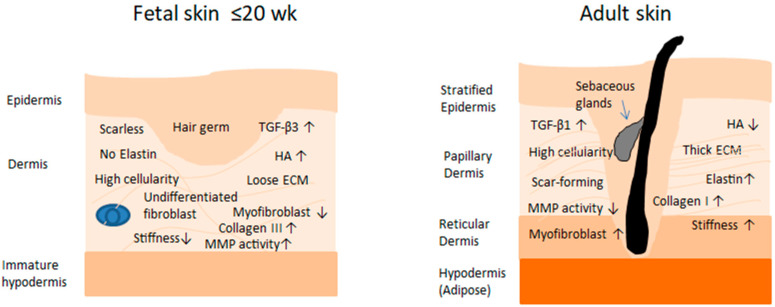 Figure 1
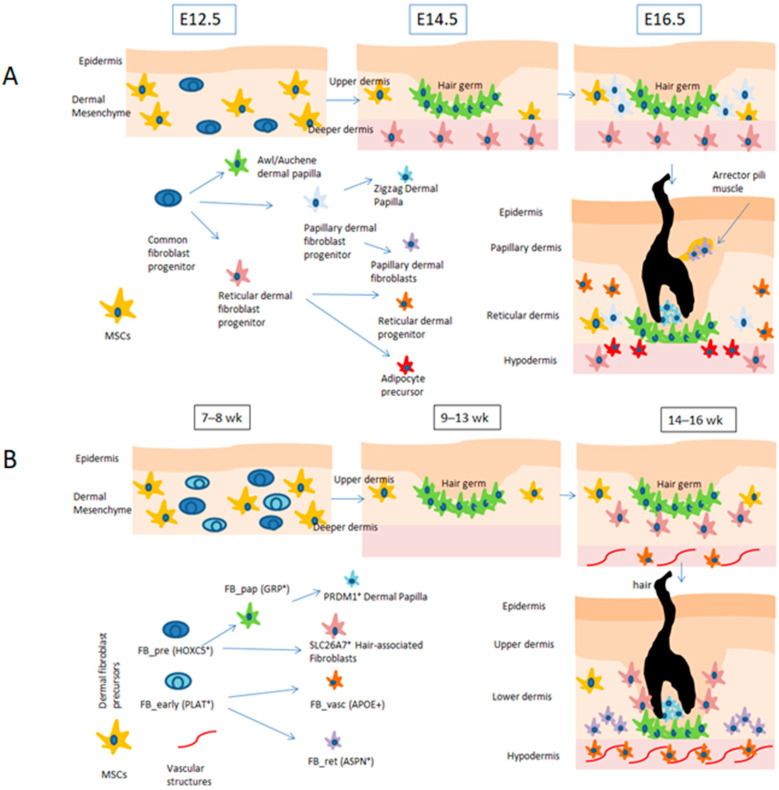 Figure 2
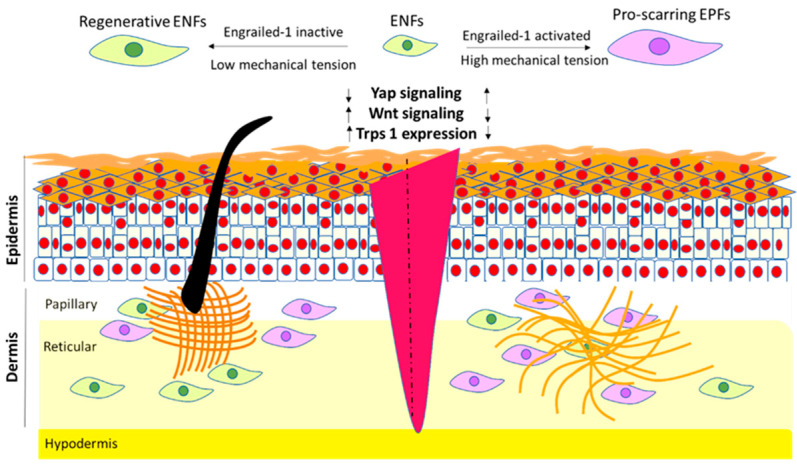 Figure 3
Peer Reviews
No public reviews on file for this paper yet. If you reviewed it on a platform where reviews are public (OpenReview, ICLR, NeurIPS, ICML), you can paste yours below so the community can read it here.
Videos
No videos yet. Explain this paper in a talk, walkthrough, or lecture? Add one.
Taxonomy
TopicsWound Healing and Treatments · Hair Growth and Disorders · Dermatologic Treatments and Research