In Vitro Bioaccessibility of Selenium in Popular Thai Seafood Across Cooking Methods
Narisa Rueangsri, Chonnikarn Limpaninchart, Niratchaporn Thanopajai, Kunchit Judprasong, Piyanut Sridonpai, Nunnapus Laitip, Nattikarn Ornthai, Jörg Feldmann, Alongkote Singhato

TL;DR
This study examines how cooking affects selenium bioaccessibility in Thai seafood, finding that horseshoe crab eggs have the highest selenium content and bioavailability.
Contribution
The study provides novel insights into selenium bioaccessibility in Thai seafood across different cooking methods.
Findings
Indo-Pacific horseshoe crab eggs had significantly higher selenium content than other seafood species.
Selenium bioaccessibility in horseshoe crab eggs was 81.1–88.3%, much higher than in other seafood items.
Cooking methods like boiling, frying, and grilling did not significantly affect selenium bioaccessibility.
Abstract
Selenium (Se) is a vital element for human health and seafood represents one of its major dietary sources. Nevertheless, information regarding the bioaccessibility of Se from seafood commonly consumed in Thailand remains scarce. To address this limitation, the present study evaluated in vitro Se bioaccessibility using the equilibrium dialyzability approach. Ten seafood species frequently selected by Thai consumers were investigated to determine total Se concentrations following different culinary treatments, namely fresh, boiling, frying, and grilling. For thermally processed samples, gastrointestinal digestion was simulated in vitro through enzymatic digestion prior to bioaccessibility assessment using the equilibrium dialyzability method. Inductively coupled plasma triple quadrupole mass spectrometry (ICP-QQQ-MS) was used to precisely quantify the total and dialyzable Se fractions.…
Genes, proteins, chemicals, diseases, species, mutations and cell lines named across the full text — each resolved to its canonical identifier and authoritative record.
Click any figure to enlarge with its caption.
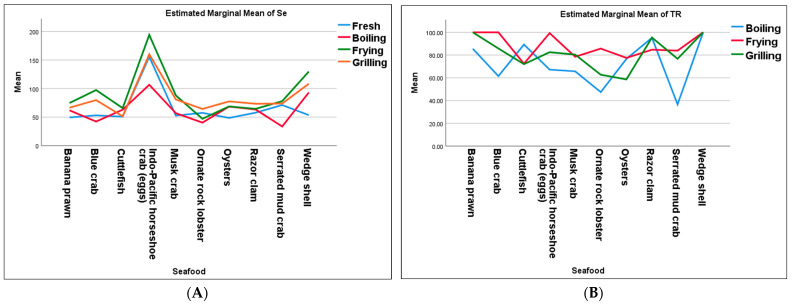 Figure 1
Peer Reviews
No public reviews on file for this paper yet. If you reviewed it on a platform where reviews are public (OpenReview, ICLR, NeurIPS, ICML), you can paste yours below so the community can read it here.
Videos
No videos yet. Explain this paper in a talk, walkthrough, or lecture? Add one.
Taxonomy
TopicsSelenium in Biological Systems · Heavy metals in environment · Mercury impact and mitigation studies