Stress Echocardiography in the Diagnosis and Evaluation of Pulmonary Hypertension: Practical Recommendations, Haemodynamic Phenotyping, and Application in Adults and Children
Dafni Charisopoulou, George Koulaouzidis, Panagiota Kleitsioti, Nikolaos Antoniou, Christos Mantzios, Orestis Grammenos, Sotiria Iliopoulou

TL;DR
Stress echocardiography helps detect and evaluate pulmonary hypertension by revealing hidden hemodynamic issues not seen at rest, especially in patients with exertional symptoms.
Contribution
The paper provides practical recommendations for using stress echocardiography to improve hemodynamic phenotyping in pulmonary hypertension.
Findings
Stress echocardiography can reveal abnormal pulmonary pressure-flow relationships not visible at rest.
It improves functional and hemodynamic characterization in patients with unexplained exertional symptoms.
The technique is particularly useful in systemic sclerosis and heart failure with preserved ejection fraction.
Abstract
Pulmonary hypertension (PH) is a complex condition in which early diagnosis remains challenging, particularly in patients with exertional symptoms and normal or borderline resting haemodynamics. Although right heart catheterisation is the diagnostic gold standard, transthoracic echocardiography is the recommended first-line non-invasive test. However, resting echocardiography provides only a static assessment and may underestimate disease severity in early or latent pulmonary vascular disease due to preserved pulmonary vascular compliance and adaptive right ventricular responses. Because pulmonary haemodynamics are intrinsically flow-dependent, pathological abnormalities may only emerge during increased cardiac output. Stress echocardiography, performed using exercise or pharmacological stress, enables dynamic evaluation of pulmonary pressure responses, cardiac output augmentation,…
Genes, proteins, chemicals, diseases, species, mutations and cell lines named across the full text — each resolved to its canonical identifier and authoritative record.
Click any figure to enlarge with its caption.
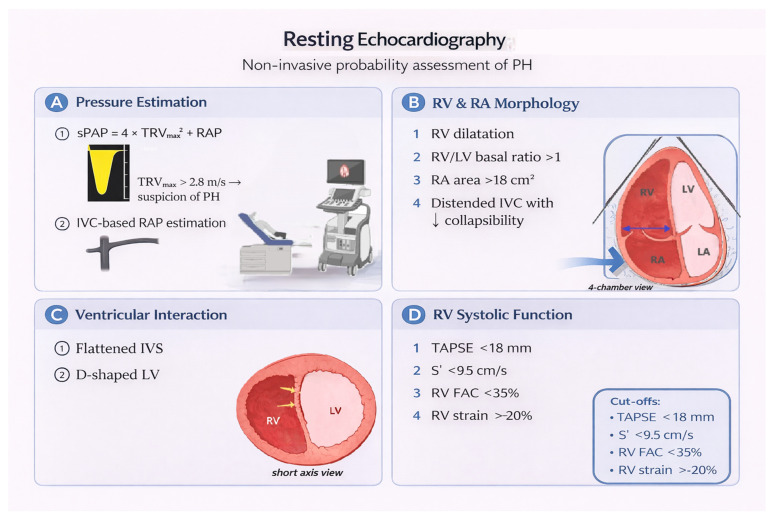 Figure 1
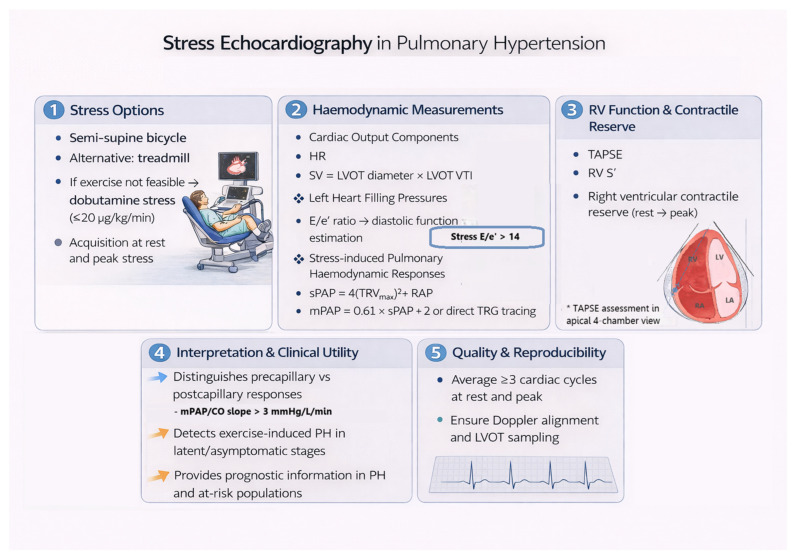 Figure 2
Peer Reviews
No public reviews on file for this paper yet. If you reviewed it on a platform where reviews are public (OpenReview, ICLR, NeurIPS, ICML), you can paste yours below so the community can read it here.
Videos
No videos yet. Explain this paper in a talk, walkthrough, or lecture? Add one.
Taxonomy
TopicsPulmonary Hypertension Research and Treatments · Cardiovascular Effects of Exercise · Chronic Obstructive Pulmonary Disease (COPD) Research