Selection and Validation of Endogenous Reference microRNAs for Post-Mortem Interval Estimation in Vitreous Humor: A Preliminary Study
Julia Lazzari, Andrea Scatena, Marco Di Paolo, Anna Rocchi

TL;DR
This study identifies a reliable microRNA reference gene for estimating time since death in forensic investigations.
Contribution
The study validates hsa-miR-96-5p as a stable reference gene for post-mortem interval estimation in vitreous humor.
Findings
miR-222-3p was rejected due to poor detectability in 61.7% of cases.
hsa-miR-96-5p showed high detectability and stability (CV = 9.07%).
hsa-miR-96-5p levels were not correlated with PMI or pre-freezing time.
Abstract
Estimating the post-mortem interval (PMI) using microRNAs (miRNAs) in vitreous humor (VH) is a promising technique in forensic pathology. However, the reliability of quantitative Real-Time PCR (qPCR) data in this matrix is currently constrained by a critical methodological challenge: the lack of a rigorously validated endogenous reference gene (normalizer) capable of correcting for non-biological variations without being influenced by decomposition. This study aimed to identify a robust reference gene for VH analysis by performing a comparative validation of two candidates proposed in the literature: miR-222-3p and miR-96-5p. VH samples were collected from 47 forensic autopsy cases with estimated PMIs ranging from 3 to 24 h. The validation process assessed three key parameters: amplification detectability, expression stability (Coefficient of Variation, CV), and statistical independence…
Click any figure to enlarge with its caption.
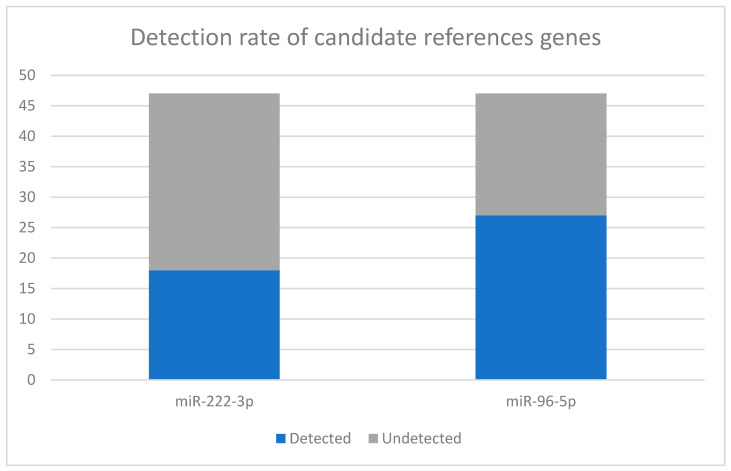 Figure 1
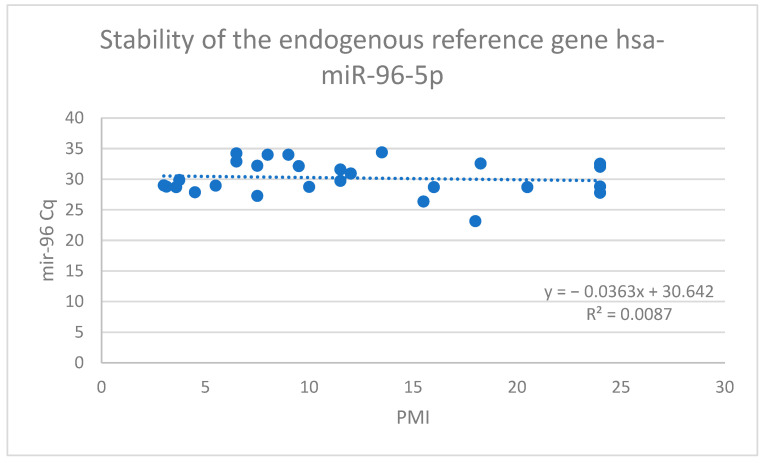 Figure 2
Peer Reviews
No public reviews on file for this paper yet. If you reviewed it on a platform where reviews are public (OpenReview, ICLR, NeurIPS, ICML), you can paste yours below so the community can read it here.
Videos
No videos yet. Explain this paper in a talk, walkthrough, or lecture? Add one.
Taxonomy
TopicsForensic Entomology and Diptera Studies · Molecular Biology Techniques and Applications · Forensic and Genetic Research