Use of Artificial Intelligence Model Associated with Masson’s Trichrome Staining as a Predictor of Muscle Invasion in Bladder Cancer
Diego Parrao, Hector Gallegos, Karin Ruz, Román Lay, Catalina Saavedra, Renata Guerrero, Matías Larrañaga, Carolina B. Lindsay, Juan Cristóbal Bravo

TL;DR
This study uses AI with Masson’s trichrome staining to accurately predict muscle invasion in bladder cancer, potentially improving diagnosis.
Contribution
The novel use of a convolutional neural network with Masson’s trichrome staining to predict muscle invasion in bladder cancer is introduced.
Findings
A CNN achieved 95.2% accuracy in training and 90.1% in validation for predicting muscle invasion.
Model outputs were significantly associated with tumor grade, lesion size, and muscle invasion.
Logistic regression showed a strong association between model predictions and invasive disease (OR = 0.07, p = 0.017).
Abstract
Bladder cancer (BC) is the most common malignancy of the urinary tract. Approximately 75% of cases are non-muscle-invasive BC (NMIBC), while muscle-invasive BC (MIBC) and advanced tumors account for most cancer-specific mortality. Accurate assessment of tumor invasion is essential, as staging variability may lead to inappropriate treatments. Tumor invasion involves several mechanisms including extracellular matrix (ECM) remodeling mediated by metalloproteinases, angiogenesis, and cell adhesions. Masson’s trichrome staining (MTS) provides relevant information on ECM composition. This study evaluated the application of machine learning to MTS-stained bladder biopsies to predict muscle invasion. A retrospective analysis of bladder biopsy images obtained from transurethral resections and cystectomies (2022–2024). A total of 702 histological images were analyzed. A convolutional neural…
Genes, proteins, chemicals, diseases, species, mutations and cell lines named across the full text — each resolved to its canonical identifier and authoritative record.
Click any figure to enlarge with its caption.
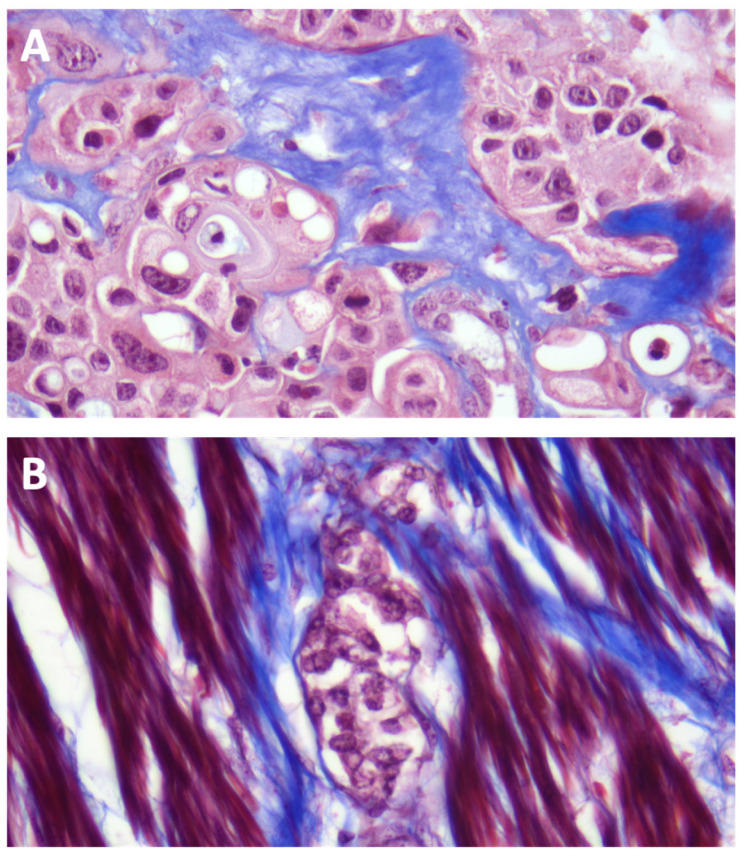 Figure 1
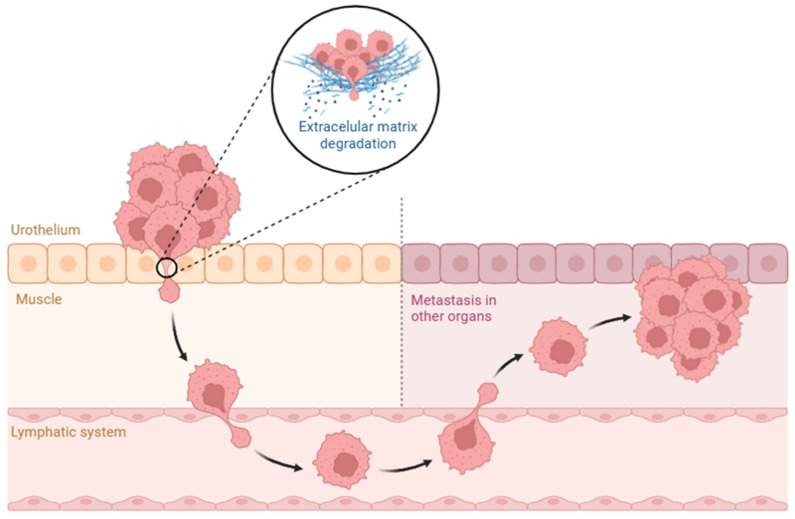 Figure 2
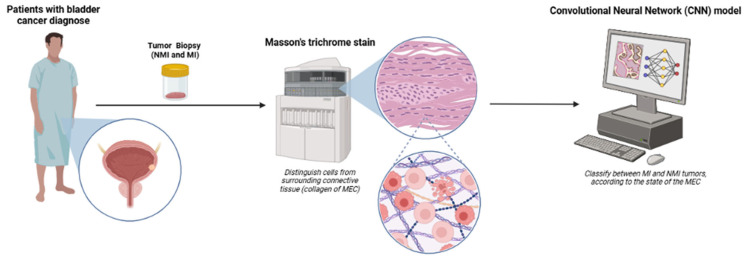 Figure 3
Peer Reviews
No public reviews on file for this paper yet. If you reviewed it on a platform where reviews are public (OpenReview, ICLR, NeurIPS, ICML), you can paste yours below so the community can read it here.
Videos
No videos yet. Explain this paper in a talk, walkthrough, or lecture? Add one.
Taxonomy
TopicsBladder and Urothelial Cancer Treatments · AI in cancer detection · Esophageal Cancer Research and Treatment