Longitudinal Evaluation of Dysarthria Progression in Patients with Parkinson’s Disease
Wilmar Alesander Vásquez-Barrientos, Daniel Escobar-Grisales, Cristian David Ríos-Urrego, Juan Rafael Orozco-Arroyave

TL;DR
This study uses speech recordings to track how dysarthria worsens over time in Parkinson’s disease patients, identifying specific speech patterns that indicate disease progression.
Contribution
The study introduces a novel method using phonological posteriors and GRUs to model dysarthria progression in Parkinson’s disease.
Findings
Strident, dental, pause, back, and continuant phonological classes best explain dysarthria progression over two years.
Speech patterns can be used to automatically assess Parkinson’s disease progression and identify contributing phonological classes.
Abnormal speech production may reflect broader issues like respiration in Parkinson’s patients.
Abstract
Background/Objectives: Automatic evaluation of Parkinson’s disease (PD) progression is an emerging topic that deserves special attention from the research community. Unobtrusive, low-cost technology is essential for monitoring PD patients in remote areas. This paper proposes the use of phonological posteriors to create models that allow the progression of dysarthria level progression to be modelled based on speech recordings. Methods: Eighteen Gated Recurrent Units (GRUs) are used to estimate an equal number of phonological classes assigned to each phoneme pronounced in a given recording. Classification models of PD vs. healthy control (HC) subjects are trained with recordings of the PC-GITA corpus. This information is used in a separate corpus, with longitudinal recordings, to evaluate whether the progression of the dysarthria level, according to the modified Frenchay Dysarthria…
Genes, proteins, chemicals, diseases, species, mutations and cell lines named across the full text — each resolved to its canonical identifier and authoritative record.
Click any figure to enlarge with its caption.
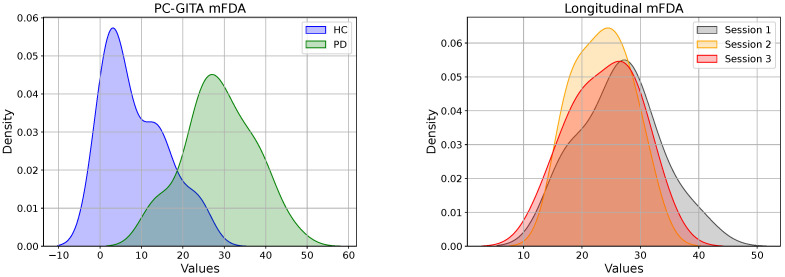 Figure 1
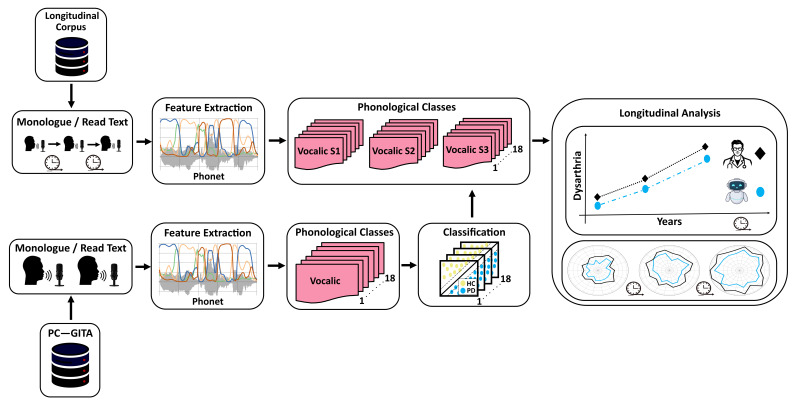 Figure 2
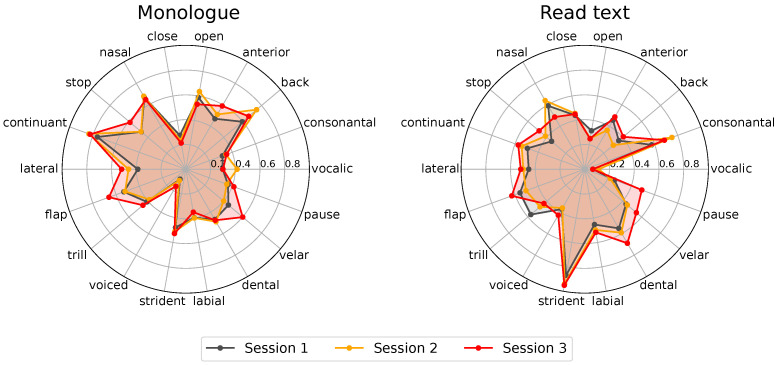 Figure 3
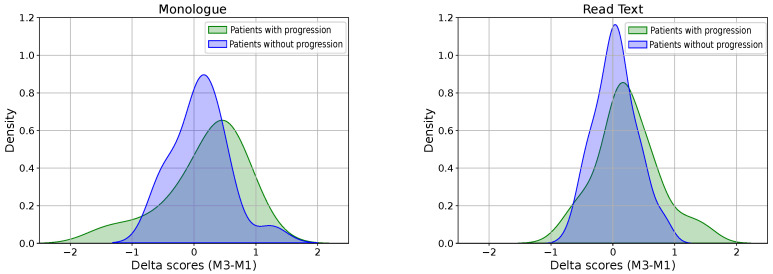 Figure 4
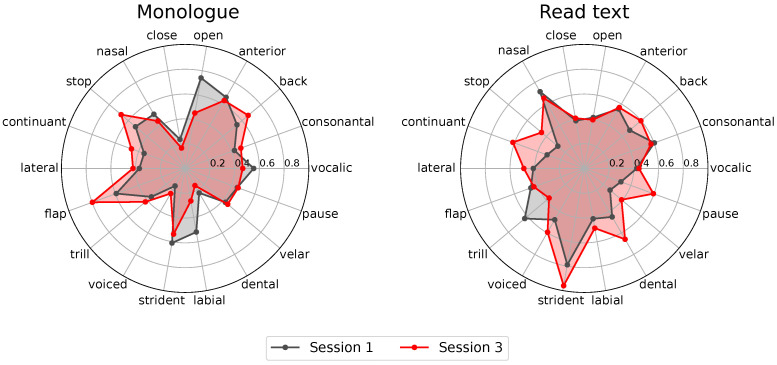 Figure 5
Peer Reviews
No public reviews on file for this paper yet. If you reviewed it on a platform where reviews are public (OpenReview, ICLR, NeurIPS, ICML), you can paste yours below so the community can read it here.
Videos
No videos yet. Explain this paper in a talk, walkthrough, or lecture? Add one.
Taxonomy
TopicsVoice and Speech Disorders · Respiratory and Cough-Related Research · Phonetics and Phonology Research