Fetal Growth Restriction: Contemporary Evidence to Guide Delivery Timing and Intrapartum Management
Ana Carolina Rabachini Caetano, Ana Cristina Perez Zamarian, Luciano Marcondes Machado Nardozza, Seizo Miyadahira, Giselle Darahem Tedesco, Lara Dariolli Rossi, Gustavo Yano Callado, Edward Araujo Júnior, Alessandra Cristina Marcolin

TL;DR
This paper reviews recent evidence on managing pregnancies with fetal growth restriction, focusing on when and how to deliver to improve outcomes.
Contribution
The paper provides updated management flowcharts for fetal growth restriction based on the latest evidence and fetal surveillance findings.
Findings
There is limited high-quality evidence for managing fetal growth restriction, with few randomized clinical trials.
Delivery timing depends on gestational age and fetal surveillance abnormalities.
Management flowcharts were developed to guide clinicians based on available evidence.
Abstract
Fetal growth restriction (FGR), a condition in which the fetus fails to achieve its growth and developmental potential, affects 5% to 10% of pregnancies and is associated with high rates of perinatal morbidity and mortality. There is currently insufficient high-quality evidence to define the optimal approach for diagnosing fetal growth restriction. In 2016, with the aim of standardizing clinical practice and enabling comparability across scientific studies, an expert opinion-based consensus was published. This document proposed unified terminology and clear diagnostic criteria for early- and late-onset fetal growth restriction (FGR). Because no effective treatment is available, careful assessment of fetal well-being and appropriate timing of delivery are the main tools for managing these fetuses. This decision should be based on gestational age and the severity of abnormalities…
Genes, proteins, chemicals, diseases, species, mutations and cell lines named across the full text — each resolved to its canonical identifier and authoritative record.
Click any figure to enlarge with its caption.
 Figure 1
 Figure 2
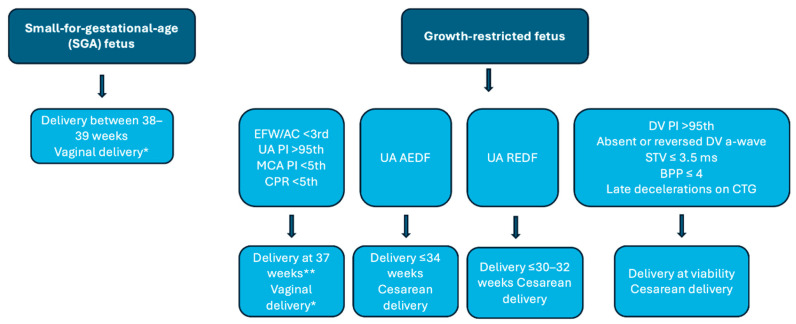 Figure 3
Peer Reviews
No public reviews on file for this paper yet. If you reviewed it on a platform where reviews are public (OpenReview, ICLR, NeurIPS, ICML), you can paste yours below so the community can read it here.
Videos
No videos yet. Explain this paper in a talk, walkthrough, or lecture? Add one.
Taxonomy
TopicsPregnancy and preeclampsia studies · Neonatal and fetal brain pathology · Preterm Birth and Chorioamnionitis