From Amputation to Persistent Pain: A Review of Molecular and Cellular Processes in Phantom Limb Pain
Catalin-Bogdan Satala, Andreea Onofrei (Popa), Oana Vrînceanu, Daniela Mihalache

TL;DR
Phantom limb pain after amputation involves complex interactions across the nervous system and immune responses, but its mechanisms are still not fully understood.
Contribution
This review synthesizes molecular and cellular processes across peripheral, spinal, and supraspinal levels to provide a biological framework for phantom limb pain.
Findings
Peripheral nerve injury triggers molecular changes that influence early pain signaling.
Spinal adaptations, including neuron–glia interactions, amplify pain signals.
Supraspinal neural network changes and immune signaling contribute to persistent pain.
Abstract
Phantom limb pain (PLP) is a frequent and often persistent consequence of limb amputation, characterized by pain perceived in the absent limb. Despite decades of research, its biological basis remains incompletely understood, and available treatments often provide inconsistent relief. This reflects the complex and heterogeneous nature of phantom limb pain, which cannot be explained by a single anatomical site or pathological process. Current evidence suggests that phantom limb pain emerges from the interaction of changes occurring at multiple levels of the nervous system. Peripheral nerve injury associated with amputation induces molecular and cellular alterations that may influence early nociceptive signaling. These changes can interact with adaptive and maladaptive responses within the spinal cord, including altered synaptic transmission and neuron–glia interactions, which may…
Genes, proteins, chemicals, diseases, species, mutations and cell lines named across the full text — each resolved to its canonical identifier and authoritative record.
Click any figure to enlarge with its caption.
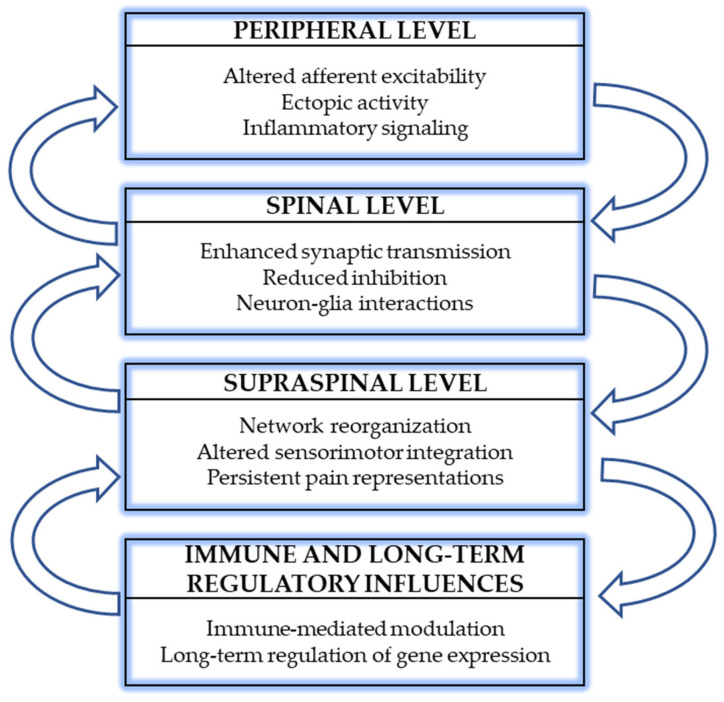 Figure 1
Peer Reviews
No public reviews on file for this paper yet. If you reviewed it on a platform where reviews are public (OpenReview, ICLR, NeurIPS, ICML), you can paste yours below so the community can read it here.
Videos
No videos yet. Explain this paper in a talk, walkthrough, or lecture? Add one.
Taxonomy
TopicsPain Management and Treatment · Pain Mechanisms and Treatments · Vagus Nerve Stimulation Research