Revealing and engineering contact-origin noise in ultrathin tellurium transistors
Hae-Won Lee, Minjae Kim, Junho Ban, Jae Hyeon Jun, Kiyung Kim, Useok Choi, Jung Tae Lee, Byoung Hun Lee

TL;DR
This study identifies the source of noise in ultrathin tellurium transistors and shows how to reduce it by adjusting the thickness of tellurium near the contacts.
Contribution
The paper introduces a contact-centric engineering strategy to suppress noise in ultrathin tellurium transistors.
Findings
Contact-origin trap-assisted tunneling dominates noise in 5 nm Te devices at room temperature.
Locally thickening the Te layer under contacts reduces noise by an order of magnitude in the nA current regime.
Noise suppression is achieved without compromising the 5 nm active channel thickness.
Abstract
Tellurium (Te) has emerged as a promising p-type semiconductor for ultrathin electronics owing to its strong air stability, excellent hole transport, narrow bandgap, and BEOL-integration compatibility. However, when the Te thickness approaches the depletion width, traps at the contact interface strongly affect carrier injection and introduce excess low-frequency noise. Here, we systematically investigate the origin of noise in ultrathin Te field-effect transistors (FETs) through bias- and temperature-dependent 1/f noise analysis. In devices with a 5 nm Te channel, contact-origin trap-assisted tunneling dominates in the low-current regime, producing deviations from the carrier-number-fluctuation (CNF) model at 300 K. Cooling to 100 K suppresses trap activation and restores typical CNF behavior, whereas 13 nm devices maintain CNF consistency at both temperatures due to screening of the…
Genes, proteins, chemicals, diseases, species, mutations and cell lines named across the full text — each resolved to its canonical identifier and authoritative record.
Click any figure to enlarge with its caption.
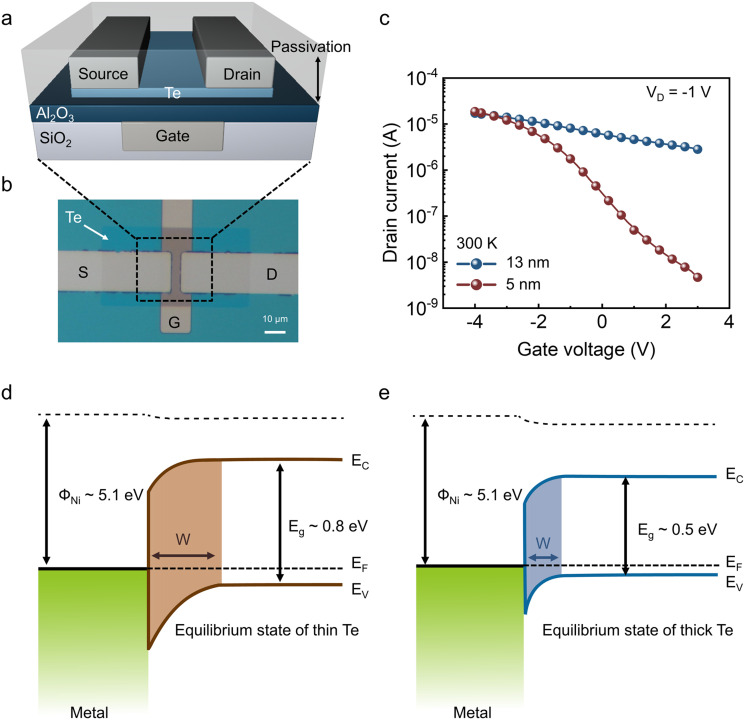 Figure 1
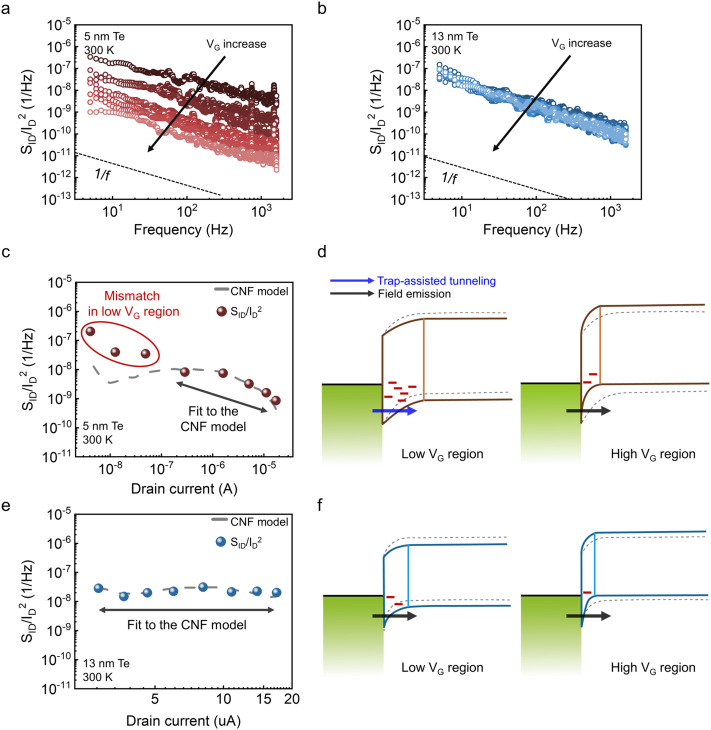 Figure 2
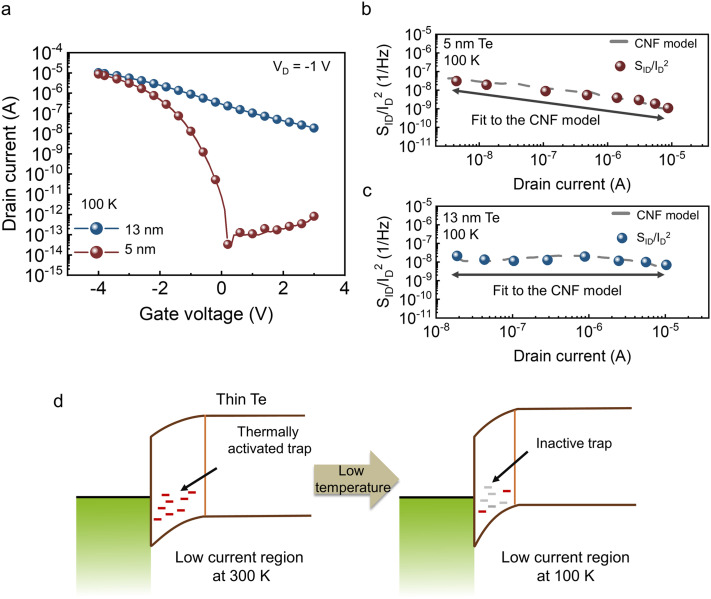 Figure 3
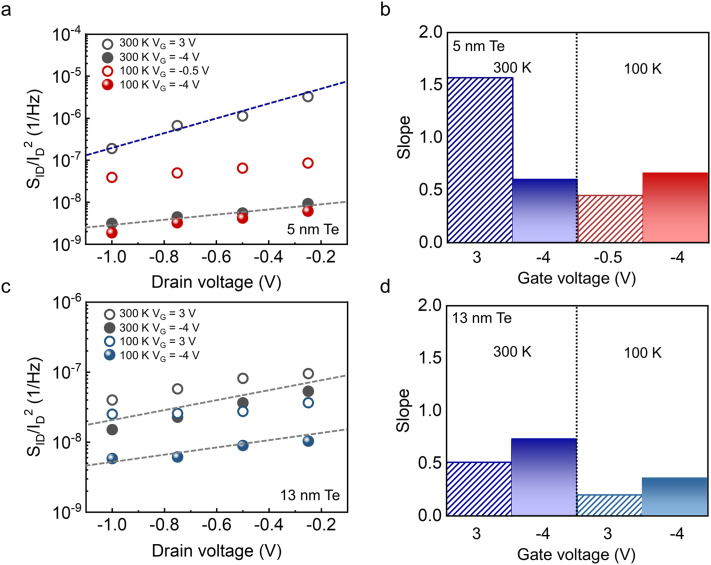 Figure 4
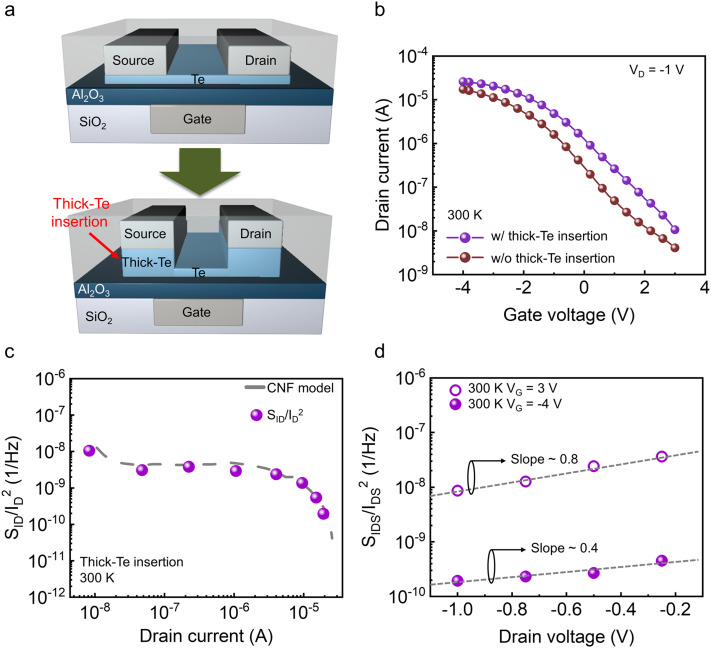 Figure 5
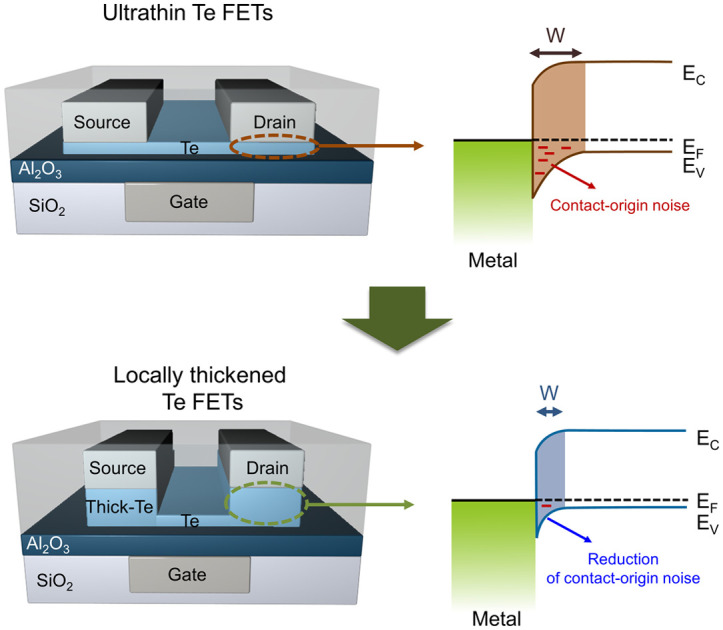 Figure 6
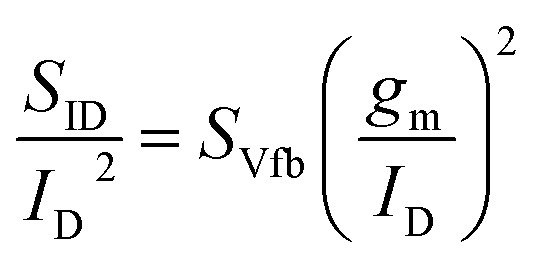 Figure 7
Peer Reviews
No public reviews on file for this paper yet. If you reviewed it on a platform where reviews are public (OpenReview, ICLR, NeurIPS, ICML), you can paste yours below so the community can read it here.
Videos
No videos yet. Explain this paper in a talk, walkthrough, or lecture? Add one.
Taxonomy
TopicsAdvancements in Semiconductor Devices and Circuit Design · Semiconductor Quantum Structures and Devices · Advanced Semiconductor Detectors and Materials