Math Anxiety and Its Relations to Arithmetic Fluency and Number Processing: Evidence From Finnish, Finnish‐Swedish, and Swedish Fourth‐Grade Students
Pinja Tähti, Jonatan Finell, Anna Tapola, Ellen Sammallahti, Anna Widlund, Bert Jonsson, Riikka Mononen, Johan Korhonen

TL;DR
This study explores how math anxiety affects arithmetic skills and number processing in fourth-grade students from Finland and Sweden, finding consistent negative relationships and gender differences.
Contribution
The study examines the relationship between math anxiety and mathematics performance across three cultural contexts, considering gender and the dimensionality of math anxiety.
Findings
Confirmatory factor analysis revealed a two-dimensional math anxiety construct for Finnish-speaking students and a unidimensional construct for Swedish-speaking students.
Girls experienced higher math anxiety on average, while boys showed better arithmetic fluency and stronger negative math anxiety-performance relationships.
The math anxiety–performance relationship was slightly stronger for arithmetic fluency than number processing across all samples.
Abstract
The negative relationship between math anxiety and mathematics performance is well established. However, factors such as how math anxiety is operationalized, the specific mathematical domain, gender, and cultural context may influence this relationship. Still, these factors have not been considered together and the results in primary school students have been inconsistent. Thus, this study aimed to investigate how math anxiety is related to arithmetic fluency and number processing in fourth‐grade students across three cultural contexts (Finnish‐ and Swedish‐speaking students from Finland and Swedish‐speaking students from Sweden). In addition, we investigated the dimensionality of math anxiety (i.e., cognitive and affective dimensions) and gender differences in the level of and relations between math anxiety and mathematics performance. The sample included 1022 fourth‐grade students…
Genes, proteins, chemicals, diseases, species, mutations and cell lines named across the full text — each resolved to its canonical identifier and authoritative record.
Click any figure to enlarge with its caption.
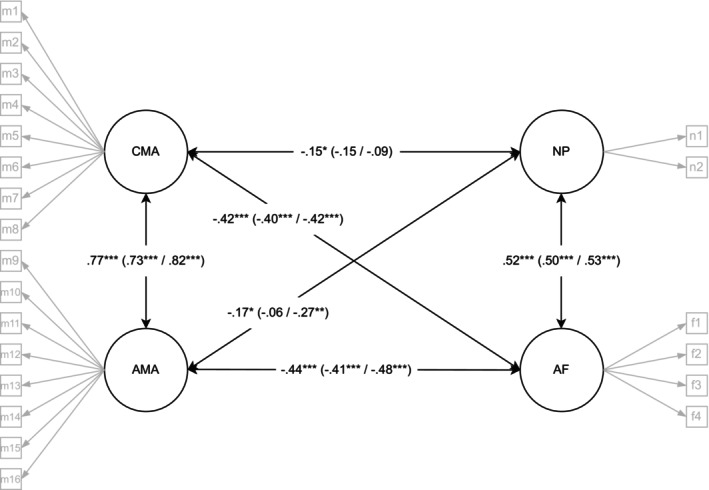 Figure 1
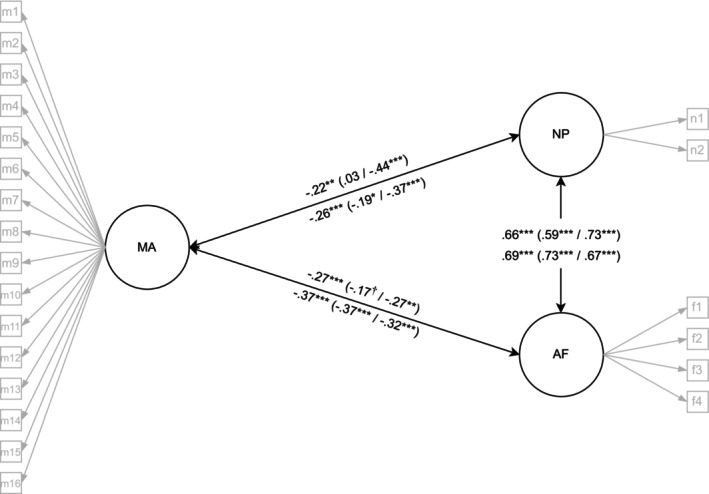 Figure 2
Peer Reviews
No public reviews on file for this paper yet. If you reviewed it on a platform where reviews are public (OpenReview, ICLR, NeurIPS, ICML), you can paste yours below so the community can read it here.
Videos
No videos yet. Explain this paper in a talk, walkthrough, or lecture? Add one.
Taxonomy
TopicsEducation, Achievement, and Giftedness · Perfectionism, Procrastination, Anxiety Studies · Anxiety, Depression, Psychometrics, Treatment, Cognitive Processes