Entangled Bonds: Dyadic Dependence and Co-Regulation in Western Urban Human–Dog Relationships
Agnieszka Grynkiewicz, Anna Reinholz, Kamil Imbir

TL;DR
This paper explores how human-dog relationships in cities help regulate emotions, but can also create stress for dogs under certain conditions.
Contribution
It introduces the concept of human-dog dyadic dependence as part of urban emotional infrastructure.
Findings
Dogs help humans with emotional recovery through shared routines and social interactions.
Chronic stress in humans can lead to increased vigilance and dependence in human-dog pairs.
Dogs without stable social buffering may experience negative effects from co-regulation.
Abstract
City life is increasingly optimised and predictable, yet often less physically shared. In this context, dogs do more than comfort people. By requiring daily walks and shared routines, they pull humans back into the physical world—weather, movement, waiting, detours—and this “analog friction” can support everyday emotional recovery. Dogs also change how people meet in public space. Their presence lowers the barrier for brief, low-stakes interaction, supports repeated recognition, and can help build weak but lasting neighbourhood ties. This review brings together research from behavioural science, physiology, psychology, and social sciences to show that humans and dogs often regulate emotions together. This coupling can buffer stress, but it is not always beneficial. Under chronic stress or heightened control, the same closeness may stabilise shared vigilance and dependence, especially…
Genes, proteins, chemicals, diseases, species, mutations and cell lines named across the full text — each resolved to its canonical identifier and authoritative record.
Click any figure to enlarge with its caption.
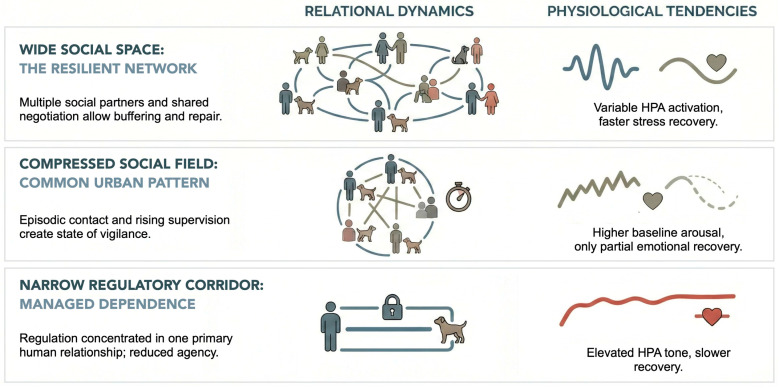 Figure 1
Peer Reviews
No public reviews on file for this paper yet. If you reviewed it on a platform where reviews are public (OpenReview, ICLR, NeurIPS, ICML), you can paste yours below so the community can read it here.
Videos
No videos yet. Explain this paper in a talk, walkthrough, or lecture? Add one.
Taxonomy
TopicsHuman-Animal Interaction Studies · Geographies of human-animal interactions · Veterinary Orthopedics and Neurology