Physical exercise and adolescent negative emotions: indirect associations via stress perception and emotional sensitivity
Yang Xin, Lu Liuheng

TL;DR
This study explores how physical exercise reduces negative emotions in Chinese adolescents, mainly through lower stress perception and partly through emotional sensitivity.
Contribution
The study identifies stress perception and emotional sensitivity as key psychological mechanisms linking physical exercise to reduced negative emotions in Chinese adolescents.
Findings
Physical exercise is directly and indirectly linked to lower negative emotions in adolescents.
Stress perception explains 40% of the association between physical exercise and reduced negative emotions.
A sequential pathway through stress perception and emotional sensitivity accounts for 8% of the association.
Abstract
Adolescent negative emotions are a major public health concern. Physical exercise is often associated with better emotional health, yet the psychological processes underlying this association, particularly in Chinese adolescents, are not fully understood. This study examined whether stress perception and emotional sensitivity are related to the association between physical exercise and negative emotions. A cross-sectional survey was conducted with 1,471 adolescents (54.52% male; Mean age = 13.16, SD = 1.01) from ten middle schools in Guangxi Province, China. Validated Chinese versions of established instruments assessed physical exercise (Youth Physical Activity Rating Scale), negative emotions (PANAS Negative Affect subscale), stress perception (Perceived Stress Scale), and emotional sensitivity operationalized through emotional contagion susceptibility. Path analysis using maximum…
Genes, proteins, chemicals, diseases, species, mutations and cell lines named across the full text — each resolved to its canonical identifier and authoritative record.
Click any figure to enlarge with its caption.
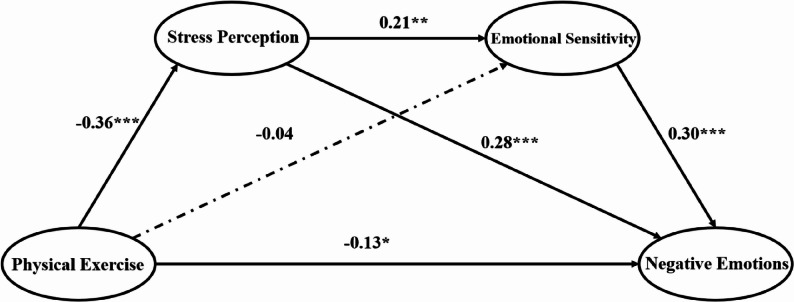 Figure 1
Peer Reviews
No public reviews on file for this paper yet. If you reviewed it on a platform where reviews are public (OpenReview, ICLR, NeurIPS, ICML), you can paste yours below so the community can read it here.
Videos
No videos yet. Explain this paper in a talk, walkthrough, or lecture? Add one.
Taxonomy
TopicsStress Responses and Cortisol · Mental Health via Writing · Emotion and Mood Recognition