New frontiers for unmanned aerial vehicles in planetary health research
Juliet T. Bramante, Morgan S. Tarpenning, Katherine E. Woo, Andrew J. Chamberlin, Kavita D. Coombe, Joelle I. Rosser

TL;DR
UAVs are being used in new ways to monitor and respond to climate change impacts on human health.
Contribution
The paper identifies four new frontiers for UAVs in planetary health research.
Findings
UAVs are being used for disease vector management.
UAVs help in managing environmental risk factors and resources.
UAVs are being piloted for medical deliveries in climate-affected regions.
Abstract
Unmanned aerial vehicles (UAVs) are a revolutionary new surveillance and transport technology with important implications for healthcare systems, particularly in the era of climate change. Rapid shifts in environmental systems are reshaping global climates. These changes have led to increasingly common extreme weather events that threaten population health. Mitigating the impacts of climate change on human health depends on our ability to predict, detect, and rapidly respond to changing ecosystem dynamics. The use of UAVs to tackle these new environmental health challenges is gaining momentum across multiple disciplines. This review identified four main areas where UAVs are being used or piloted to address climate change and health-related concerns: (1) Disease vector management, (2) environmental risk factors management, (3) environmental resource management, and (4) medical…
Genes, proteins, chemicals, diseases, species, mutations and cell lines named across the full text — each resolved to its canonical identifier and authoritative record.
Click any figure to enlarge with its caption.
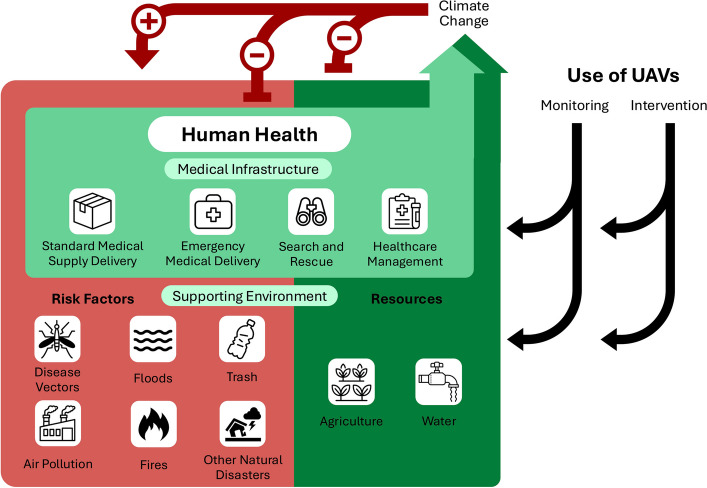 Figure 1
 Figure 2
 Figure 3
Peer Reviews
No public reviews on file for this paper yet. If you reviewed it on a platform where reviews are public (OpenReview, ICLR, NeurIPS, ICML), you can paste yours below so the community can read it here.
Videos
No videos yet. Explain this paper in a talk, walkthrough, or lecture? Add one.
Taxonomy
TopicsUAV Applications and Optimization · Climate Change and Health Impacts · Wetland Management and Conservation