Drawing Wellbeing: findings from an art-based exploration with Aboriginal and Torres Strait Islander children
Kate Anderson, Alana Gall, Tasha-Jade Cole, Taleah Carson, Kirsten Howard, Darren Garvey, Michelle Dickson, Martin Howell, Maryanne Theobald, Oliver Black, Justin Wilkey, Cammi Murrup-Stewart, Gail Garvey

TL;DR
This study explores wellbeing from the perspectives of Aboriginal and Torres Strait Islander children using art and cultural methods, revealing culture as central to their wellbeing.
Contribution
The study introduces the 'Wellbeing Stones' framework, the first culturally grounded wellbeing model developed directly from children's voices.
Findings
Culture is foundational to wellbeing, connecting all aspects of children's lives.
Seven themes emerged as central to wellbeing: caring relationships, connection to Country, safety, hopes, strong mind/body, interests, and identity.
Indigenist methods ensured authentic engagement and cultural safety in data collection.
Abstract
Aboriginal and Torres Strait Islander children are custodians of the world's oldest living cultures yet experience systemic inequities that infringe upon their rights to health, education, safety, and cultural identity due to ongoing colonisation. Despite these persistent disparities, few studies have explored wellbeing from Aboriginal and Torres Strait Islander children's own perspectives and lived experiences. This study addresses this gap by privileging children's voices in a large-scale, culturally grounded qualitative investigation. This study represents the first phase of the What Matters 2Kids (WM2K) project, which aims to develop a culturally relevant wellbeing measure for Aboriginal and Torres Strait Islander children aged 5–11 years. Using an Indigenist methodology and culturally responsive Art and Yarning method, 219 Aboriginal and Torres Strait Islander children across 15…
Genes, proteins, chemicals, diseases, species, mutations and cell lines named across the full text — each resolved to its canonical identifier and authoritative record.
Click any figure to enlarge with its caption.
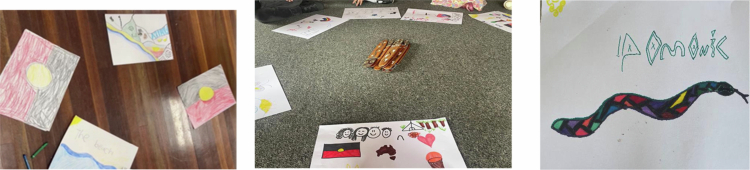 Figure 1
Peer Reviews
No public reviews on file for this paper yet. If you reviewed it on a platform where reviews are public (OpenReview, ICLR, NeurIPS, ICML), you can paste yours below so the community can read it here.
Videos
No videos yet. Explain this paper in a talk, walkthrough, or lecture? Add one.
Taxonomy
TopicsArt Therapy and Mental Health · Indigenous Health, Education, and Rights · Participatory Visual Research Methods