Serum IL-2 levels are associated with disease activity and related to dyslipidaemia and the immunological profile in systemic lupus erythematosus
Miguel Ángel Gonzalez-Gay, Fuensanta Gómez-Bernal, Beatriz Tejera-Segura, Juan Carlos Quevedo-Abeledo, Enrique García-Barrera, Luisa María Villar, J Gonzalo Ocejo-Vinyals, Raquel Largo, Iván Ferraz-Amaro

TL;DR
This study finds that IL-2 levels in lupus patients are linked to disease activity, inflammation, and lipid levels, suggesting a key role in lupus progression.
Contribution
The study establishes novel associations between serum IL-2 and specific autoantibodies, inflammation markers, and dyslipidaemia in SLE patients.
Findings
Serum IL-2 levels are positively associated with inflammatory markers like CRP and IL-6 in SLE patients.
Higher IL-2 levels correlate with disease activity and specific autoantibodies such as anti-DNA and anti-SSA/SSB.
Triglycerides are positively linked to IL-2, while HDL-cholesterol is inversely associated.
Abstract
Systemic lupus erythematosus (SLE) is an autoimmune disorder characterised by multisystem involvement, frequently including cardiovascular manifestations. Interleukin 2 (IL-2), a key cytokine in immune regulation, plays a pivotal role in maintaining tolerance by promoting regulatory T cell function. The relationship between serum IL-2 levels and specific SLE features remains incompletely defined. The aim of our study was to investigate the associations between serum IL-2 concentrations and disease activity, inflammatory markers, autoantibody profiles as well as cardiovascular and metabolic parameters in a well-characterised cohort of patients with SLE. In this cross-sectional study, 235 patients with SLE were recruited and characterised, including assessment of autoantibody profiles, disease activity indices (SLE Disease Activity Index-2000 (SLEDAI-2K)), Damage Index and remission…
Genes, proteins, chemicals, diseases, species, mutations and cell lines named across the full text — each resolved to its canonical identifier and authoritative record.
Click any figure to enlarge with its caption.
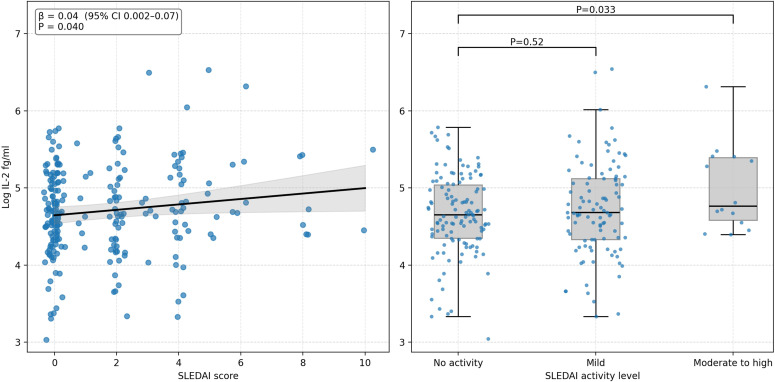 Figure 1
Peer Reviews
No public reviews on file for this paper yet. If you reviewed it on a platform where reviews are public (OpenReview, ICLR, NeurIPS, ICML), you can paste yours below so the community can read it here.
Videos
No videos yet. Explain this paper in a talk, walkthrough, or lecture? Add one.
Taxonomy
TopicsSystemic Lupus Erythematosus Research · Diabetes and associated disorders · Chemokine receptors and signaling