VR-CARE: a protocol for a mixed-methods study and pilot trial with embedded process evaluation to develop and evaluate virtual reality training for risk reduction in care homes
Norina Gasteiger, Claire R Ford, Helen Hawley-Hague, Jack Wilkinson, Debra Jones, William Whittaker, Akbar Ullah, Roman Kislov, Emma Stanmore, Louise Laverty, Joan Chantrell, Claire Callaghan, Victoria Edmondson, Dawn Dowding

TL;DR
This study develops and tests a virtual reality training program for UK care home staff to reduce risks like falls and improve hygiene, with a focus on usability and real-world impact.
Contribution
VR-CARE introduces a novel mixed-methods approach to create and evaluate immersive VR training for care home risk reduction, including a pilot trial and process evaluation.
Findings
VR-CARE will produce a user-friendly VR training program for care home staff with hand hygiene and falls prevention modules.
A pilot trial will assess the practicality and impact of VR training on care home staff and residents.
An implementation toolkit will be developed to support adoption of VR training in social care settings.
Abstract
Risk reduction training for UK care home staff is limited, not standardised and challenging to implement. Virtual reality (VR) is an immersive, engaging method of education delivery that is being adopted in health and social care. VR may be an effective education tool in care homes, but this research has yet to be conducted. The VR-CARE project aims to create a new VR risk reduction training programme for care homes that combines hand hygiene and falls prevention modules, and to evaluate this through a pilot trial to inform a future randomised controlled trial (RCT). There are two research phases with patient and public involvement and engagement (PPIE) activities embedded throughout. Care home stakeholders are collaborating to design the training and toolkit, oversee methods, review resources for accessibility, support recruitment and ensure the project meets the needs of the…
Genes, proteins, chemicals, diseases, species, mutations and cell lines named across the full text — each resolved to its canonical identifier and authoritative record.
Click any figure to enlarge with its caption.
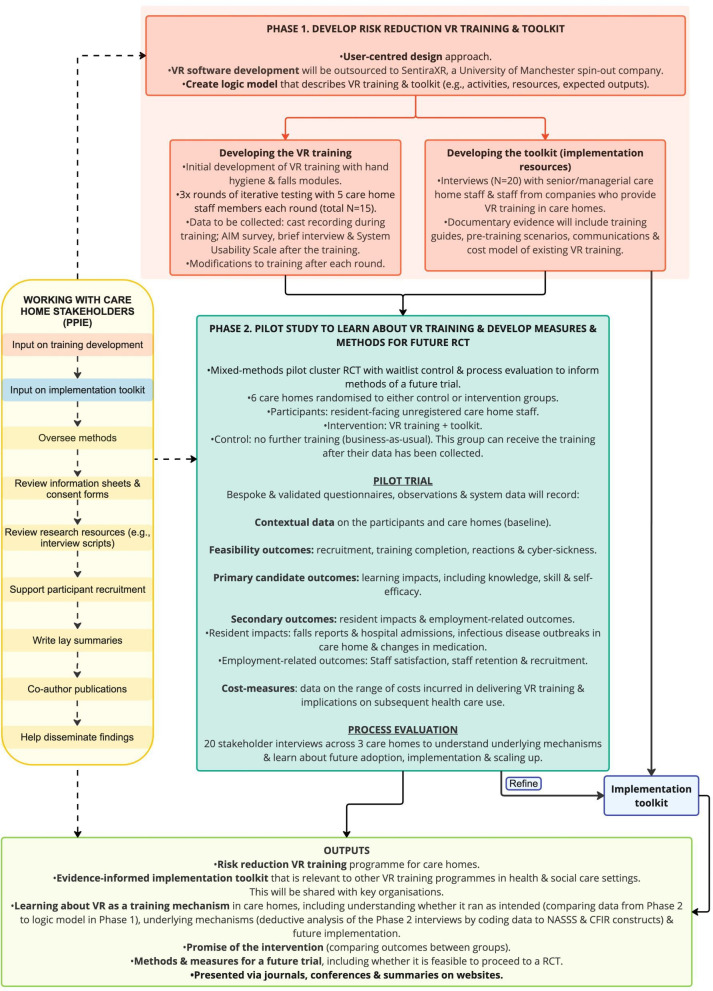 Figure 1
Peer Reviews
No public reviews on file for this paper yet. If you reviewed it on a platform where reviews are public (OpenReview, ICLR, NeurIPS, ICML), you can paste yours below so the community can read it here.
Videos
No videos yet. Explain this paper in a talk, walkthrough, or lecture? Add one.
Taxonomy
TopicsVirtual Reality Applications and Impacts · Occupational Therapy Practice and Research · Simulation-Based Education in Healthcare