The ability of the GENESIS-UV metric to reflect the positive dose-response relationship between cumulative occupational UV exposure and squamous cell carcinoma of the skin
Andreas Seidler, Ulrich Bolm-Audorff, David Reissig, Andrea Bauer, Karla Romero Starke, Sven Connemann, Rolf Ellegast, Peter Knuschke, René Mauer, Henriette Rönsch, Wiho Stöppelmann, Claudine Strehl, Stephan Westerhausen, Marc Wittlich

TL;DR
This study shows that a new UV exposure metric, GENESIS-UV, better reflects the link between occupational UV exposure and skin cancer risk compared to an older method.
Contribution
The study demonstrates the improved suitability of the GENESIS-UV metric for assessing occupational UV exposure and its association with squamous cell carcinoma.
Findings
GENESIS-UV provides a better goodness of fit (AIC 748.0) compared to the Wittlich metric (AIC 758.6).
High UV exposure using GENESIS-UV increases SCC risk with an OR of 2.23 (95% CI 1.36–3.65).
GENESIS-UV confirms a positive dose-response relationship between UV exposure and SCC in a case-control study.
Abstract
The newly developed GENESIS-UV metric is based on occupational UV exposure measurements in about 1,000 outdoor-workers (covering 250 different occupational settings). The GENESIS-UV metric calculates occupational exposure values for the standard erythema dose (SED) that differ substantially from those produced by the “Wittlich metric” which applies multiple correction factors to a fixed SED reference value of 300 SED per year. This Wittlich metric has served as the basis for calculating occupational UV exposure of occupational disease No. 5103 (“squamous cell carcinoma or multiple actinic keratoses caused by natural UV radiation”) in Germany since 2015. In a large case-control study (“FB181”, 632 cases and 632 individually matched control subjects), a positive dose-response relationship between UV exposure estimated using the “Wittlich metric” and squamous cell carcinoma (SCC) of the…
Genes, proteins, chemicals, diseases, species, mutations and cell lines named across the full text — each resolved to its canonical identifier and authoritative record.
Click any figure to enlarge with its caption.
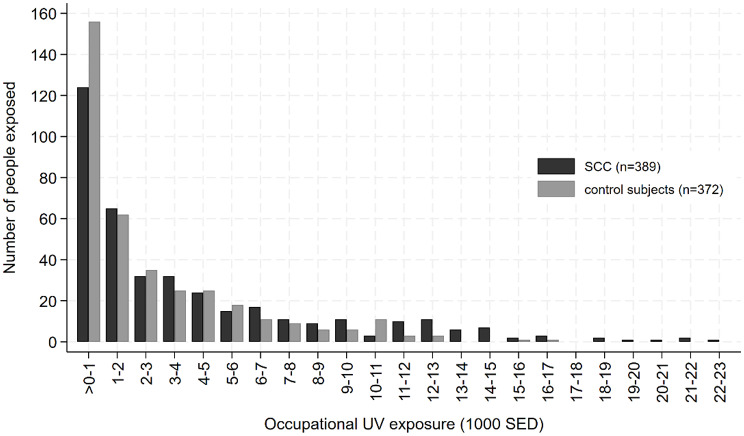 Figure 1
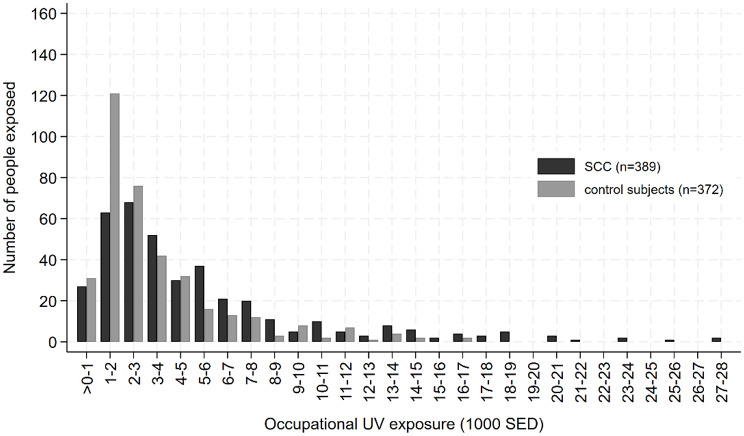 Figure 2
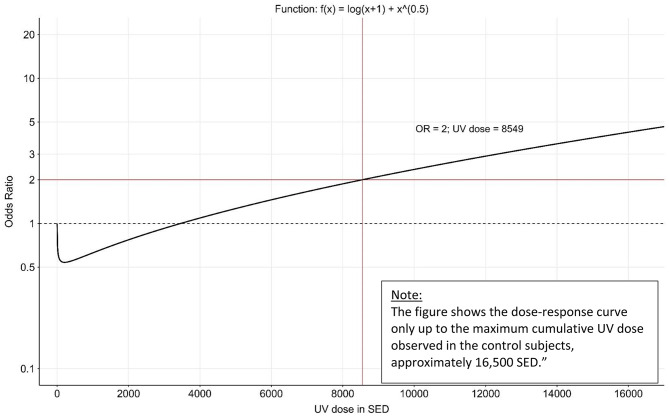 Figure 3
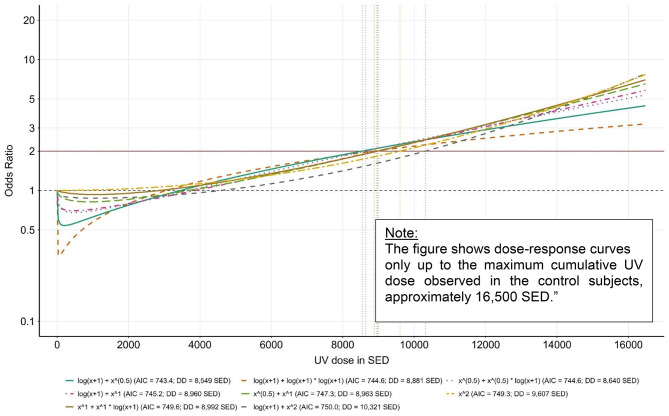 Figure 4
Peer Reviews
No public reviews on file for this paper yet. If you reviewed it on a platform where reviews are public (OpenReview, ICLR, NeurIPS, ICML), you can paste yours below so the community can read it here.
Videos
No videos yet. Explain this paper in a talk, walkthrough, or lecture? Add one.
Taxonomy
TopicsSkin Protection and Aging · Nonmelanoma Skin Cancer Studies · Cutaneous Melanoma Detection and Management