Thermal Stability of Botulinum Toxin Type A Formulations Exposed to Heat In Vitro, Assessed by an In Vivo Mouse Potency Bioassay
Hyoung Moon Kim, Seongsung Kwak, Yu Sun Choi, Dongkyu Lee, Jin-Hee Kwon, Hyosan Jung

TL;DR
This study tested how heat affects the potency of different botulinum toxin type A products, finding that only one liquid formulation remained stable.
Contribution
The study provides new empirical evidence on the thermal stability of commercial botulinum toxin type A formulations.
Findings
InnoBoNT/A maintained potency after 25 minutes at 60°C, unlike other formulations.
OnaBoNT/A lost 32% potency after 25 minutes at 60°C and was ineffective after 40 minutes.
Only the liquid-stabilized formulation preserved potency under thermal stress.
Abstract
Energy-based devices (EBDs), such as high-intensity focused ultrasound, radiofrequency, and microwave, are increasingly used for facial rejuvenation, raising concerns about whether heat exposure may affect the potency of botulinum toxin. This study investigated the thermal stability of 4 commercial botulinum toxin type A (BoNT/A) products under conditions simulating EBD-related heat exposure, which includes 1 liquid formulation (INNOTOX, Medytox, Seoul, South Korea; hereafter referred to as innoBoNT/A) and 3 powder formulations: onabotulinumtoxinA (onaBoNT/A, BOTOX, Allergan, an Abbvie company, North Chicago, IL), incobotulinumtoxinA (incoBoNT/A, XEOMIN, Merz, Frankfurt, Germany), and abobotulinumtoxinA (aboBoNT/A, DYSPORT, Ipsen, Boulogne-Billancourt, France). Mouse intraperitoneal LD50 potency assays were performed after exposing reconstituted and liquid formulations to 60°C for 10…
Genes, proteins, chemicals, diseases, species, mutations and cell lines named across the full text — each resolved to its canonical identifier and authoritative record.
Click any figure to enlarge with its caption.
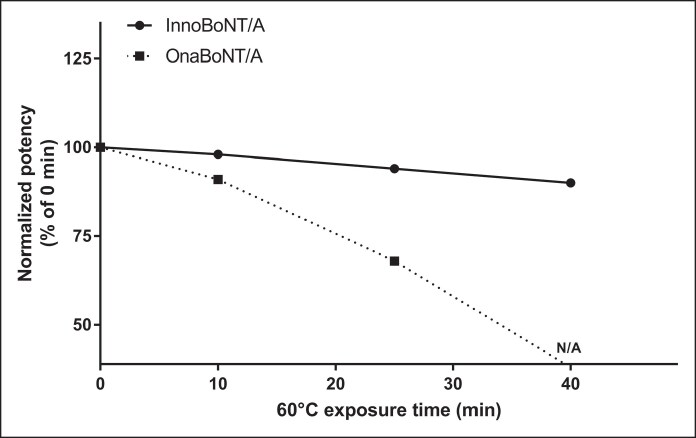 Figure 1
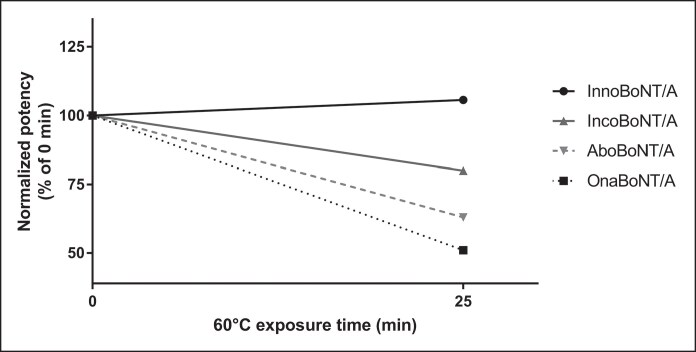 Figure 2
 Figure 3
Peer Reviews
No public reviews on file for this paper yet. If you reviewed it on a platform where reviews are public (OpenReview, ICLR, NeurIPS, ICML), you can paste yours below so the community can read it here.
Videos
No videos yet. Explain this paper in a talk, walkthrough, or lecture? Add one.
Taxonomy
TopicsBotulinum Toxin and Related Neurological Disorders · Voice and Speech Disorders · Ultrasound and Hyperthermia Applications