What does a good day look like?: An interpretable machine learning approach to the American Time Use Survey
Dunigan Folk, Mirka Henninger, Elizabeth Dunn

TL;DR
This study uses machine learning to explore what activities make a day feel happier than usual, based on time-use data from surveys.
Contribution
The novel contribution is applying interpretable machine learning to identify patterns in daily activities linked to happiness ratings.
Findings
Socializing up to 2 hours is strongly linked to better-than-typical days, but more time does not increase happiness.
Working up to 6 hours is not associated with better days, but working longer sharply decreases the likelihood of a good day rating.
Machine learning models achieved 62–63% balanced accuracy in predicting better-than-typical days.
Abstract
What differentiates a happy day from a typical one? Using interpretable machine learning techniques, we assessed the relationship between the time people spent on over 100 activities and whether they rated their day as typical or “better than typical” in the 2013 (n = 9,286) and 2021 (n = 6,196) waves of the American Time Use Survey. Our random forest models identified better than typical (vs. typical) days with accuracy levels substantially above chance (i.e. 62–63% balanced accuracy across 2013 and 2021). Socializing was one of the activities most strongly linked to the probability of having a good day, but beyond 2 hours, additional socializing was not associated with further increases in the probability of reporting a better than typical day. Working for up to 6 hours was not related to whether people rated their day as better than usual; beyond 6 hours, however, additional work was…
Click any figure to enlarge with its caption.
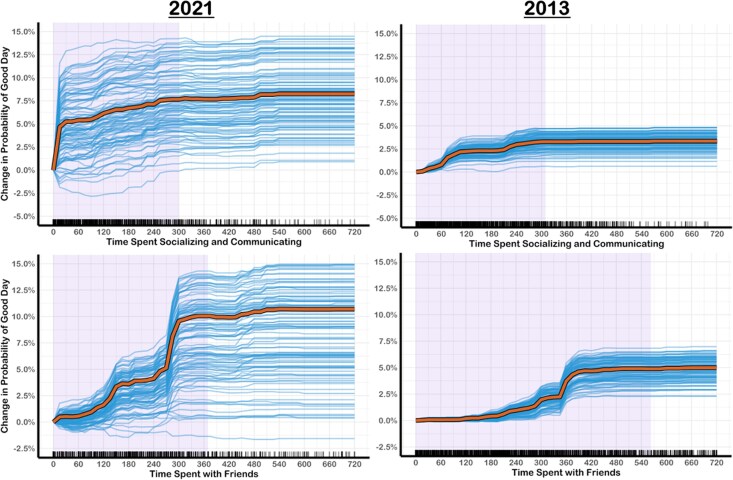 Figure 1
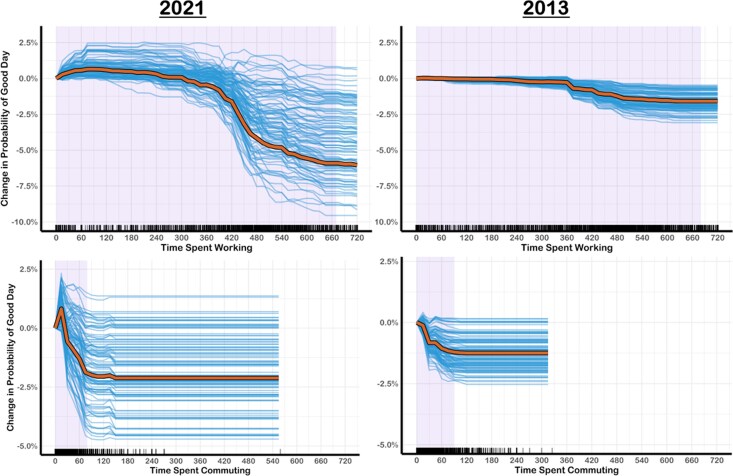 Figure 2
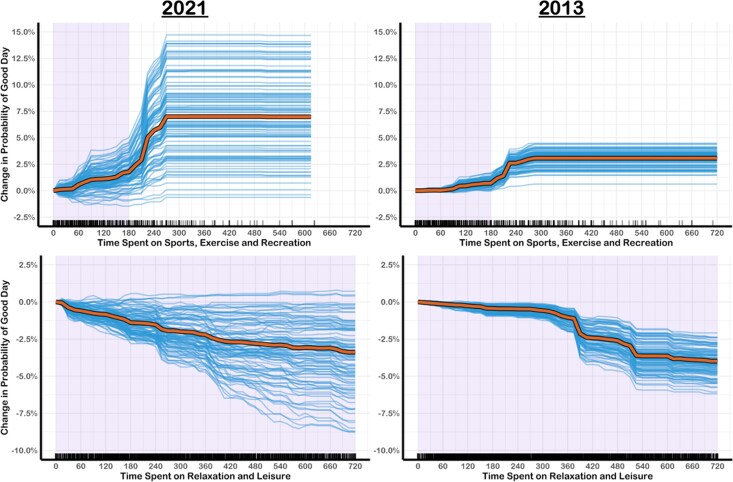 Figure 3
Peer Reviews
No public reviews on file for this paper yet. If you reviewed it on a platform where reviews are public (OpenReview, ICLR, NeurIPS, ICML), you can paste yours below so the community can read it here.
Videos
No videos yet. Explain this paper in a talk, walkthrough, or lecture? Add one.
Taxonomy
TopicsSleep and related disorders · Work-Family Balance Challenges · Physical Activity and Health