Efficient Non‐Invasive Rejuvenation of Spent Lithium Iron Phosphate Batteries Through Controlled Overdischarge
Jinu Song, Yujie Chen, Nianji Zhang, Cancan Peng, Huan Li, Chao Ye, Shi‐Zhang Qiao

TL;DR
A new non-invasive method called controlled overdischarge helps revive old lithium iron phosphate batteries, making them last longer and reducing environmental impact.
Contribution
The COD protocol introduces a scalable and sustainable way to rejuvenate spent LFP batteries by targeting SEI and reducing defects.
Findings
The COD protocol recovers 9.56% of lost battery capacity and extends lifespan by over 200 cycles.
The method reduces greenhouse gas emissions to 168 g kg−1 and energy consumption to 3 MJ kg−1 of feedstock.
COD suppresses copper dissolution and reduces Li/Fe antisite defects in spent LFP batteries.
Abstract
Recycling lithium iron phosphate (LFP) batteries presents critical economic and environmental challenges because of their low metal value and high energy intensity of conventional metallurgical processes. While direct recycling methods offer a pathway for lithium replenishment, they are often hindered by stringent impurity controls and complex operating conditions that limit scalability. Here, we introduce a controlled overdischarge (COD) protocol as a non‐invasive strategy to rejuvenate spent LFP (S‐LFP) batteries. COD selectively decomposes the solid‐electrolyte interphase, releasing trapped Li+ and reducing Li/Fe antisite defects while simultaneously suppressing copper dissolution. The COD protocol recovers 9.56% of lost capacity and extends lifespan by over 200 cycles. Furthermore, compared to metallurgical recycling, this method markedly lowers greenhouse gas emissions to 168 g…
Genes, proteins, chemicals, diseases, species, mutations and cell lines named across the full text — each resolved to its canonical identifier and authoritative record.
Click any figure to enlarge with its caption.
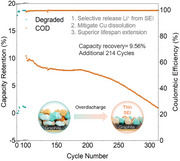 Figure 1
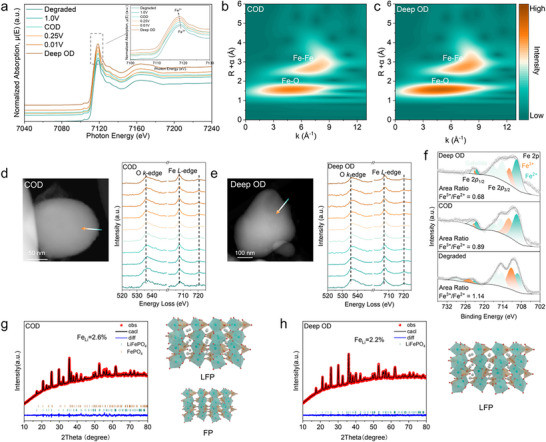 Figure 2
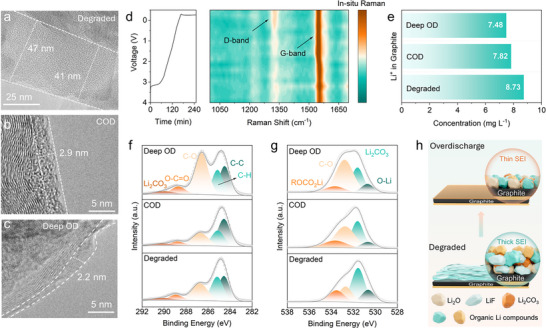 Figure 3
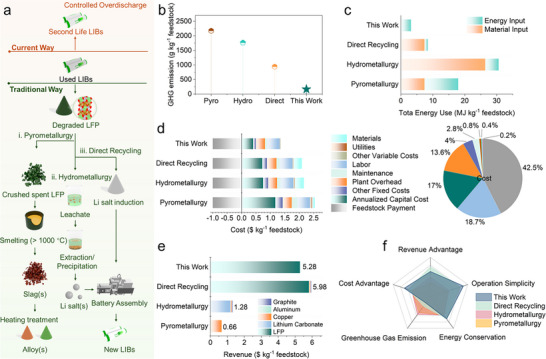 Figure 4
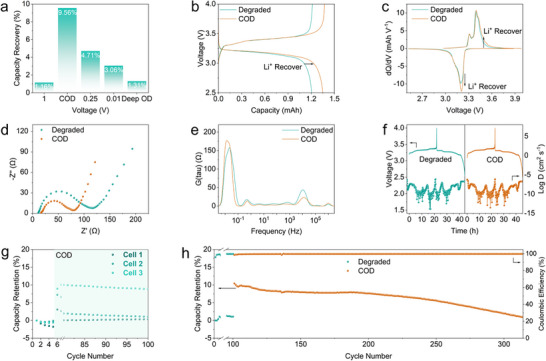 Figure 5
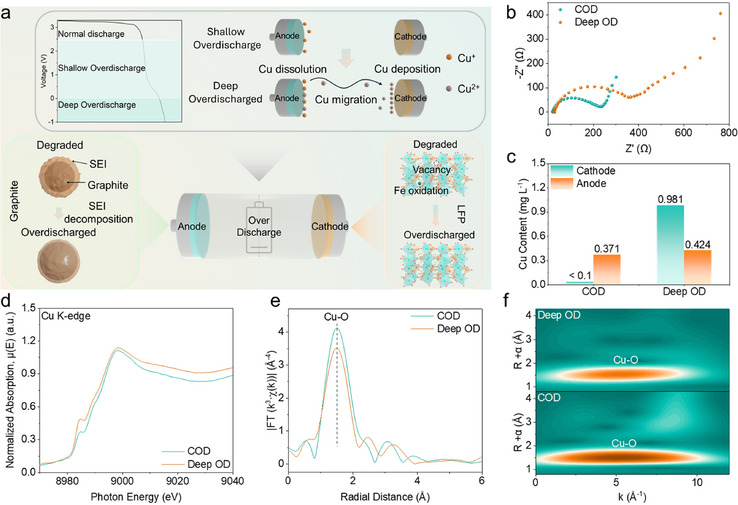 Figure 6
Peer Reviews
No public reviews on file for this paper yet. If you reviewed it on a platform where reviews are public (OpenReview, ICLR, NeurIPS, ICML), you can paste yours below so the community can read it here.
Videos
No videos yet. Explain this paper in a talk, walkthrough, or lecture? Add one.
Taxonomy
TopicsExtraction and Separation Processes · Advanced Battery Materials and Technologies · Advancements in Battery Materials