Factors Associated With Kirschner Wire Backout After Tension Band Wiring for Olecranon Fractures: A Retrospective Study
Takahiro Maeda, Tomoyasu Homma, Misato Sakamoto, Hideaki Ishii, Shu Yoshizawa, Hiroyasu Ikegami

TL;DR
This study identifies factors linked to Kirschner wire backout after a common surgical technique for elbow fractures, suggesting optimal insertion depth to reduce complications.
Contribution
The study identifies insertion depth as a novel predictor of K-wire backout and suggests practical thresholds to minimize postoperative complications.
Findings
Shallower insertion depth of K-wires was significantly associated with increased backout.
Backout exceeding 7-8 mm was frequently observed in patients with irritation symptoms or reoperation.
Thicker K-wires were less commonly used in the backout group, but diameter was not independently predictive.
Abstract
Background: Tension band wiring (TBW) is widely used for olecranon fractures; however, posterior migration of Kirschner wires (K-wires), termed “backout,” is a common complication. At our institution, during intramedullary fixation, the proximal ends of K-wires are bent by 180° and embedded into the olecranon fragment. This study aimed primarily to identify clinical and radiographic factors associated with K-wire backout after TBW for olecranon fractures, and secondarily to explore clinically relevant thresholds of insertion depth and backout distance in relation to postoperative symptoms and reoperation. Methods: We retrospectively reviewed data from 34 patients with olecranon fractures who underwent TBW and intramedullary K-wire fixation at our institute between 2014 and 2023. The backout distance was measured using postoperative radiographs. Patients were divided into backout (≥ 5…
Genes, proteins, chemicals, diseases, species, mutations and cell lines named across the full text — each resolved to its canonical identifier and authoritative record.
Click any figure to enlarge with its caption.
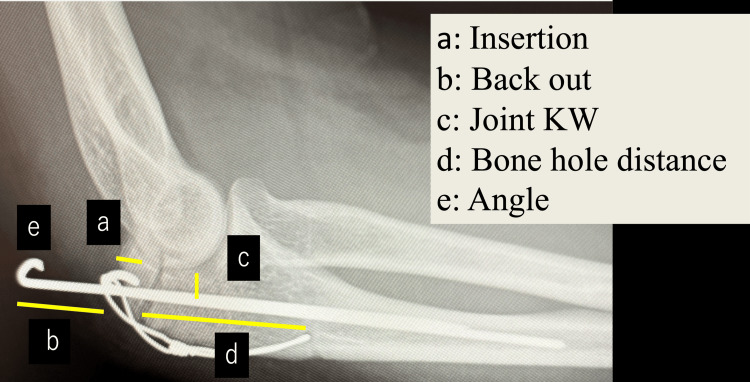 Figure 1
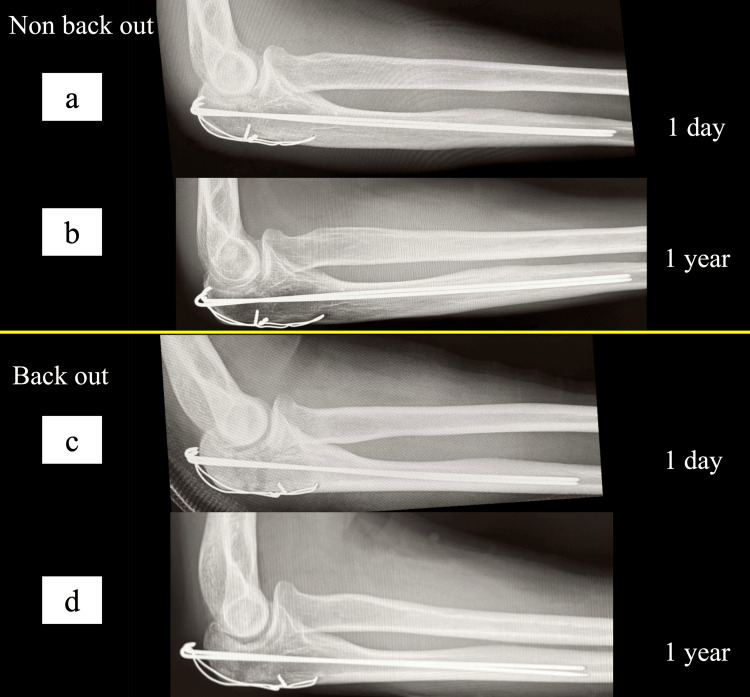 Figure 2
Peer Reviews
No public reviews on file for this paper yet. If you reviewed it on a platform where reviews are public (OpenReview, ICLR, NeurIPS, ICML), you can paste yours below so the community can read it here.
Videos
No videos yet. Explain this paper in a talk, walkthrough, or lecture? Add one.
Taxonomy
TopicsElbow and Forearm Trauma Treatment · Orthopedic Surgery and Rehabilitation · Shoulder and Clavicle Injuries