Controlling Magnetism in the 2D van der Waals Antiferromagnet CrPS4 via Ion Intercalation
Alberto M. Ruiz, Diego López-Alcalá, Gonzalo Rivero-Carracedo, Andrei Shumilin, José J. Baldoví

TL;DR
This paper shows how inserting ions into a 2D magnetic material can change its magnetic properties and improve its performance for electronic applications.
Contribution
The study demonstrates that ion intercalation can switch magnetic states and significantly enhance ordering temperatures in CrPS4.
Findings
Li+ intercalation turns CrPS4 from a semiconductor to a metal and changes its magnetic state from antiferromagnetic to ferromagnetic.
TBA+ intercalation increases the van der Waals gap and stabilizes in-plane ferromagnetism with a Curie temperature above 100 K.
Intercalation enhances magnon transport properties and makes them more isotropic.
Abstract
Two-dimensional (2D) van der Waals (vdW) magnetic materials are platforms in which inserting chemical species into their interlayer gaps offers a powerful route to engineer magnetism. Here, we focus on the A-type antiferromagnetic semiconductor CrPS4 (T N = 38 K) and investigate its electronic and magnetic properties upon intercalation of lithium (Li+) and organic tetrabutylammonium (TBA+) ions using first-principles calculations. Li+ incorporation induces a semiconductor-to-metal transition in CrPS4 and triggers a switching from an out-of-plane antiferromagnetism state to an in-plane ferromagnetic state. This is accompanied by an increase of the ordering temperature, reaching a 5-fold enhancement for Li0.5CrPS4. TBA+ intercalation expands the vdW gap, decoupling CrPS4 layers and stabilizing in-plane ferromagnetism with T C > 100 K. Furthermore, it enhances magnon group velocities and…
Genes, proteins, chemicals, diseases, species, mutations and cell lines named across the full text — each resolved to its canonical identifier and authoritative record.
Click any figure to enlarge with its caption.
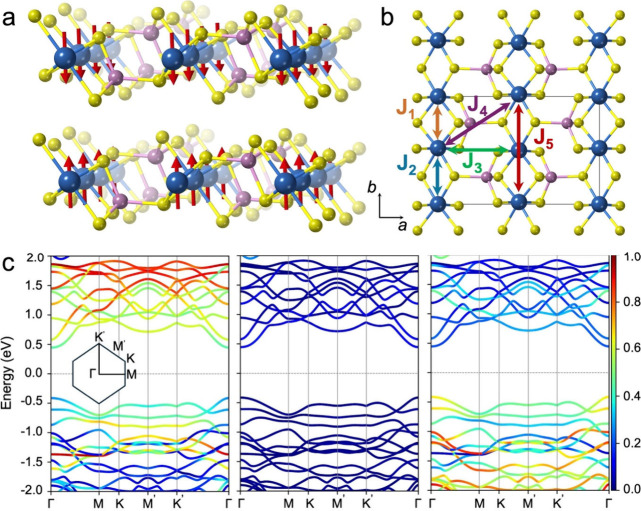 Figure 1
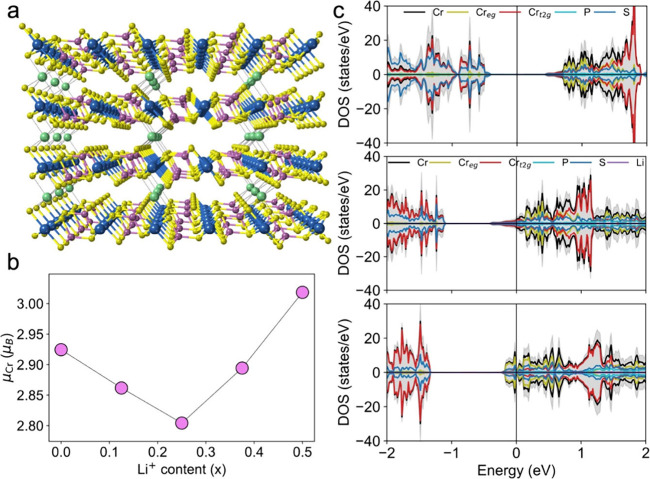 Figure 2
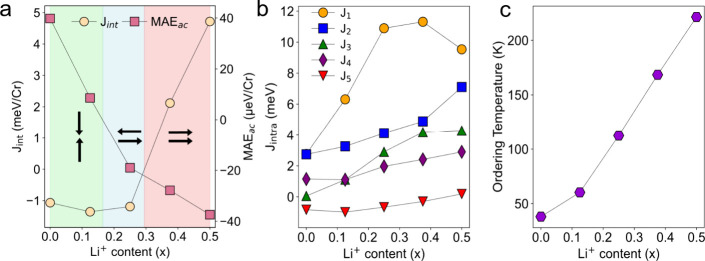 Figure 3
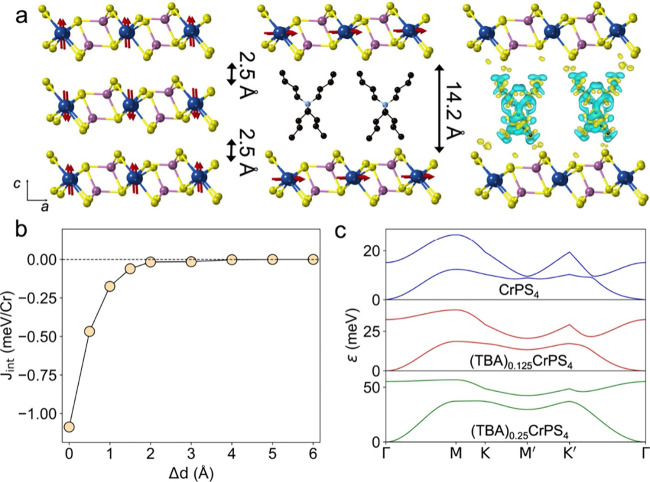 Figure 4
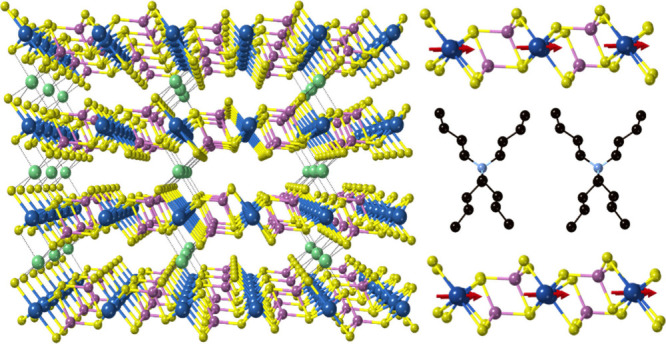 Figure 5
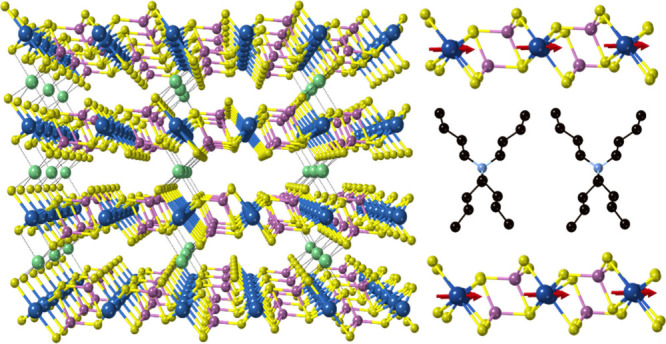 Figure 6
Peer Reviews
No public reviews on file for this paper yet. If you reviewed it on a platform where reviews are public (OpenReview, ICLR, NeurIPS, ICML), you can paste yours below so the community can read it here.
Videos
No videos yet. Explain this paper in a talk, walkthrough, or lecture? Add one.
Taxonomy
Topics2D Materials and Applications · Graphene research and applications · MXene and MAX Phase Materials