Travel-Acquired Furuncular Cutaneous Myiasis Mimicking a Bacterial Abscess in a Pediatric Patient
Simran K Chandawarkar, Ibrahim Amjad

TL;DR
A child developed abscess-like lesions after a Caribbean trip, but they were actually caused by a fly larvae, highlighting the need for travel history in diagnosis.
Contribution
This case highlights the diagnostic challenge of furuncular cutaneous myiasis mimicking bacterial abscesses in pediatric patients.
Findings
A six-year-old child had four D. hominis larvae removed from his scalp and arm after being misdiagnosed as bacterial abscesses.
Operative removal was necessary due to the child's inability to tolerate awake extraction.
The case emphasizes the importance of travel history in diagnosing pediatric furuncular lesions.
Abstract
Furuncular cutaneous myiasis can closely mimic common bacterial abscesses, especially in regions where Dermatobia hominis is not endemic. Here, we present a case of a healthy six-year-old male who returned from a Caribbean cruise and developed four painful nodules on his scalp and arm that were initially presumed to be bacterial abscesses. Incision and drainage yielded little to no purulence. Operative exploration under general anesthesia revealed four intact D. hominis larvae, all of which were successfully extracted. This case underscores the importance of obtaining a travel history and considering myiasis when "abscesses" do not behave as expected, particularly when attempted drainage yields minimal material. Pediatric cases can present with multiple lesions, and definitive treatment may require operative removal in young patients who cannot tolerate awake extraction. Awareness of…
Genes, proteins, chemicals, diseases, species, mutations and cell lines named across the full text — each resolved to its canonical identifier and authoritative record.
Click any figure to enlarge with its caption.
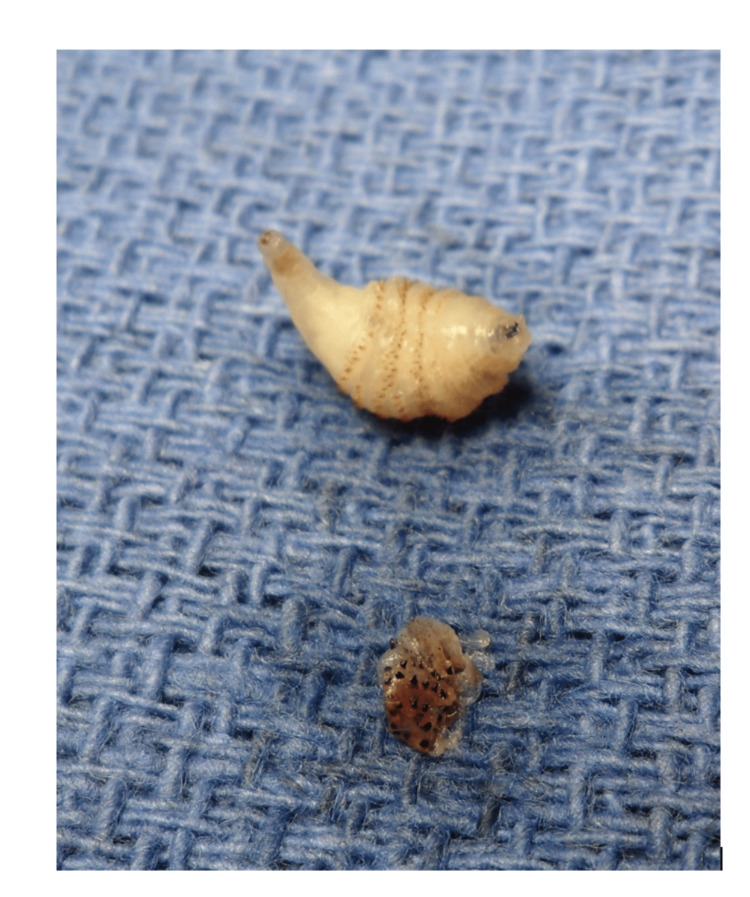 Figure 1
Peer Reviews
No public reviews on file for this paper yet. If you reviewed it on a platform where reviews are public (OpenReview, ICLR, NeurIPS, ICML), you can paste yours below so the community can read it here.
Videos
No videos yet. Explain this paper in a talk, walkthrough, or lecture? Add one.
Taxonomy
TopicsForensic Entomology and Diptera Studies · Dermatological diseases and infestations · Parasitic Diseases Research and Treatment