Medium-Range Structural Order in Amorphous Arsenic
Yuanbin Liu, Yuxing Zhou, Richard Ademuwagun, Luc Walterbos, Janine George, Stephen R. Elliott, Volker L. Deringer

TL;DR
This paper uses advanced simulations to uncover the medium-range order in amorphous arsenic and compares it to amorphous phosphorus.
Contribution
The study reveals the structural nature of medium-range order in amorphous arsenic using machine-learned potentials and automated simulations.
Findings
Amorphous arsenic has a more uniform dihedral-angle distribution compared to amorphous phosphorus.
The first sharp diffraction peak in amorphous arsenic is linked to the size and distribution of voids in its network.
Automation enhances the accuracy and efficiency of machine-learning-driven atomistic simulations.
Abstract
Medium-range order (MRO) is a key structural feature of amorphous materials, but its origin and nature remain elusive. Here, we reveal the MRO in amorphous arsenic (a-As) using advanced atomistic simulations, based on machine-learned potentials derived using automated workflows. Our simulations accurately reproduce the experimental structure factor of a-As, especially the first sharp diffraction peak (FSDP), which is a signature of MRO. We compare and contrast the structure of a-As with that of its lighter homologue, red amorphous phosphorus (a-P): we find that a-As has a more uniform dihedral-angle distribution, and so we confirm that its structure can be thought of as a 3-fold coordinated continuous random network in first approximation, in contrast to the more molecular-cluster-like structure of a-P. The pressure-dependent structural behaviors of a-As and a-P differ as well, and the…
Genes, proteins, chemicals, diseases, species, mutations and cell lines named across the full text — each resolved to its canonical identifier and authoritative record.
Click any figure to enlarge with its caption.
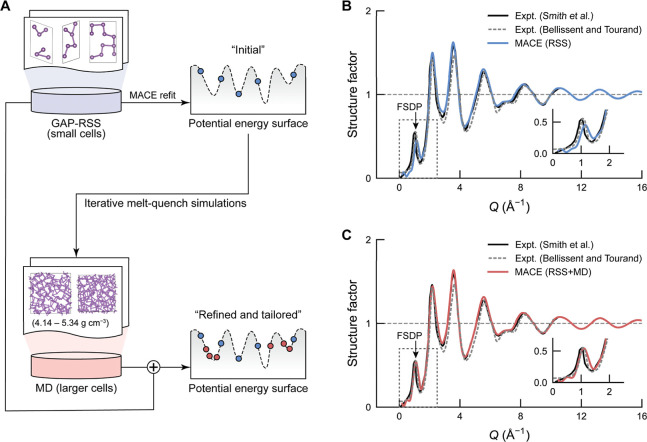 Figure 1
 Figure 2
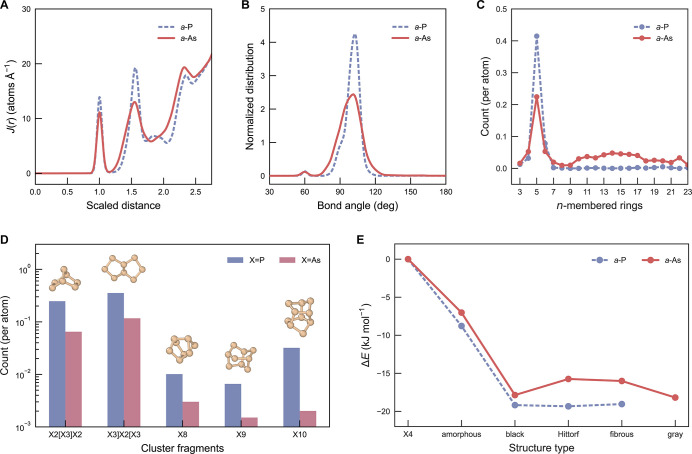 Figure 3
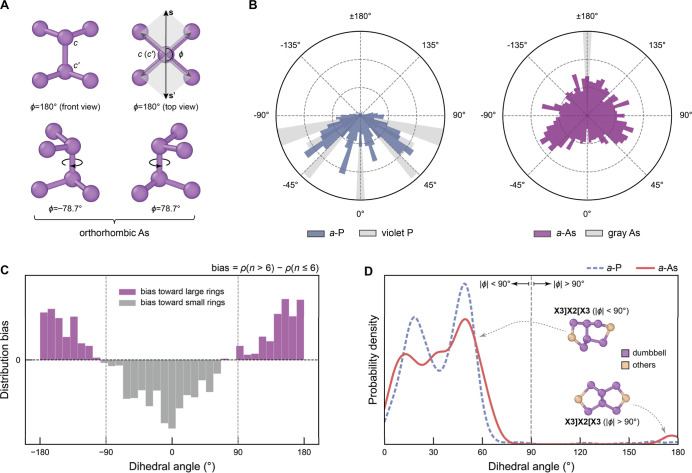 Figure 4
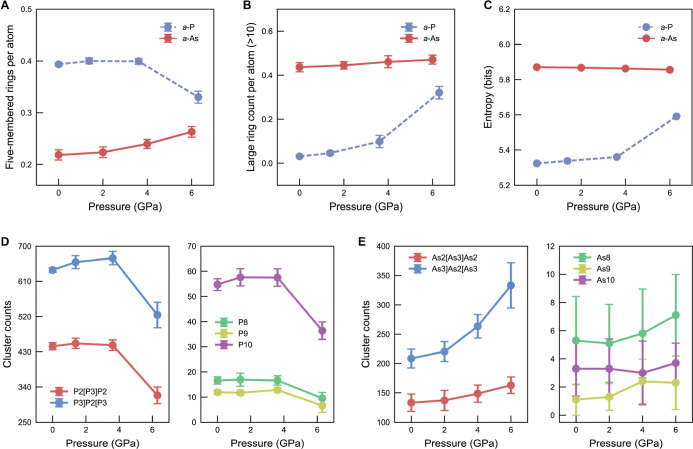 Figure 5
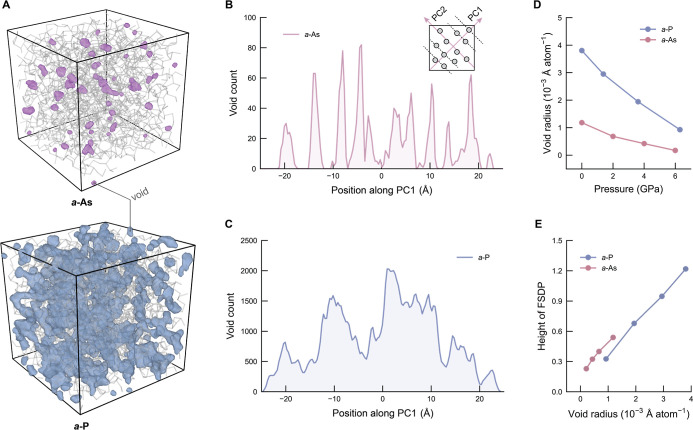 Figure 6
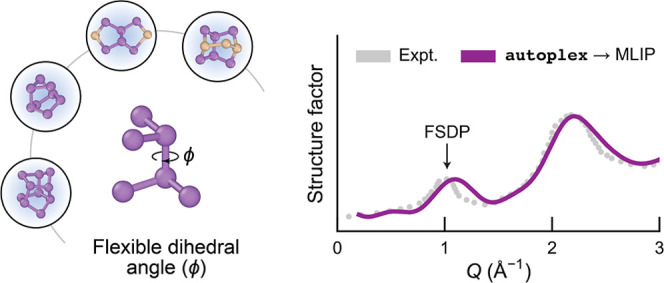 Figure 7
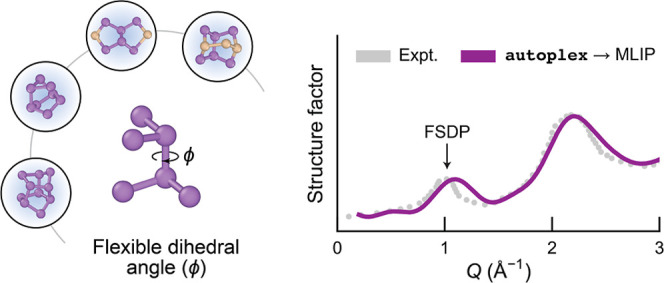 Figure 8
 Figure 9
 Figure 10
 Figure 11
 Figure 12
 Figure 13
 Figure 14
 Figure 15
 Figure 16
 Figure 17
 Figure 18
Peer Reviews
No public reviews on file for this paper yet. If you reviewed it on a platform where reviews are public (OpenReview, ICLR, NeurIPS, ICML), you can paste yours below so the community can read it here.
Videos
No videos yet. Explain this paper in a talk, walkthrough, or lecture? Add one.
Taxonomy
TopicsMachine Learning in Materials Science · Material Dynamics and Properties · Metallic Glasses and Amorphous Alloys