A Small Molecule That Inhibits the Quorum Sensing Receptor AgrC in Staphylococcus aureus
Thomas J. Polaske, Troy D. Vulpis, Alexandra E. Nelson, Ke Zhao, Helen E. Blackwell

TL;DR
Researchers developed a small molecule, CP-20, that effectively inhibits a key receptor in Staphylococcus aureus, which could help reduce its virulence.
Contribution
The discovery of a synthetically tractable small molecule that completely inhibits quorum sensing in Staphylococcus aureus.
Findings
CP-20 derivative inhibits quorum sensing with mid-nanomolar potency.
CP-20 binds AgrC and competitively inhibits its activity in vitro.
CP-20 is a versatile probe for studying Staphylococcal virulence.
Abstract
We report the synthesis and characterization of a small molecule, CP-20, capable of inhibiting the key quorum sensing receptor AgrC in Staphylococcus aureus. Structural alterations enabled the discovery of a CP-20 derivative that is capable of complete quorum sensing inhibition with mid-nanomolar potency. In vitro biochemical investigations support CP-20 binding AgrC and competitively inhibiting its activity. CP-20 represents a versatile and synthetically tractable small molecule probe for investigating Staphylococcal virulence via quorum sensing modulation.
Genes, proteins, chemicals, diseases, species, mutations and cell lines named across the full text — each resolved to its canonical identifier and authoritative record.
Click any figure to enlarge with its caption.
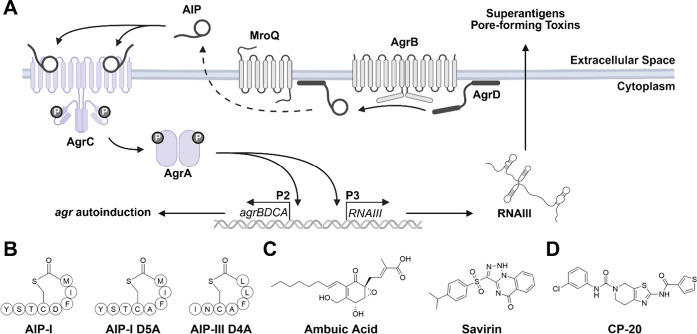 Figure 1
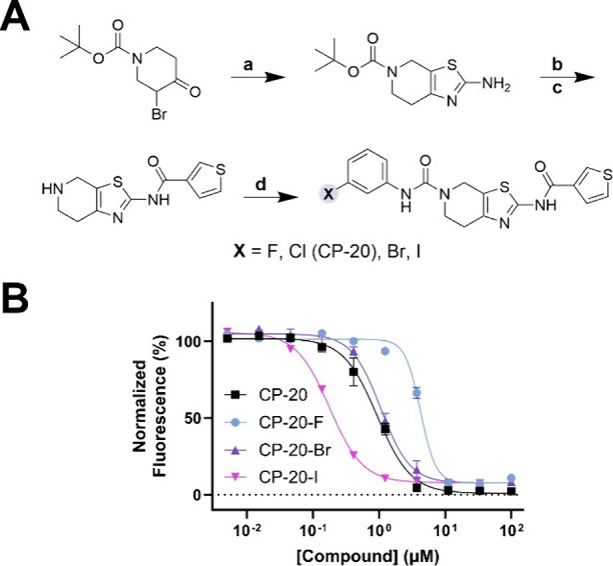 Figure 2
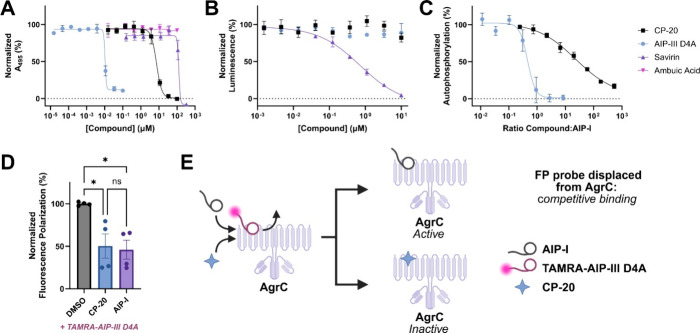 Figure 3
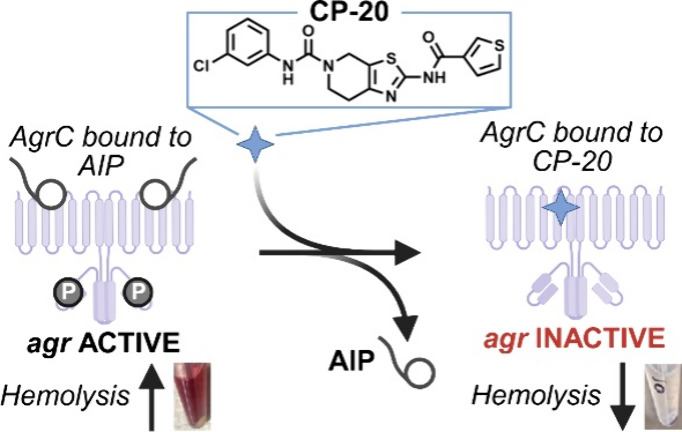 Figure 4
Peer Reviews
No public reviews on file for this paper yet. If you reviewed it on a platform where reviews are public (OpenReview, ICLR, NeurIPS, ICML), you can paste yours below so the community can read it here.
Videos
No videos yet. Explain this paper in a talk, walkthrough, or lecture? Add one.
Taxonomy
TopicsAntimicrobial Resistance in Staphylococcus · Bacterial biofilms and quorum sensing · Biochemical and Structural Characterization