BRCA genetic testing and treatment patterns for patients with HER2-negative early-stage breast cancer in the US community setting
Kathryn E. Mishkin, Yezhou Sun, Ke Meng, Xiaoqing Xu, Qixin Li, Yu-Han Kao, Jagadeswara Rao Earla, Kim M. Hirshfield, Jaime A. Mejia

TL;DR
This study examines BRCA genetic testing and treatment patterns for early-stage HER2-negative breast cancer patients in the US, finding suboptimal testing rates and highlighting areas for improvement.
Contribution
The study provides real-world data on BRCA testing patterns and treatment decisions for HER2-negative early-stage breast cancer patients in the US community setting.
Findings
BRCAm testing rates were 51% in 2022 and 56% in 2023 for HER2-negative early-stage breast cancer patients.
Only 3% of HR+/HER2-negative patients and 13% of triple-negative breast cancer patients tested positive for BRCA mutations.
Most patients with BRCA-mutated breast cancer underwent mastectomy compared to those without mutations.
Abstract
Adjuvant olaparib has been approved in the US since 2022 for patients with high-risk HER2-negative early-stage breast cancer (eBC) with germline mutation in BRCA1 or BRCA2 (gBRCAm), and contemporary real-world data are needed regarding BRCAm testing patterns, BRCAm prevalence, and therapy selection for HER2-negative eBC in the US. This retrospective cohort study used a longitudinal, real-world dataset from US community healthcare systems to describe characteristics and BRCAm testing of adults with initial diagnosis from 1-Jan-2022 to 22-Jan-2024 of clinical stage I-III HER2-negative BC. Patients with unknown hormone receptor (HR) status, enrolled in a clinical trial, or with lobular carcinoma in situ or other primary cancer were excluded. Subsequent therapy was described by BRCAm status. Among 3741 patients with HER2-negative eBC, 51% and 56% were BRCAm tested in 2022 and 2023,…
Genes, proteins, chemicals, diseases, species, mutations and cell lines named across the full text — each resolved to its canonical identifier and authoritative record.
Click any figure to enlarge with its caption.
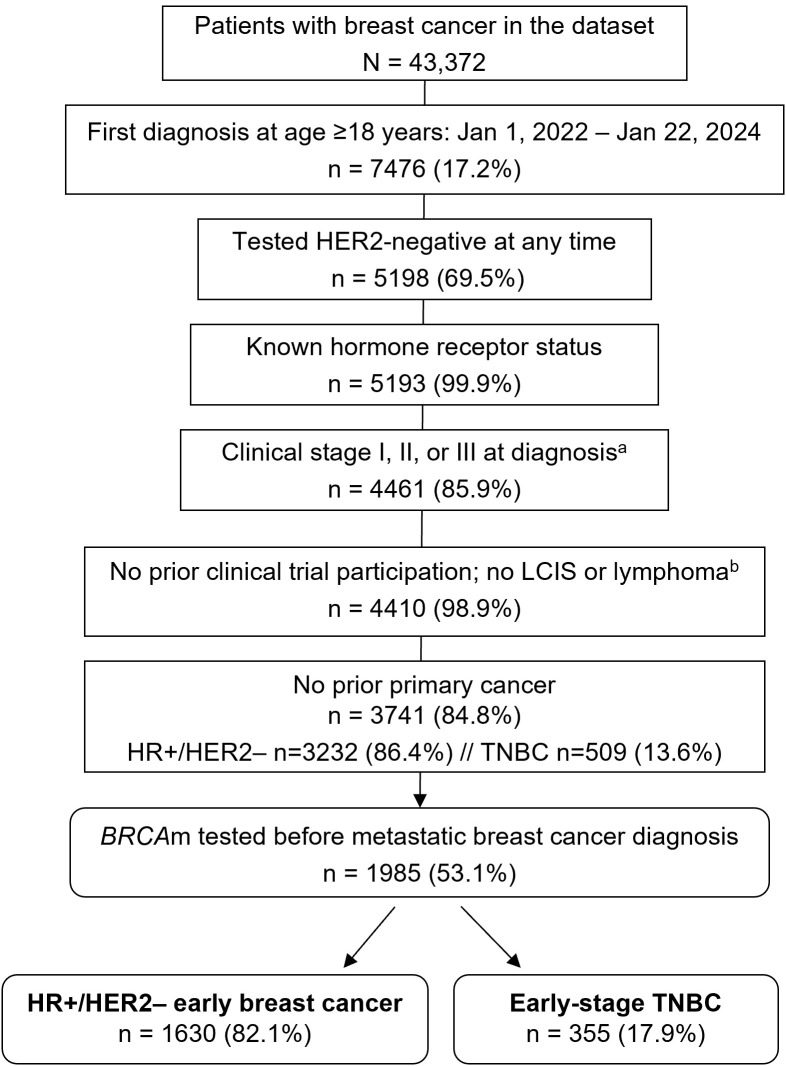 Figure 1
Peer Reviews
No public reviews on file for this paper yet. If you reviewed it on a platform where reviews are public (OpenReview, ICLR, NeurIPS, ICML), you can paste yours below so the community can read it here.
Videos
No videos yet. Explain this paper in a talk, walkthrough, or lecture? Add one.
Taxonomy
TopicsBRCA gene mutations in cancer · PARP inhibition in cancer therapy · Breast Cancer Treatment Studies