Maternal and child immune profiles are associated with neurometabolite measures of early-life neuroinflammation in children who are HIV-exposed and uninfected: a South African birth cohort
Cesc Bertran-Cobo, Frances C. Robertson, Tusekile Sarah Kangwa, Jenna Annandale, Sivenesi Subramoney, Katherine L. Narr, Shantanu H. Joshi, Nadia Hoffman, Heather J. Zar, Dan J. Stein, Kirsten A. Donald, Catherine J. Wedderburn, Petrus J. W. Naudé, Ashley Harris

TL;DR
This study finds that immune markers in mothers and children are linked to brain chemistry in HIV-exposed but uninfected children, suggesting prenatal immune changes may affect early brain development.
Contribution
The study identifies specific immune-neurometabolite associations in HIV-exposed children, highlighting potential mechanisms for neurodevelopmental risks.
Findings
Higher maternal IL-5 and IL-8 were linked to increased myo-inositol in HEU children's brain regions.
Child MMP-9 levels at two years correlated with myo-inositol in midline parietal grey matter.
Maternal IL-13 was associated with higher glutamate in non-HEU children, with interactions modified by HIV status.
Abstract
Children who are HIV-exposed and uninfected (HEU) are at risk of neurodevelopmental delays, potentially via prenatal immune dysregulation. We investigated whether maternal and child peripheral blood immune markers relate to early brain metabolite profiles in children with and without HIV exposure from a South African birth cohort. Within the Drakenstein Child Health Study, a neuroimaging subgroup of children underwent single-voxel magnetic resonance spectroscopy at 23 years (n=156; 66 HEU, 90 HIV-unexposed). A panel of eighteen immune markers was quantified in blood serum of pregnant women and in their children at 7 weeks and 2 years follow-up. Neurometabolite ratios to creatine were quantified in midline parietal grey matter and left and right parietal white matter. Cross-sectional associations between immune markers and neurometabolite ratios were tested using linear models with…
Genes, proteins, chemicals, diseases, species, mutations and cell lines named across the full text — each resolved to its canonical identifier and authoritative record.
Click any figure to enlarge with its caption.
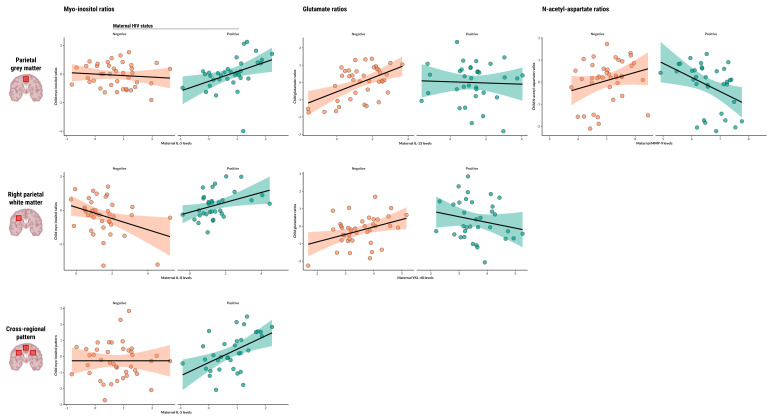 Figure 1
Peer Reviews
No public reviews on file for this paper yet. If you reviewed it on a platform where reviews are public (OpenReview, ICLR, NeurIPS, ICML), you can paste yours below so the community can read it here.
Videos
No videos yet. Explain this paper in a talk, walkthrough, or lecture? Add one.
Taxonomy
TopicsHIV Research and Treatment · Tryptophan and brain disorders · Neonatal and fetal brain pathology