Using AI in Forward-Backward Translation of Questionnaires for Men Invited to Prostate Cancer Screening: Methodological Study
Sofie Meyer Andersen, Pia Kirkegaard, Krzysztof Tupikowski, Katarzyna Hodyra-Stefaniak, Mette Bach Larsen

TL;DR
This study explores using AI to translate health questionnaires into Polish, finding that AI can save time while maintaining accuracy, though human review is still needed.
Contribution
The study demonstrates a practical method integrating AI into the WHO translation framework for questionnaires.
Findings
AI-generated translations had minor discrepancies that were resolved by native speakers.
Cognitive interviews revealed that small language adjustments improved questionnaire clarity.
AI can reduce translation time and costs without compromising conceptual accuracy.
Abstract
Translation is important in research to ensure cultural relevance, accuracy, and generalizability, particularly in cross-cultural studies. The forward-backward translation method of the World Health Organization (WHO) is commonly used to improve linguistic and conceptual accuracy but is often time-consuming and resource intensive. The development of advanced artificial intelligence (AI) offers new opportunities to make the translation process more efficient, potentially reducing time and costs. However, concerns remain regarding the ability of AI to capture cultural nuances and complex linguistic structures, which may affect translation quality. Therefore, evidence on how AI can be effectively integrated into established translation frameworks remains limited. This study aimed to explore the use of AI in the forward-backward translation process for questionnaires. We used an adapted…
Genes, proteins, chemicals, diseases, species, mutations and cell lines named across the full text — each resolved to its canonical identifier and authoritative record.
Click any figure to enlarge with its caption.
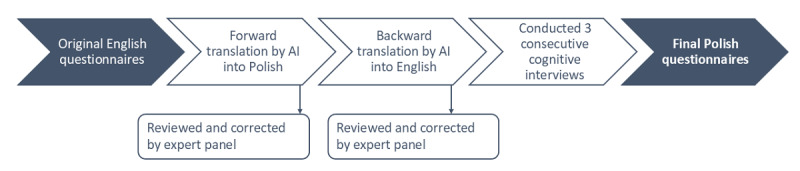 Figure 1
Peer Reviews
No public reviews on file for this paper yet. If you reviewed it on a platform where reviews are public (OpenReview, ICLR, NeurIPS, ICML), you can paste yours below so the community can read it here.
Videos
No videos yet. Explain this paper in a talk, walkthrough, or lecture? Add one.
Taxonomy
TopicsArtificial Intelligence in Healthcare and Education · Mental Health via Writing · Cancer survivorship and care