Attitudes toward artificial intelligence and its application in psychotherapy: Assessment in healthy adults and validation of an assessment measure
Jannis Nagel, Karsten Hollmann, Annika K Alt, Tobias J Renner, Annette Conzelmann

TL;DR
This study explores how adults view AI in psychotherapy, finding generally neutral attitudes and identifying factors like gender and personality that influence acceptance.
Contribution
The study introduces and validates a measure for assessing attitudes toward AI in psychotherapy and identifies influencing factors.
Findings
Men, academics, and those without psychological symptoms showed lower AI anxiety.
Conscientiousness and extraversion correlated with lower AI acceptance.
AI diagnostics and app-based interventions were most accepted, while robotics were least accepted.
Abstract
Artificial intelligence (AI) represents a digital turning point that might have an impact on psychological treatment. To effectively integrate AI into psychological practice, it is important to analyze attitudes toward AI and the factors influencing these attitudes. To achieve this objective, a quantitative online survey to assess acceptance of AI was designed and assessed in 205 adult participants. Additionally, demographic variables, psychological symptoms, psychotherapy experience, and personality traits were assessed as potential factors influencing AI acceptance. In general, attitudes toward AI and its application in psychotherapy were relatively neutral. The results indicated that men, academics, and people without psychological symptom burdens showed lower anxiety of AI in general. Conscientiousness and extraversion correlated negatively with the acceptance of AI in general.…
Genes, proteins, chemicals, diseases, species, mutations and cell lines named across the full text — each resolved to its canonical identifier and authoritative record.
Click any figure to enlarge with its caption.
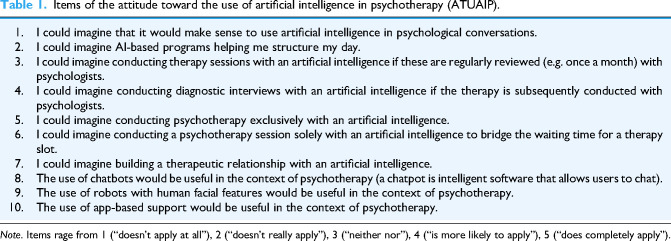 Figure 1
Peer Reviews
No public reviews on file for this paper yet. If you reviewed it on a platform where reviews are public (OpenReview, ICLR, NeurIPS, ICML), you can paste yours below so the community can read it here.
Videos
No videos yet. Explain this paper in a talk, walkthrough, or lecture? Add one.
Taxonomy
TopicsDigital Mental Health Interventions · Mental Health via Writing · AI in Service Interactions