Almost optimal geometrically local quantum LDPC codes in any dimension
Xingjian Li, Ting-Chun Lin, Adam Wills, Min-Hsiu Hsieh

TL;DR
This paper presents a method to create almost optimal quantum codes that are geometrically local in any dimension.
Contribution
A new procedure to transform any good quantum LDPC code into an almost optimal geometrically local quantum code in any dimension.
Findings
The method generalizes previous constructions by removing specialized prerequisites.
It builds a connection between geometric operations and code constructions.
The approach works for arbitrary three-term chain complexes.
Abstract
Geometrically local quantum codes, comprised of qubits and checks embedded in \documentclass[12pt]{minimal} \usepackage{amsmath} \usepackage{wasysym} \usepackage{amsfonts} \usepackage{amssymb} \usepackage{amsbsy} \usepackage{mathrsfs} \usepackage{upgreek} \setlength{\oddsidemargin}{-69pt} \begin{document}\end{document}RD with local check operators, have been a subject of significant interest. A key challenge is identifying the optimal code construction that maximizes both code dimension and distance under the geometric constraints. In this work, we introduce a construction that can transform any good quantum LDPC code into an almost optimal geometrically local quantum code. Our approach hinges on a novel yet simple procedure that extracts a two-dimensional structure from an arbitrary three-term chain complex, building a…
Genes, proteins, chemicals, diseases, species, mutations and cell lines named across the full text — each resolved to its canonical identifier and authoritative record.
Click any figure to enlarge with its caption.
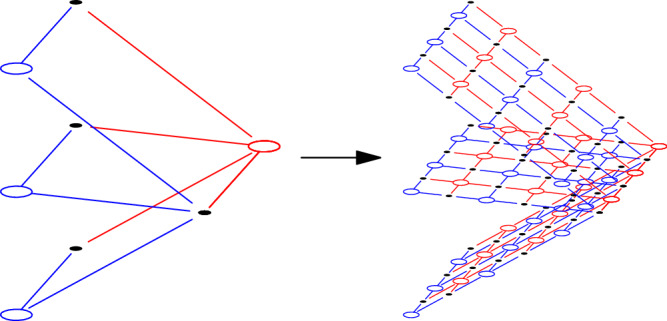 Figure 1
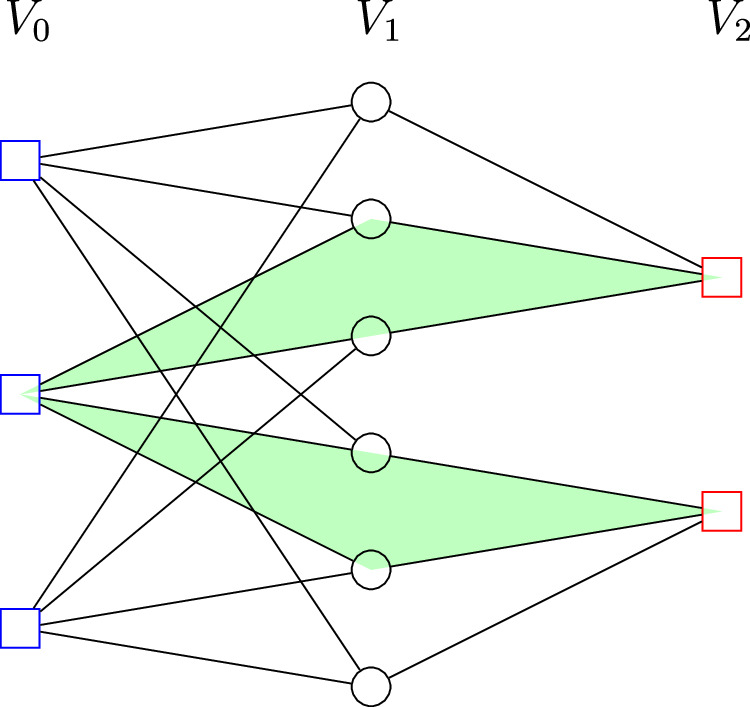 Figure 2
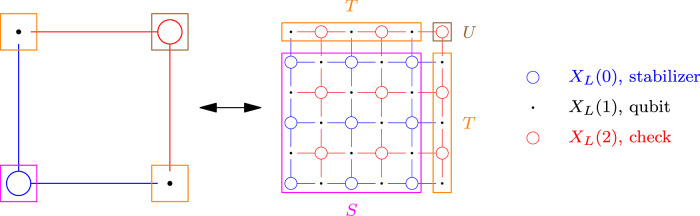 Figure 3
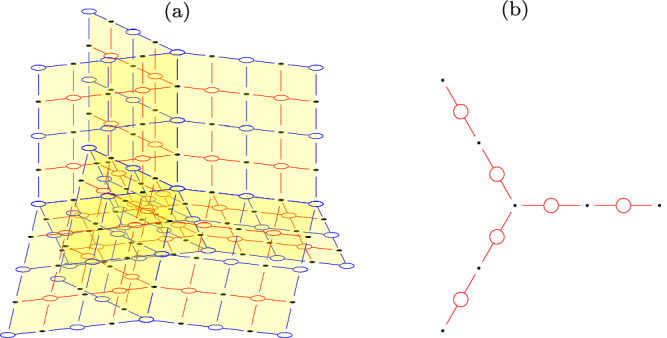 Figure 4
Peer Reviews
No public reviews on file for this paper yet. If you reviewed it on a platform where reviews are public (OpenReview, ICLR, NeurIPS, ICML), you can paste yours below so the community can read it here.
Videos
No videos yet. Explain this paper in a talk, walkthrough, or lecture? Add one.
Taxonomy
TopicsQuantum Computing Algorithms and Architecture · Quantum Information and Cryptography · Mathematical Approximation and Integration