Fertility preservation in women with diminished ovarian reserve: evaluating the AMH criteria
Maria Elisabetta Coccia, Benedetta Gabbrielli, Giulia Cutajar, Francesca Piazzini, Paolo Evangelisti, Laura Badolato, Patrizia Falcone, Rossella Fucci, Carlo Bulletti

TL;DR
The study examines whether fertility preservation through oocyte freezing is effective for women with low ovarian reserve, finding that current AMH thresholds may need revision.
Contribution
The study provides new evidence on the effectiveness of fertility preservation in women with diminished ovarian reserve using AMH thresholds.
Findings
DOR patients achieved significantly lower oocyte yields compared to those with higher AMH levels.
AMH and age were significant predictors of vitrified oocytes, suggesting the need for age-stratified counseling.
DOR patients' oocyte yields were below thresholds associated with reasonable live birth rates, questioning FP efficacy.
Abstract
Does fertility preservation (FP) through oocyte cryopreservation provide realistic reproductive opportunities for diminished ovarian reserve (DOR)? Literature suggests cumulative live birth rates of 30–45% with 8–10 oocytes under 35 years old. Insufficient data exist to define whether DOR patients should be offered FP systematically. This retrospective single-center study analyzed data from 304 women undergoing oocyte cryopreservation (January 2016–December 2024). Patients were stratified into cohort 1 (Anti-Müllerian hormone—AMH—≤ 0.5 ng/mL, n = 49) and cohort 2 (AMH > 0.5 ng/mL, n = 255). Primary outcomes included retrieved oocytes (RO) and vitrified oocytes (VO). Secondary outcome examined DuoStim results. Statistical analysis included correlation assessments, ANCOVA, and multiple linear regression. DOR patients achieved lower oocyte yields compared to cohort 2 (RO: 3.1 ± 2.3 vs.…
Genes, proteins, chemicals, diseases, species, mutations and cell lines named across the full text — each resolved to its canonical identifier and authoritative record.
Click any figure to enlarge with its caption.
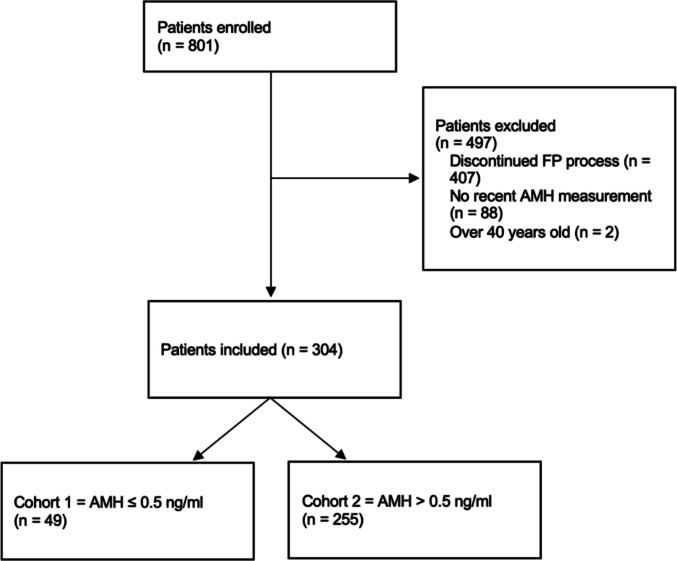 Figure 1
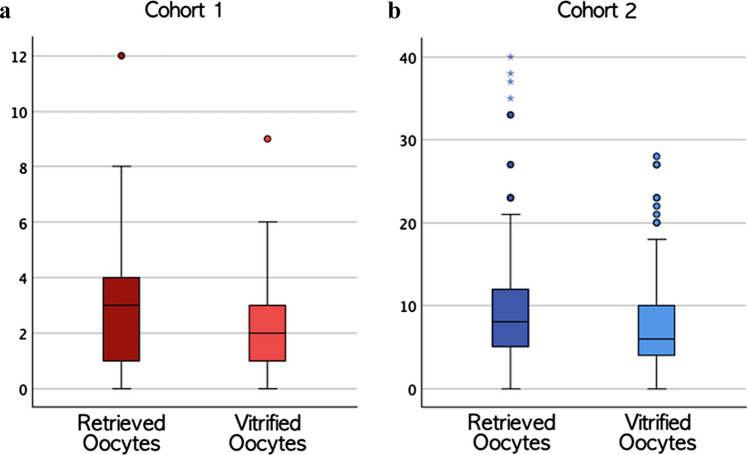 Figure 2
Peer Reviews
No public reviews on file for this paper yet. If you reviewed it on a platform where reviews are public (OpenReview, ICLR, NeurIPS, ICML), you can paste yours below so the community can read it here.
Videos
No videos yet. Explain this paper in a talk, walkthrough, or lecture? Add one.
Taxonomy
TopicsReproductive Biology and Fertility · Ovarian function and disorders · Reproductive Health and Technologies