The waiting room: Unmet sexual health service needs among men and gender-diverse individuals having sex with men in England, findings from an online, cross-sectional community survey in 2024
Dana Ogaz, Dolores Mullen, George Baldry, Danielle Jayes, Dawn Phillips, Catherine M Lowndes, David Reid, Jordan Charlesworth, Erna Buitendam, David Phillips, Gwenda Hughes, Catherine H Mercer, John Saunders, Kate Folkard, Katy Sinka, Hamish Mohammed

TL;DR
Many men and gender-diverse individuals in England who have sex with men face unmet needs for in-person sexual health services, especially outside London and among those with health conditions or using online testing.
Contribution
This study identifies unmet in-person sexual health service needs among key populations in England using a large community survey.
Findings
12% of participants who tried to access in-person sexual health services experienced unmet need in the past year.
Unmet need was higher outside London and among those with physical health conditions or using online postal self-sampling services.
Financial comfort and sexual risk markers were associated with lower unmet need for in-person services.
Abstract
Sexual health service (SHS) delivery in England shifted substantially with rapid expansion of online services during the COVID-19 pandemic. While digital services may improve reach, limited data exist on unmet need for in-person SHS in England, especially among men and gender-diverse individuals who have sex with men, key populations disproportionately affected by sexual health inequalities. We analysed data from “Reducing inequalities in Sexual Health” (RiiSH) 2024 (Nov/Dec 2024), an online survey of UK-resident men and gender-diverse individuals having sex with men. We assessed in-person SHS access and unmet need (tried but failed to access a SHS in-person) over the past year. Bivariate and multivariable logistic regression was used to examine associations with unmet need. Among 2404 participants living in England (median age 45 years, 88% White, 95% cisgender), 86% had ever…
Genes, proteins, chemicals, diseases, species, mutations and cell lines named across the full text — each resolved to its canonical identifier and authoritative record.
Click any figure to enlarge with its caption.
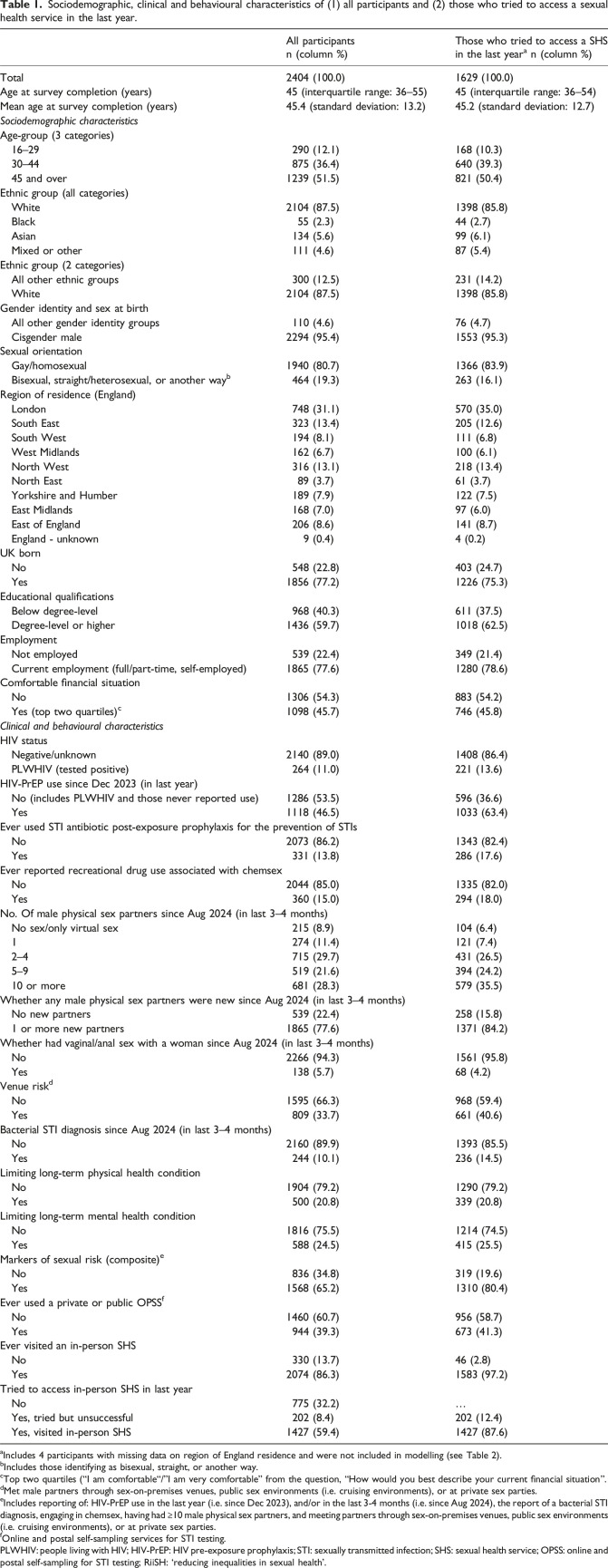 Figure 1
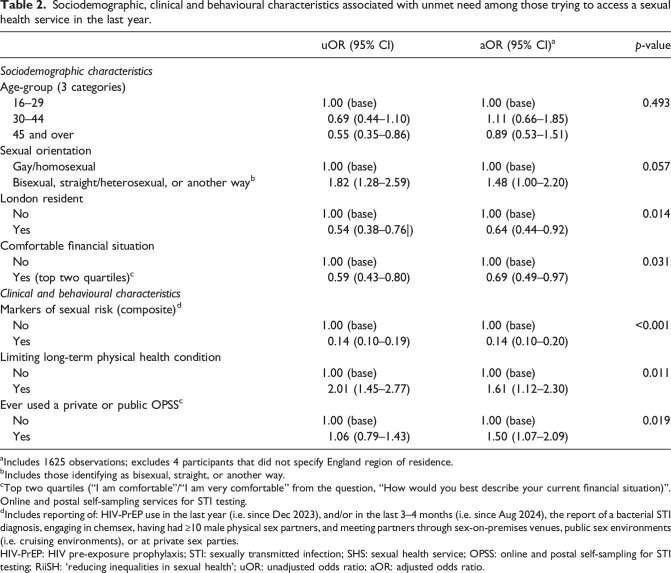 Figure 2
Peer Reviews
No public reviews on file for this paper yet. If you reviewed it on a platform where reviews are public (OpenReview, ICLR, NeurIPS, ICML), you can paste yours below so the community can read it here.
Videos
No videos yet. Explain this paper in a talk, walkthrough, or lecture? Add one.
Taxonomy
TopicsHIV/AIDS Research and Interventions · Mobile Health and mHealth Applications · Sex work and related issues