Repetition leads to short-term reduction of word frequency and name agreement effects: Evidence from a Dutch two-session picture naming experiment
Caitlin Decuyper, Ruth E Corps, Antje S Meyer

TL;DR
Repeating word names temporarily reduces the influence of word frequency and name agreement on how quickly people can name objects, but these effects return after a week.
Contribution
This study provides evidence that repetition temporarily reduces word frequency and name agreement effects in speech production.
Findings
Repetition eliminated the word frequency effect in the first session but it reappeared after a week.
The name agreement effect was reduced by repetition but still present in the first session and returned in the second session.
Short-term repetition affects lexical accessibility, but the effects are not long-lasting.
Abstract
Word frequency (WF) and name agreement (NA) affect a word’s accessibility during speech production. Speakers are faster to name pictures with high-frequency (e.g. dog) compared to low-frequency names (e.g. rhinoceros) and those that a group of speakers tend to agree on the name of (high NA; e.g. arm) than those that they do not (low NA; e.g. sofa, couch). Recent accounts of lexical access suggest that the structure of the mental lexicon is flexible and changes with exposure. Consistent with this view, repetition priming studies have shown that low-frequency and low NA items benefit from repetition more than high-frequency and high NA items. But there is little evidence that repetition has long-term effects on WF and NA. We tested this issue in a two-session (online) picture naming study. In Session 1, participants named pictures varying in WF and NA three times each, and so we could…
Genes, proteins, chemicals, diseases, species, mutations and cell lines named across the full text — each resolved to its canonical identifier and authoritative record.
Click any figure to enlarge with its caption.
 Figure 1
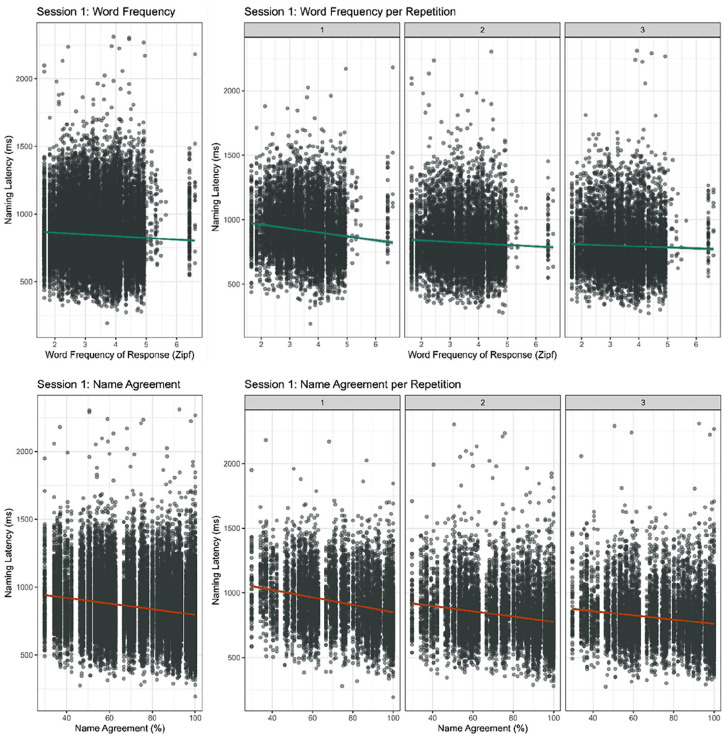 Figure 2
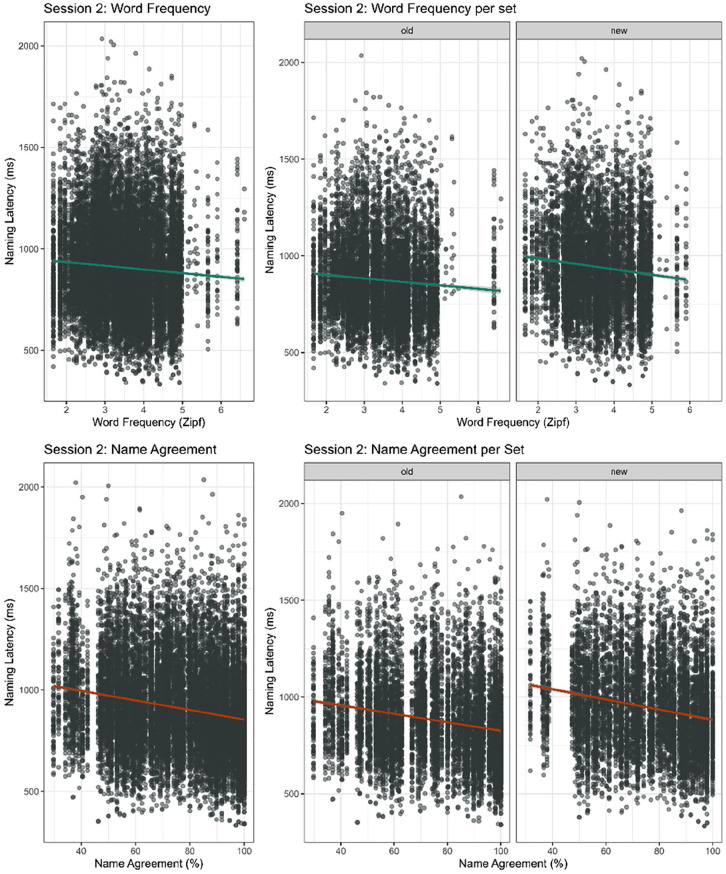 Figure 3
 Figure 4
 Figure 5
 Figure 6
 Figure 7
Peer Reviews
No public reviews on file for this paper yet. If you reviewed it on a platform where reviews are public (OpenReview, ICLR, NeurIPS, ICML), you can paste yours below so the community can read it here.
Videos
No videos yet. Explain this paper in a talk, walkthrough, or lecture? Add one.
Taxonomy
TopicsNeurobiology of Language and Bilingualism · Second Language Acquisition and Learning · Interpreting and Communication in Healthcare