Kept at a Distance: A Qualitative Study of Bereaved Individuals’ Experiences of How Death Was Addressed When Their Partner Died at Home
Margareta Aurén-Møkleby, Gunvor Aasbø, Anne Marit Mengshoel, Kari Nyheim Solbrække, Lisbeth Thoresen

TL;DR
This study explores how couples address death when a partner dies at home, revealing that communication often avoids direct discussion and relies on unspoken understandings.
Contribution
The study introduces new insights into the diversity of communication styles around death in home settings, emphasizing unspoken and indirect methods.
Findings
Bereaved individuals often relied on unspoken understandings rather than direct discussions about death.
Actions, such as becoming closer or arranging for the partner's future, were common ways to address death.
Avoidant or indirect communication was more prevalent than open dialogue about dying.
Abstract
Open awareness and dialogue concerning dying are considered essential for planning and realizing death at home. Moreover, much help and support throughout the dying process and death trajectory are provided by a person’s next of kin, often a spouse or partner. To explore how death was addressed among couples when one of the partners had died at home, we interviewed 14 bereaved individuals. The results were grouped into the following themes: “Idea(l)s and realities of communication,” “Different kinds of talks,” and “Unspoken understandings and showing without talking.” We found that prevailing narratives about how death should be discussed in socially and culturally expected ways affected how the bereaved addressed the imminent death of their partner, both at the time and in their retrospective reflections. In a few cases, death had been talked about directly using words such as “death”…
Genes, proteins, chemicals, diseases, species, mutations and cell lines named across the full text — each resolved to its canonical identifier and authoritative record.
Click any figure to enlarge with its caption.
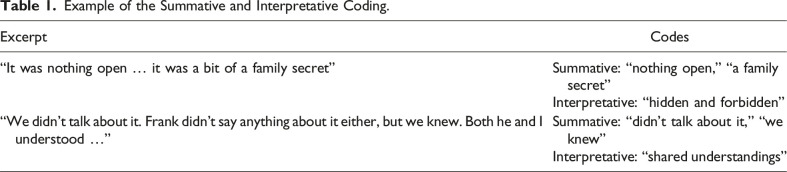 Figure 1
Peer Reviews
No public reviews on file for this paper yet. If you reviewed it on a platform where reviews are public (OpenReview, ICLR, NeurIPS, ICML), you can paste yours below so the community can read it here.
Videos
No videos yet. Explain this paper in a talk, walkthrough, or lecture? Add one.
Taxonomy
TopicsGrief, Bereavement, and Mental Health · Palliative Care and End-of-Life Issues · Religion, Spirituality, and Psychology