Revisiting our primate roots in infants grooming
Chunmiao Mai, Guillaume Lio, Maude Beaudoin-Gobert, Chen Qu, Liuba Papeo, Michel Desmurget, Jean-Réné Duhamel, Irene Cristofori, Angela Sirigu

TL;DR
The study finds that infants display grooming-like behaviors, which may reflect evolutionary roots shared with primates and decline as gestural communication emerges.
Contribution
The study identifies grooming-like behaviors in preverbal infants as a vestigial motor pattern with potential evolutionary significance.
Findings
Infants display grooming-like behaviors directed at caregivers' hairy skin, resembling non-human primate grooming.
Grooming behaviors decline by 15 months, coinciding with the emergence of gestural communication.
Grooming frequency peaks between 2pm and 4pm, aligning with a circadian dip in beta-endorphins.
Abstract
Grooming is a common behavior across many animal species, including non-human primates (NHP), and serves a variety of functions, such as cleaning hair, alleviating stress, and enhancing social bonds. This study aims to explore whether grooming-like behaviors are present in humans during early developmental stages, before the emergence of gestural and language communication. Through the observations of 67 preverbal infants, we identified frequent manual behaviors, including grasping, holding, and behaviors resembling grooming, particularly directed toward caregivers’ hairy skin. These behaviors were analyzed and validated by twelve independent primatologists, who confirmed that behavioral sequences and their kinematics closely resembled grooming behaviors seen in NHPs, while also distinguishing them from other types of manual actions such as holding or grasping. Longitudinal analyses…
Genes, proteins, chemicals, diseases, species, mutations and cell lines named across the full text — each resolved to its canonical identifier and authoritative record.
Click any figure to enlarge with its caption.
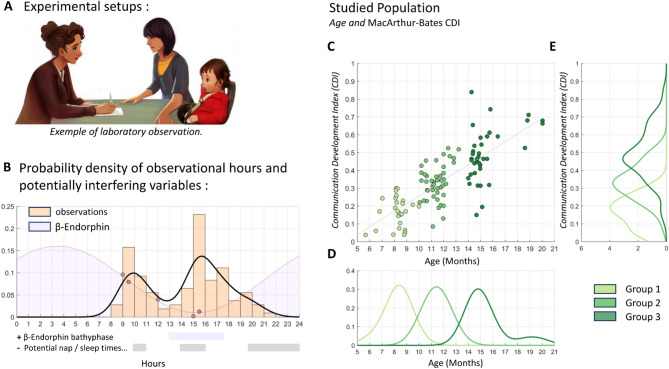 Figure 1
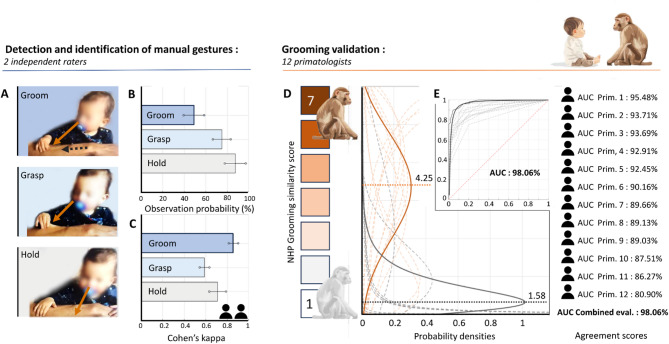 Figure 2
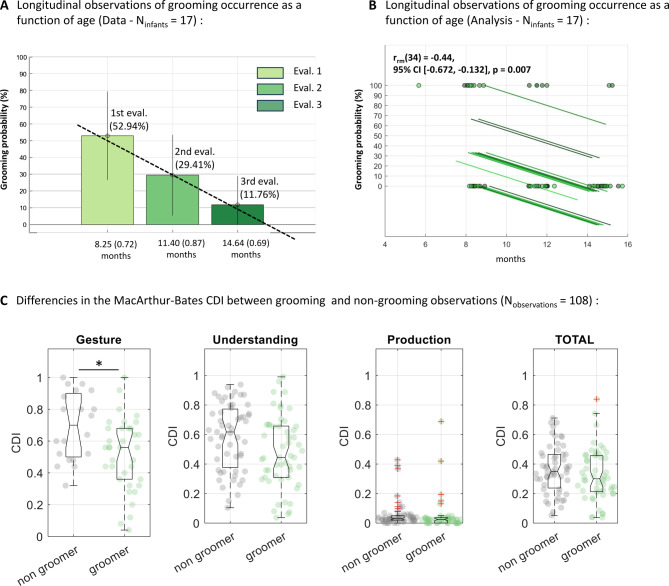 Figure 3
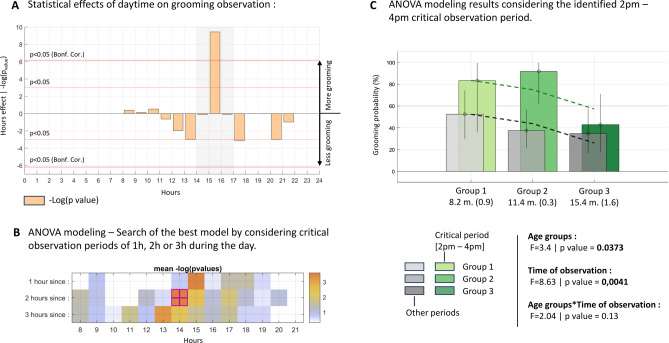 Figure 4
Peer Reviews
No public reviews on file for this paper yet. If you reviewed it on a platform where reviews are public (OpenReview, ICLR, NeurIPS, ICML), you can paste yours below so the community can read it here.
Videos
No videos yet. Explain this paper in a talk, walkthrough, or lecture? Add one.
Taxonomy
TopicsPrimate Behavior and Ecology · Hemispheric Asymmetry in Neuroscience · Action Observation and Synchronization