Cultural validation of the RCADS and use of ensemble learning for symptom profiling of anxiety and depression
Zamir Hussain, Mahnoor Hasan, Mehwish Zaman, Syeda Aneela Zahra Shamsi, Qurrat Ulain Hamdan, Haseeba Afzal

TL;DR
This study validates a mental health screening tool for anxiety and depression in Pakistani children and uses machine learning to identify key symptoms.
Contribution
The study validates the RCADS for Pakistani populations and introduces ML-based symptom profiling for anxiety and depression.
Findings
47 RCADS items are culturally significant for anxiety and depression screening in Pakistan.
Random Forest ML models achieved high accuracy (0.85–0.98) in symptom profiling.
Gini importance identified dominant symptoms for each disorder.
Abstract
Depression and anxiety are the most prevalent global mental health concerns, especially among children and adolescents. Numerous screening tools are available to readily detect these issues. The cultural significance of these tools in specific communities should be validated, as socio-demographic factors can influence psychopathology. Moreover, screening tools are limited to the identification of a disorder and do not highlight critical symptoms that may be more dominant in disease progression. In this study, a community sample of 237 Pakistani children and adolescents was used to validate the cultural significance of the Revised Child Anxiety and Depression Scale (RCADS) and its subscales, and develop machine learning (ML) models for profiling of the most significant symptoms of anxiety and depression. Cronbach’s alpha for all subscales of RCADS except Separation Anxiety Disorder…
Genes, proteins, chemicals, diseases, species, mutations and cell lines named across the full text — each resolved to its canonical identifier and authoritative record.
Click any figure to enlarge with its caption.
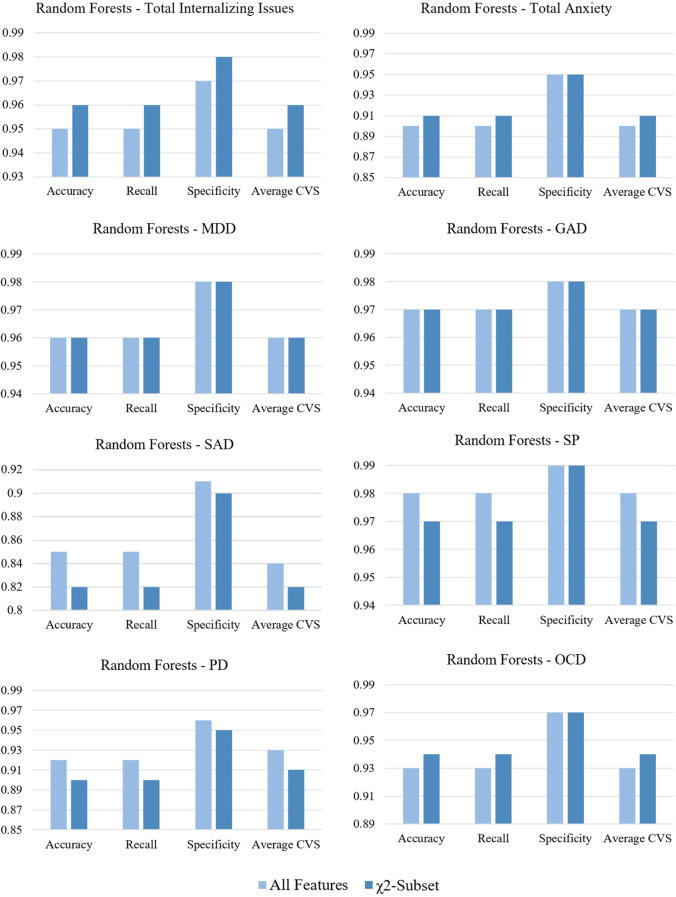 Figure 1
Peer Reviews
No public reviews on file for this paper yet. If you reviewed it on a platform where reviews are public (OpenReview, ICLR, NeurIPS, ICML), you can paste yours below so the community can read it here.
Videos
No videos yet. Explain this paper in a talk, walkthrough, or lecture? Add one.
Taxonomy
TopicsDigital Mental Health Interventions · Emotion and Mood Recognition · Mental Health via Writing