Serum Otolin-1 and Otoconin-90 are not elevated in vestibular migraine: a preliminary case-control study
Ange Li, Zhenyi Fan, Lulu Li, Xiaoxia Liu, Qiongfeng Guan, Weinv Fan, Yunqin Wu

TL;DR
This study found that serum Otolin-1 and Otoconin-90 levels are not elevated in vestibular migraine patients compared to healthy controls, suggesting these proteins may not be useful biomarkers for this condition.
Contribution
The study is the first to investigate Otolin-1 and Otoconin-90 as potential biomarkers for vestibular migraine, revealing their lack of diagnostic utility.
Findings
Serum Otolin-1 and Otoconin-90 levels were not significantly different between vestibular migraine patients and healthy controls.
Otolin-1 levels in VM patients decreased over time post-attack, showing a phase-dependent pattern.
The results suggest a central/functional pathophysiology for vestibular migraine rather than structural damage to otoconia.
Abstract
Vestibular migraine (VM) is a common cause of episodic vertigo but lacks objective diagnostic biomarkers. The symptomatic overlap of VM with benign paroxysmal positional vertigo (BPPV) and Meniere’s disease (MD) complicates differential diagnosis. Given that elevated serum Otolin-1 and Otoconin-90 (OC90) levels are established biomarkers in BPPV and MD, this study aimed to determine whether these otoconia-derived proteins are also altered in VM. In this case-control study, 40 patients with definite VM and 143 age- and sex-matched healthy controls were included. Serum samples were collected during the interictal period. Otolin-1 and OC90 levels were quantified using enzyme-linked immunosorbent assays. No significant differences were found in serum levels of Otolin-1 and OC90 between groups. The median (IQR) Otolin-1 level was 215.5 pg/mL (127.5–314.9) in the VM group vs. 200.6 pg/mL…
Genes, proteins, chemicals, diseases, species, mutations and cell lines named across the full text — each resolved to its canonical identifier and authoritative record.
Click any figure to enlarge with its caption.
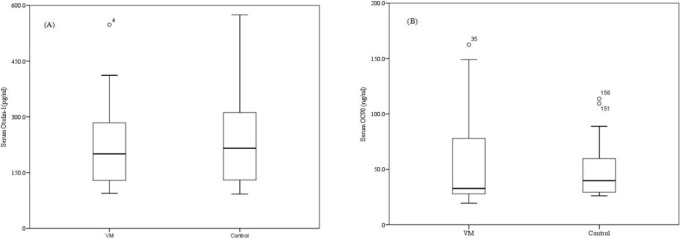 Figure 1
Peer Reviews
No public reviews on file for this paper yet. If you reviewed it on a platform where reviews are public (OpenReview, ICLR, NeurIPS, ICML), you can paste yours below so the community can read it here.
Videos
No videos yet. Explain this paper in a talk, walkthrough, or lecture? Add one.
Taxonomy
TopicsVestibular and auditory disorders · Hearing, Cochlea, Tinnitus, Genetics · Sleep and Wakefulness Research