Elderly Tai Chi practitioners exhibit superior multisensory integration in a dual-task paradigm
Weiyi Dong, Tianxin Zheng, Pinyun Wu, Tingting Li, Jiugen Zhong, Yajun Zhang, Yong Zhang

TL;DR
Elderly people who practice Tai Chi show better balance and stability when doing two tasks at once, especially under challenging conditions.
Contribution
This study reveals that long-term Tai Chi practice enhances multisensory integration and dual-task performance in older adults.
Findings
TCP showed significantly lower COG sway velocity during dual-task conditions compared to controls.
TCP exhibited a significant interaction between task and balance challenge level.
TCP did not show main effects of task, unlike the control group.
Abstract
This study aims to investigate whether elderly Tai Chi (TC) practitioners demonstrate enhanced multisensory integration when performing dual-tasking. Twenty-six TC practitioners (TCP) with at least 5 years of TC experience and 28 controls (TC Naïve) without TC experience were recruited for this cross-sectional study. Standing was employed as the postural task and serial subtraction as the cognitive task to explore dual-task standing stability in the modified Clinical Test of Sensory Interaction on Balance (mCTSIB), which involved increasing the balance challenge via sensory conflict. The Center of Gravity (COG) Sway Velocity was measured to evaluate standing stability in the mCTSIB. There was no significant difference in standing stability between the TCP and TC Naïve groups in mCTSIB during single tasks. However, the TCP exhibited significantly lower COG Sway Velocity than the TC…
Click any figure to enlarge with its caption.
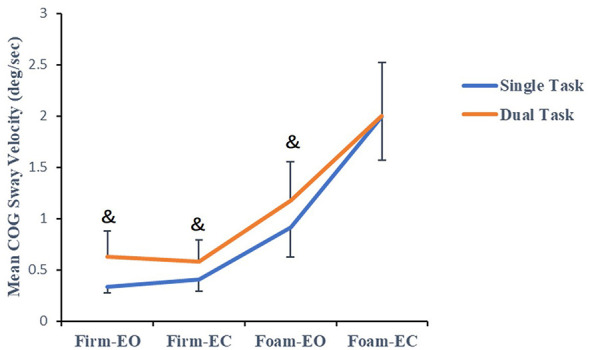 Figure 1
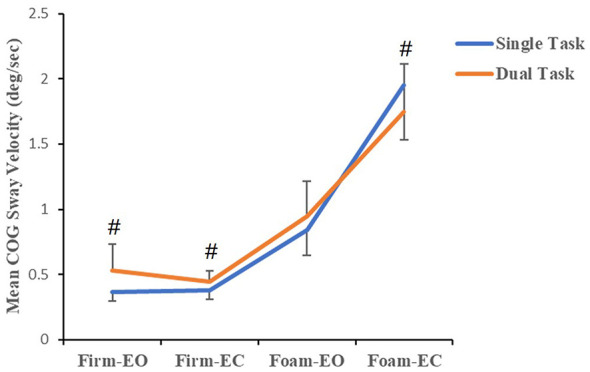 Figure 2
Peer Reviews
No public reviews on file for this paper yet. If you reviewed it on a platform where reviews are public (OpenReview, ICLR, NeurIPS, ICML), you can paste yours below so the community can read it here.
Videos
No videos yet. Explain this paper in a talk, walkthrough, or lecture? Add one.
Taxonomy
TopicsBalance, Gait, and Falls Prevention · Stroke Rehabilitation and Recovery · Motor Control and Adaptation