Soluble Urokinase-type Plasminogen Activator Receptor (suPAR) as a Biomarker of Neurodysfunction
Victoria Linden de Rezende, Khiany Mathias, Lucineia Gainski Danielski, Tatiana Barichello, Fabricia Petronilho

TL;DR
This review explores how suPAR, a marker of chronic inflammation, may be linked to brain dysfunction and neuroinflammation.
Contribution
The paper highlights suPAR's emerging role as a biomarker connecting systemic inflammation to central nervous system dysfunction.
Findings
Higher suPAR levels are associated with memory impairment and poor outcomes after brain injury.
suPAR reflects neuroinflammation and blood-brain barrier disruption in immune-activated conditions.
Study designs and populations vary, limiting clear mechanistic understanding of suPAR's role in the CNS.
Abstract
The inflammatory response is essential for host defense, but its persistence can lead to chronic systemic inflammation (CSI). Soluble urokinase-type plasminogen activator receptor (suPAR) has emerged as a reliable biomarker of CSI because elevated levels consistently indicate the presence and progression of chronic disease as well as increased mortality risk. There is growing evidence that CSI influences neurovascular regulation, including changes in blood-brain barrier (BBB) integrity, which suggests that suPAR may also be relevant to central nervous system (CNS) processes. This narrative review summarizes current findings on suPAR in CSI and examines its emerging implications for CNS. Higher suPAR concentrations have been linked to working memory impairment, executive dysfunction and worse clinical outcomes after brain injury. Evidence also indicates that suPAR reflects…
Genes, proteins, chemicals, diseases, species, mutations and cell lines named across the full text — each resolved to its canonical identifier and authoritative record.
Click any figure to enlarge with its caption.
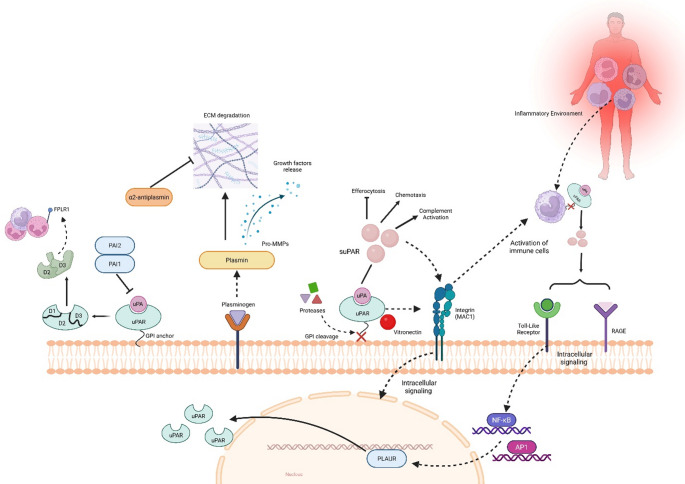 Figure 1
Peer Reviews
No public reviews on file for this paper yet. If you reviewed it on a platform where reviews are public (OpenReview, ICLR, NeurIPS, ICML), you can paste yours below so the community can read it here.
Videos
No videos yet. Explain this paper in a talk, walkthrough, or lecture? Add one.
Taxonomy
TopicsProtease and Inhibitor Mechanisms · Neuroinflammation and Neurodegeneration Mechanisms · Barrier Structure and Function Studies