The effect of emotional valence on concrete and abstract words in L2 lexical processing among Chinese–English learners
Ying Zhang, Zurui Zhang

TL;DR
The study explores how emotions affect processing of concrete and abstract words in Chinese-English bilinguals.
Contribution
It reveals that emotional valence has distinct effects on concrete and abstract word processing in L2 learners.
Findings
Emotion advantage is stronger for concrete words in accuracy but not reaction time.
Abstract words are processed faster and more accurately overall.
Emotional information compensates for limited sensorimotor grounding in abstract words.
Abstract
Emotional valence influences word processing, and this effect is modulated by word concreteness, but findings remain inconsistent in L2 contexts—especially among Chinese-English learners. Based on the Embodied Cognition Theory, we adopted a 3 (valence: positive/neutral/negative) × 2 (concreteness: abstract/concrete) mixed-factorial design and a lexical decision task to test 57 late Chinese-English bilinguals. (1) The valence × concreteness interaction was significant in accuracy (emotion advantage was larger for concrete than abstract words) but not in reaction time; (2) The main effect of concreteness was significant: abstract words were processed faster and more accurately than concrete words. Emotional valence exerts functionally different effects on L2 concrete/abstract word processing—concrete words benefit more from emotional facilitation via sensorimotor connections, while…
Click any figure to enlarge with its caption.
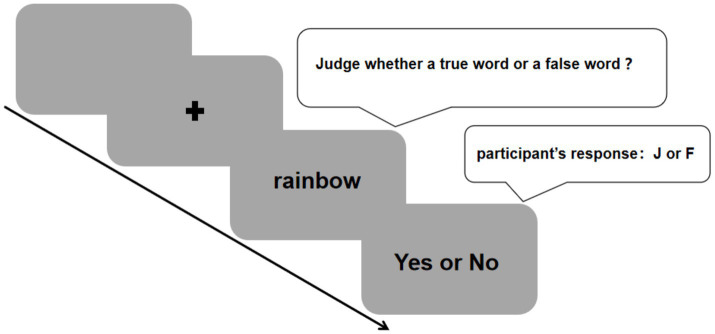 Figure 1
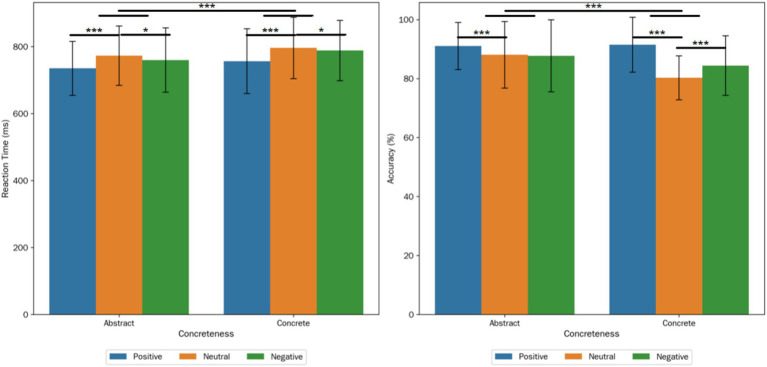 Figure 2
Peer Reviews
No public reviews on file for this paper yet. If you reviewed it on a platform where reviews are public (OpenReview, ICLR, NeurIPS, ICML), you can paste yours below so the community can read it here.
Videos
No videos yet. Explain this paper in a talk, walkthrough, or lecture? Add one.
Taxonomy
TopicsNeurobiology of Language and Bilingualism · Action Observation and Synchronization · Second Language Acquisition and Learning