The role of clinical laboratory parameters in diabetic neuropathy: correlations and recent advances
Ruitong Guo, Pingping Lou, Min Li, Meimei Tian, Lu Gao, Huijie Ma, Yan Liu, Xinli Jiang

TL;DR
This review explores how clinical lab tests can help predict and manage diabetic neuropathy, a common complication in diabetes.
Contribution
The paper provides a comprehensive overview of lab parameters linked to diabetic neuropathy, highlighting their potential for early diagnosis and personalized treatment.
Findings
Diabetic neuropathy is associated with metabolic, renal, and hepatic parameters.
Inflammatory biomarkers and vitamin levels correlate with neuropathy risk.
Combining multiple lab parameters may improve patient care and diagnosis.
Abstract
Diabetic neuropathy affects approximately 50% of patients with diabetes, causing significant health issues and reducing quality of life. This review examined the associations between diabetic neuropathy and various laboratory parameters, including metabolic indicators, renal and hepatic function parameters, inflammatory biomarkers, thyroid hormones and vitamins. By summarizing the latest evidence on these easily accessible clinical parameters, the article aims to improve risk stratification, enable earlier diagnosis and develop personalized therapeutic strategies, emphasizing the potential of multi-parameter biomarker integration to optimize patient care.
Genes, proteins, chemicals, diseases, species, mutations and cell lines named across the full text — each resolved to its canonical identifier and authoritative record.
Click any figure to enlarge with its caption.
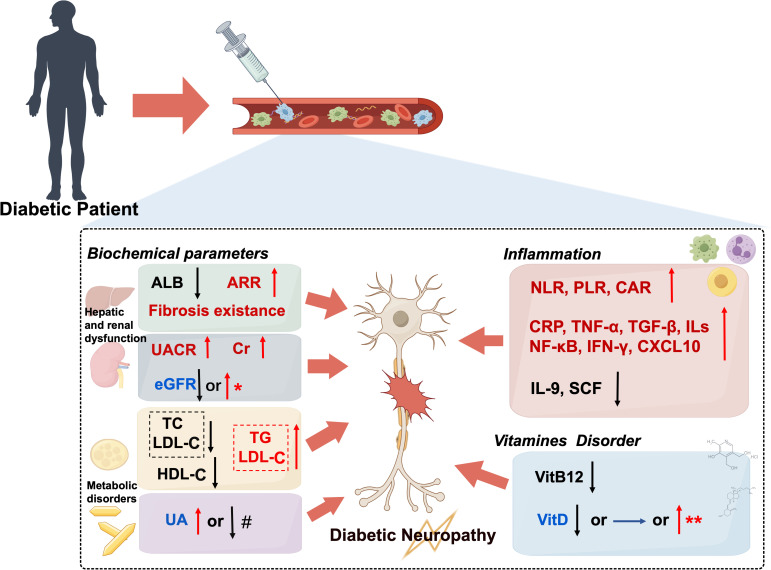 Figure 1
Peer Reviews
No public reviews on file for this paper yet. If you reviewed it on a platform where reviews are public (OpenReview, ICLR, NeurIPS, ICML), you can paste yours below so the community can read it here.
Videos
No videos yet. Explain this paper in a talk, walkthrough, or lecture? Add one.
Taxonomy
TopicsPain Mechanisms and Treatments · Liver Disease Diagnosis and Treatment · Diabetes, Cardiovascular Risks, and Lipoproteins