Facility‐Level Factors Associating Antenatal Corticosteroid Administration Rates and Subsequent Term Birth Rates: A Nationwide Cross‐Sectional Observational Study Using the 2020–2022 Perinatal Registry Database in Japan
Kazuya Fuma, Takafumi Ushida, Takahiro Imaizumi, Sho Tano, Seiko Matsuo, Satoru Katsuki, Kenji Imai, Hiroaki Kajiyama, Tomomi Kotani

TL;DR
This study explores factors at healthcare facilities in Japan that affect the use of antenatal corticosteroids and the likelihood of term births, aiming to improve treatment rates while avoiding unnecessary use.
Contribution
The study identifies facility-level factors influencing antenatal corticosteroid administration and term birth rates, offering insights for optimizing clinical practice.
Findings
Facility-level factors like threatened preterm labor and cesarean section rate are significantly associated with antenatal corticosteroid administration rates.
Simulation suggests increasing corticosteroid use could lead to more recipients and term births annually.
Perinatal care level and delivery volume are inversely related to term birth rates among corticosteroid recipients.
Abstract
The antenatal corticosteroid (ACS) administration rate in Japan is low. To achieve both high coverage and low overtreatment of ACS, understanding of facility‐level factors is important. This study aimed to identify facility‐level factors associated with ACS coverage and overtreatment and simulate the potential consequences of increased ACS use. This observational study used data from the 2020 to 2022 Perinatal Registry Database maintained by the Japan Society of Obstetrics and Gynecology. Primary outcomes were: (1) ACS administration rate among preterm births before 34 weeks (ACS/34w rate) and (2) proportion of term births among ACS recipients (term/ACS proportion). Multivariable regression analyses examined associations with facility‐level factors including perinatal care level, location, delivery volume, and prevalence of maternal conditions. A simulation estimated the impact of…
Genes, proteins, chemicals, diseases, species, mutations and cell lines named across the full text — each resolved to its canonical identifier and authoritative record.
Click any figure to enlarge with its caption.
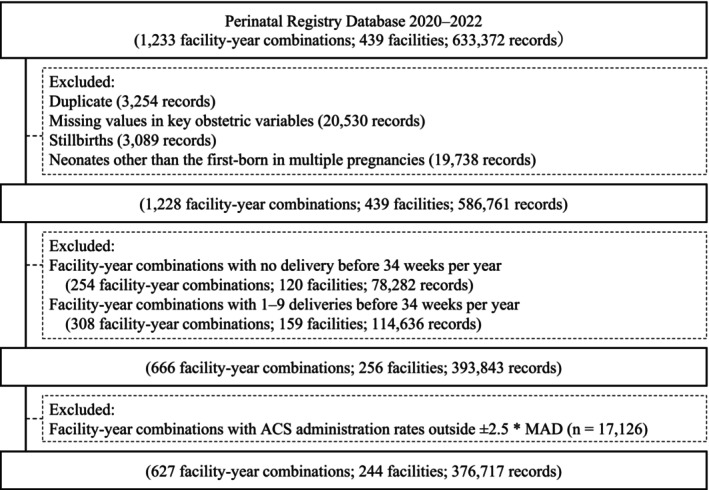 Figure 1
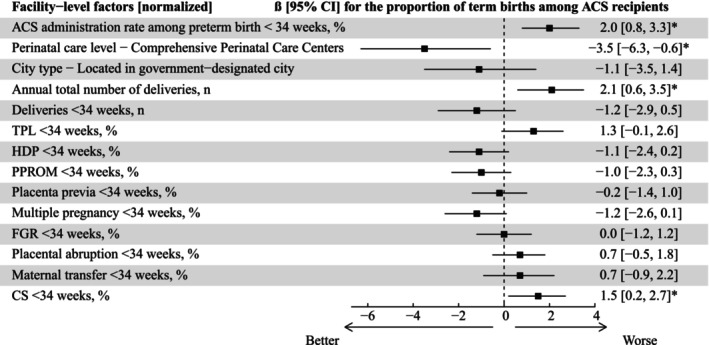 Figure 2
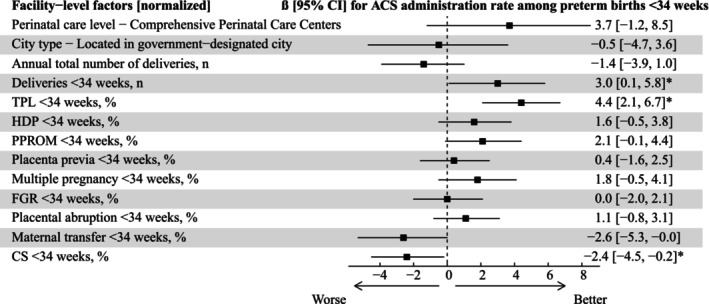 Figure 3
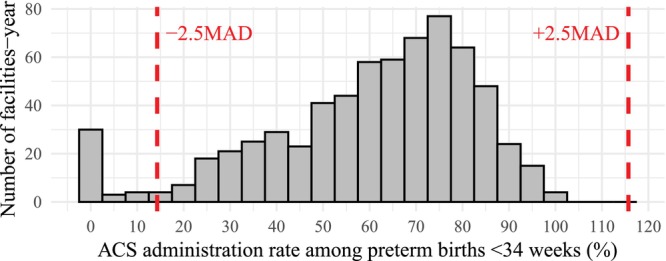 Figure 4
Peer Reviews
No public reviews on file for this paper yet. If you reviewed it on a platform where reviews are public (OpenReview, ICLR, NeurIPS, ICML), you can paste yours below so the community can read it here.
Videos
No videos yet. Explain this paper in a talk, walkthrough, or lecture? Add one.
Taxonomy
TopicsNeonatal Respiratory Health Research · Infant Nutrition and Health · Birth, Development, and Health