Association between parental recognition and engagement in child maltreatment: an Internet-based cross-sectional study in Japan
Miho Sodeno, Sumiyo Okawa, Mariko Hosozawa, Takahiro Tabuchi

TL;DR
This study in Japan finds that parents who don't recognize certain behaviors as maltreatment are more likely to engage in them, especially neglect, highlighting the need for education for both fathers and mothers.
Contribution
The study provides new insights into the relationship between parental recognition and engagement in child maltreatment, specifically highlighting differences between fathers and mothers in Japan.
Findings
Lack of recognition of maltreatment behaviors was associated with higher engagement in maltreatment for both fathers and mothers.
Fathers reported higher rates of physical, psychological, and neglect behaviors compared to mothers.
The strongest association between unrecognition and engagement was observed for neglect.
Abstract
Child maltreatment, traditionally considered a maternal issue in Japan, increasingly involves fathers. Despite the rise in paternal participation, the recognition of and engagement in child maltreatment remains poorly investigated in Japan. We explored the association between parental recognition and engagement in maltreatment, stratified by parental sex. An Internet survey was conducted in Japan from July to August 2021, involving 8,819 parents (1,671 fathers, and 7,148 mothers) with children under 24 months of age. A self-report questionnaire assessed recognition of and engagement in maltreatment behaviors, including physical and psychological maltreatment and neglect. Poisson regression analysis estimated prevalence ratios of engagement in maltreatment behaviors by recognition status, stratified by parental sex. Harsh behaviors widely recognized as maltreatment (unrecognition was…
Genes, proteins, chemicals, diseases, species, mutations and cell lines named across the full text — each resolved to its canonical identifier and authoritative record.
Click any figure to enlarge with its caption.
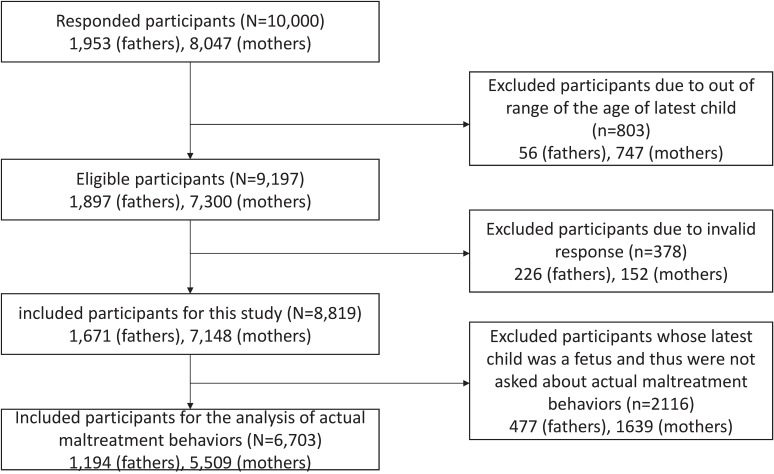 Figure 1
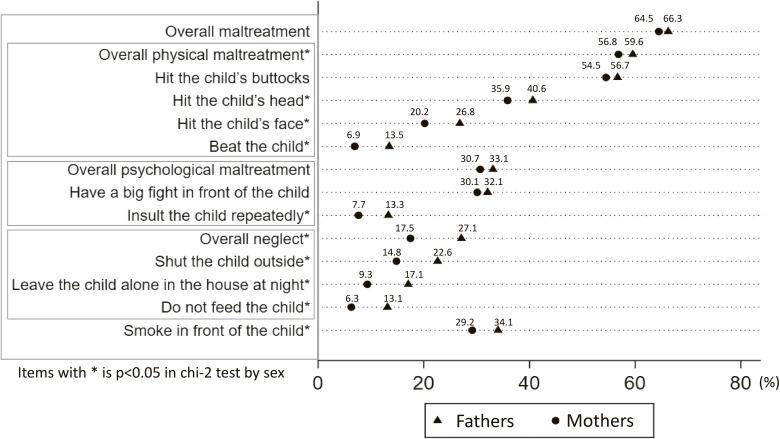 Figure 2
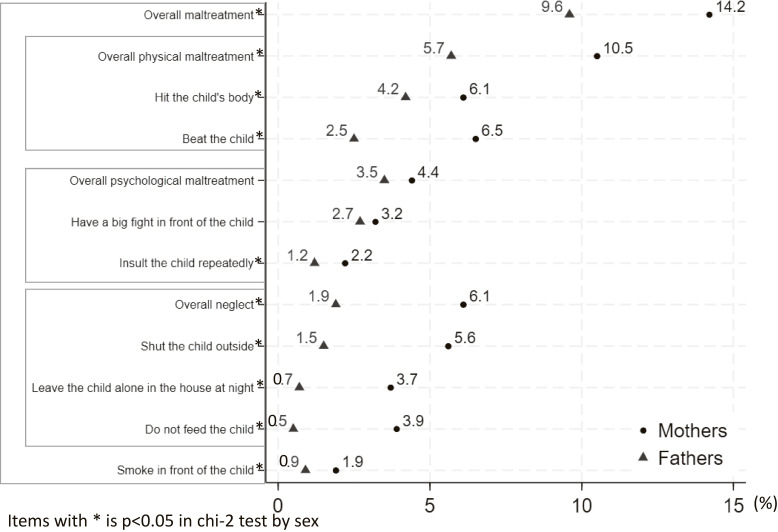 Figure 3
Peer Reviews
No public reviews on file for this paper yet. If you reviewed it on a platform where reviews are public (OpenReview, ICLR, NeurIPS, ICML), you can paste yours below so the community can read it here.
Videos
No videos yet. Explain this paper in a talk, walkthrough, or lecture? Add one.
Taxonomy
TopicsChild Abuse and Trauma · Child and Adolescent Psychosocial and Emotional Development · Intimate Partner and Family Violence