KANPM-DTA: improving drug–target affinity prediction with Kolmogorov–Arnold networks and pretrained models
M D Youshuf Khan Rakib, Muhammad Habibulla Alamin, Jiamu Li, Sheikh Sohan Mamun, Kaleb Amsalu Gobena, Shengbing Ren

TL;DR
KANPM-DTA is a new deep learning framework that improves drug–target affinity predictions by combining advanced modeling techniques and pretrained models, leading to better performance on benchmark datasets.
Contribution
The novel integration of Kolmogorov–Arnold networks and ESM-guided protein graphs enhances prediction accuracy and interpretability for drug–target affinity.
Findings
KANPM-DTA outperforms existing methods on Davis, KIBA, Metz, and BindingDB datasets with significant MSE reductions and CI increases.
The model achieves improved performance through a gated fusion mechanism and linear attention for capturing cross-modal dependencies.
A case study on the epidermal growth factor receptor demonstrates its effectiveness in predicting affinities for unknown drug–target pairs.
Abstract
Accurate drug–target affinity (DTA) prediction is critical for drug discovery and repurposing. However, existing models often struggle with generalizing to unseen drug–target pairs, lack interpretability, and fail to integrate heterogeneous biological features effectively. To overcome these challenges, we introduce KANPM-DTA, a deep learning framework designed to capture richer biochemical interactions and improve prediction reliability. Specifically, an ESM-guided protein graph construction strategy incorporates evolutionary and structural information to overcome underexplored protein representations. A gated fusion mechanism was employed to integrate drug–protein graph features, while linear attention captures cross-modal dependencies that enhance discriminative power. For the final affinity prediction, a Kolmogorov–Arnold network was used, offering a stronger nonlinear approximation…
Genes, proteins, chemicals, diseases, species, mutations and cell lines named across the full text — each resolved to its canonical identifier and authoritative record.
Click any figure to enlarge with its caption.
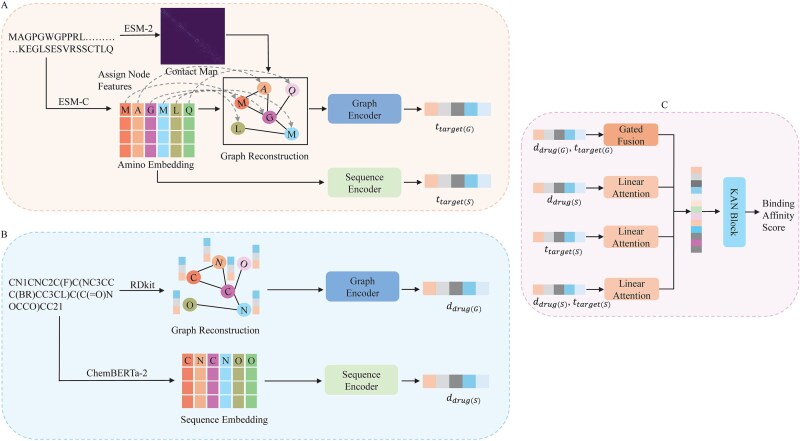 Figure 1
 Figure 2
 Figure 3
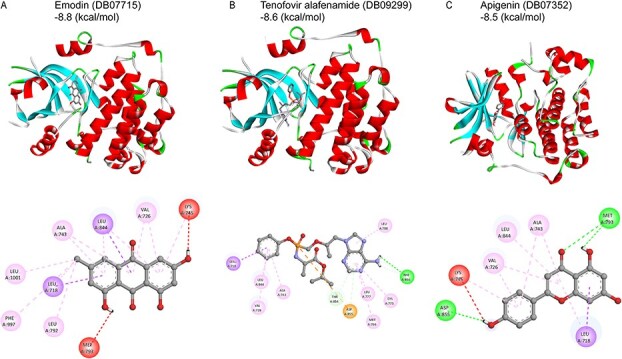 Figure 4
Peer Reviews
No public reviews on file for this paper yet. If you reviewed it on a platform where reviews are public (OpenReview, ICLR, NeurIPS, ICML), you can paste yours below so the community can read it here.
Videos
No videos yet. Explain this paper in a talk, walkthrough, or lecture? Add one.
Taxonomy
TopicsComputational Drug Discovery Methods · vaccines and immunoinformatics approaches · Bioinformatics and Genomic Networks