Auditor models to suppress poor artificial intelligence predictions can improve human-artificial intelligence collaborative performance
Katherine E Brown, Jesse O Wrenn, Nicholas J Jackson, Michael R Cauley, Benjamin X Collins, Laurie L Novak, Bradley A Malin, Jessica S Ancker

TL;DR
This paper shows that suppressing unreliable AI predictions can improve fairness and performance in human-AI healthcare decision-making.
Contribution
The study introduces auditor models to suppress poor AI predictions, improving collaborative fairness and performance in healthcare decisions.
Findings
Suppression of poor ML predictions improves collaborative performance when ML outperforms humans.
Incorporating uncertainty quantification enhances suppression effectiveness.
Suppression maintains fairness and avoids degrading performance when ML is less accurate.
Abstract
Healthcare decisions are increasingly made with the assistance of machine learning (ML). ML has been known to have unfairness—inconsistent outcomes across subpopulations. Clinicians interacting with these systems can perpetuate such unfairness by overreliance. Recent work exploring ML suppression—silencing predictions based on auditing the ML—shows promise in mitigating performance issues originating from overreliance. This study aims to evaluate the impact of suppression on collaboration fairness and evaluate ML uncertainty as desiderata to audit the ML. We used data from the Vanderbilt University Medical Center electronic health record (n = 58 817) and the MIMIC-IV-ED dataset (n = 363 145) to predict likelihood of death or intensive care unit transfer and likelihood of 30-day readmission using gradient-boosted trees and an artificially high-performing oracle model. We derived…
Genes, proteins, chemicals, diseases, species, mutations and cell lines named across the full text — each resolved to its canonical identifier and authoritative record.
Click any figure to enlarge with its caption.
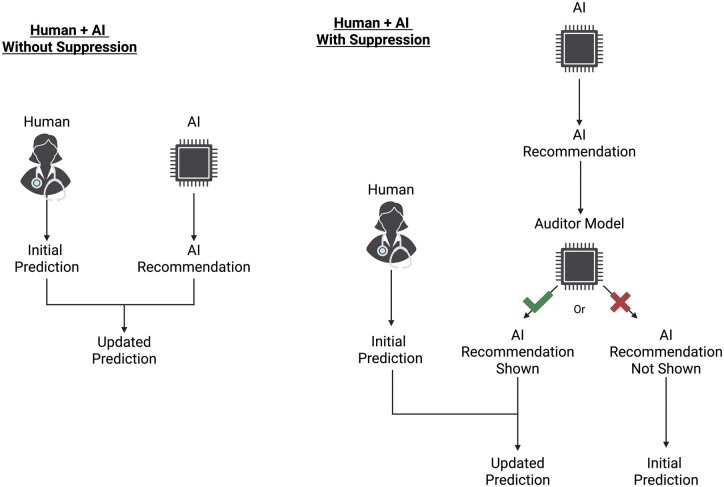 Figure 1
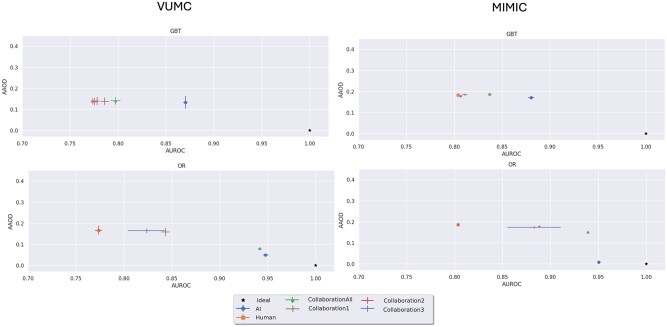 Figure 2
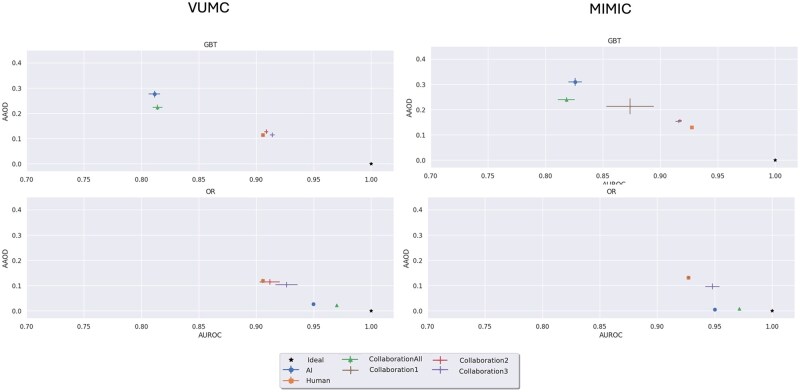 Figure 3
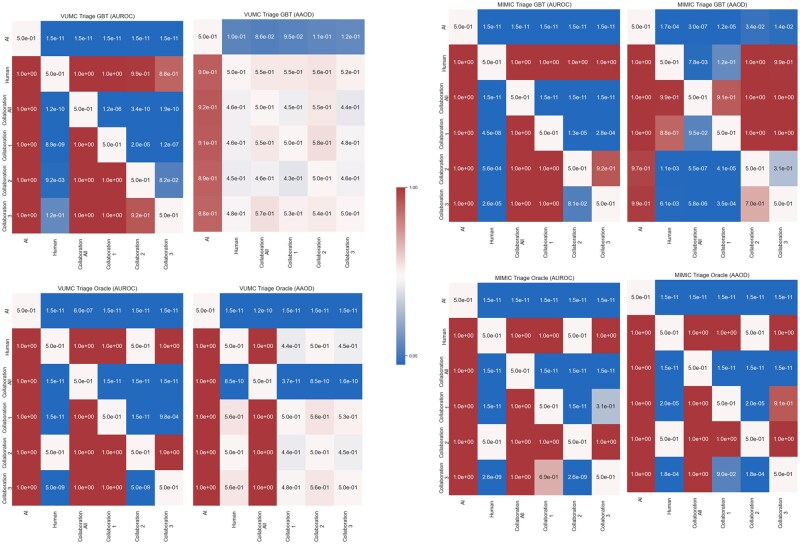 Figure 4
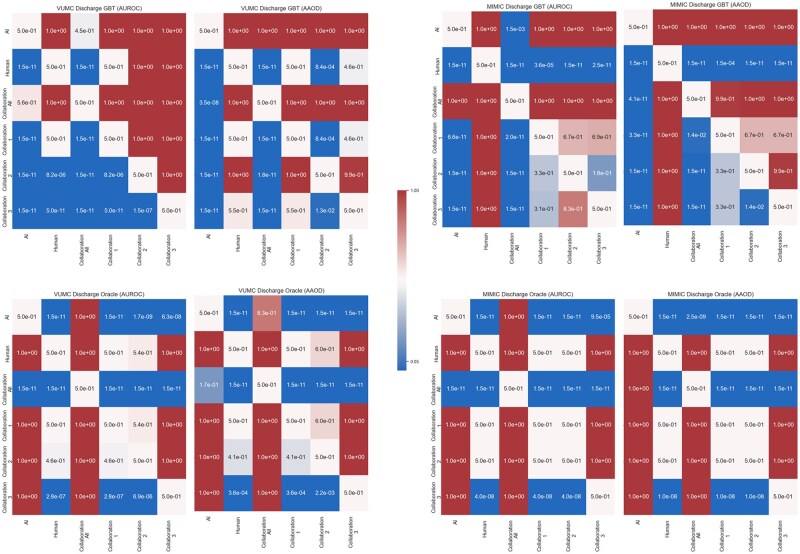 Figure 5
Peer Reviews
No public reviews on file for this paper yet. If you reviewed it on a platform where reviews are public (OpenReview, ICLR, NeurIPS, ICML), you can paste yours below so the community can read it here.
Videos
No videos yet. Explain this paper in a talk, walkthrough, or lecture? Add one.
Taxonomy
TopicsExplainable Artificial Intelligence (XAI) · Ethics and Social Impacts of AI · Adversarial Robustness in Machine Learning