Digital health literacy as mediator between language preference and telehealth use among Latinos in the United States
Miguel Linares, Jorge A Rodriguez, Lauren E Wisk, Douglas S Bell, Arleen Brown, Alejandra Casillas

TL;DR
The study shows that digital health literacy helps explain why some Latino adults prefer using telehealth in English over other languages.
Contribution
This study identifies digital health literacy as a key factor linking language preference and telehealth use among Latinos.
Findings
Digital health literacy mediates nearly half of the telehealth use difference between English and non-English preferring Latino adults.
The findings highlight the importance of inclusive telehealth design to address linguistic and digital access barriers.
Abstract
Using 2023-2024 U.S. National Health Interview Survey data, we found that digital health literacy (dHL) mediated nearly half of the difference in telehealth use between Latino adults with non-English and English language preference. These findings identify dHL as a modifiable mechanism linking linguistic and digital access barriers, underscoring the need for multilingual, inclusive, and equitable telehealth design.
Genes, proteins, chemicals, diseases, species, mutations and cell lines named across the full text — each resolved to its canonical identifier and authoritative record.
Click any figure to enlarge with its caption.
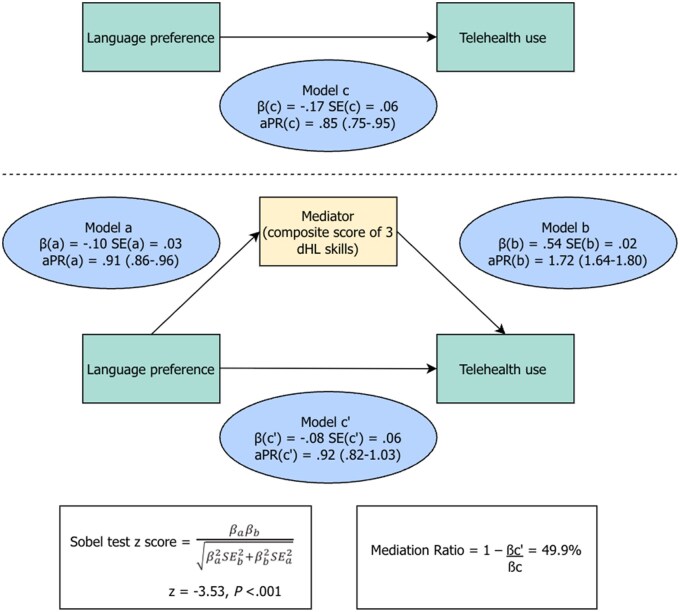 Figure 1
Peer Reviews
No public reviews on file for this paper yet. If you reviewed it on a platform where reviews are public (OpenReview, ICLR, NeurIPS, ICML), you can paste yours below so the community can read it here.
Videos
No videos yet. Explain this paper in a talk, walkthrough, or lecture? Add one.
Taxonomy
TopicsHealth Literacy and Information Accessibility · Interpreting and Communication in Healthcare · Telemedicine and Telehealth Implementation