A Telehealth-Adapted Dementia Caregiver Skills Training Intervention (TeleCARE): Single-Arm Pre-Post Intervention Study
Maureen K O'Connor, Steven D Shirk, Jaye E McLaren, Andrew H Nguyen, Kendra Pugh, Madeline A Sullivan, Emily E Metcalf, Samantha Harrington, Lauren R Moo

TL;DR
A telehealth version of a dementia caregiver training program was found to be feasible and acceptable, with some improvements needed for technology use.
Contribution
The study introduces TeleCARE, a telehealth adaptation of an in-person dementia caregiver skills training program, and evaluates its feasibility and acceptability.
Findings
TeleCARE had a recruitment rate of 22% and high session attendance (83% completion rate).
Participants reported adequate satisfaction with the telehealth intervention despite needing technological support.
Small effect sizes were observed for reduced caregiver depression, anxiety, and care recipient neuropsychiatric symptoms.
Abstract
Dementia caregivers often want to support aging at home, but as neuropsychiatric symptoms (NPS) become more severe, caregiver challenges increase, often resulting in negative outcomes for both the caregiver and care recipient and institutionalization. Project CARE is a manualized in-person group intervention for dementia caregivers designed to reduce negative caregiver outcomes by teaching skills to manage NPS in care recipients in the home environment. Interventions that occur in person, however, can be difficult for caregivers to attend. Telehealth-based interventions are possible alternatives that reduce barriers to attendance. The primary objective of this pilot study was to evaluate the feasibility and acceptability of offering CARE via telehealth (TeleCARE). The secondary objective was to explore quantitative outcome trends and effect sizes postintervention outcomes of TeleCARE…
Genes, proteins, chemicals, diseases, species, mutations and cell lines named across the full text — each resolved to its canonical identifier and authoritative record.
Click any figure to enlarge with its caption.
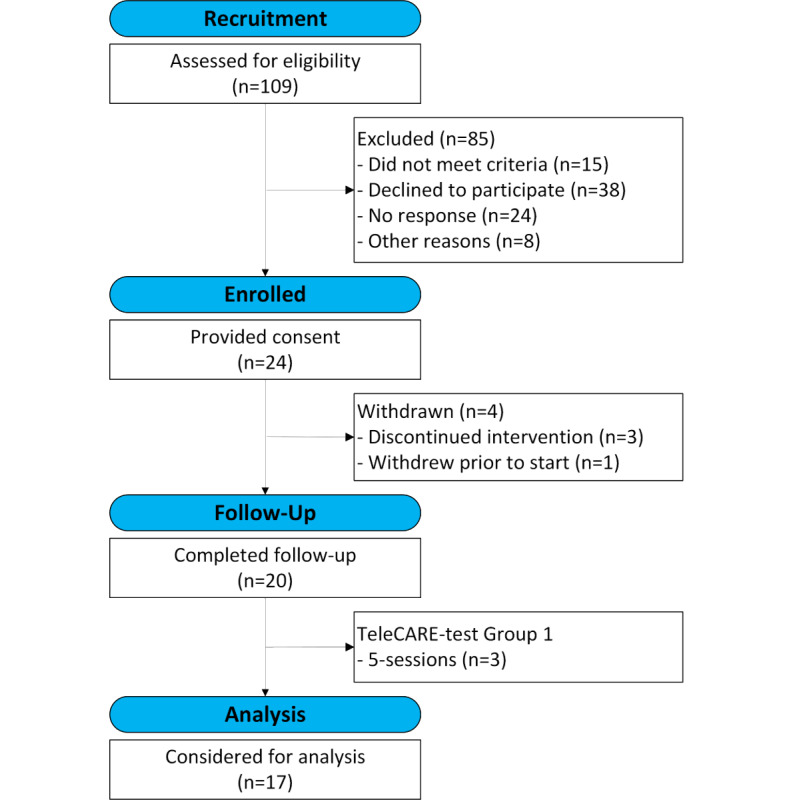 Figure 1
 Figure 2
Peer Reviews
No public reviews on file for this paper yet. If you reviewed it on a platform where reviews are public (OpenReview, ICLR, NeurIPS, ICML), you can paste yours below so the community can read it here.
Videos
No videos yet. Explain this paper in a talk, walkthrough, or lecture? Add one.
Taxonomy
TopicsTechnology Use by Older Adults · Telemedicine and Telehealth Implementation · Dementia and Cognitive Impairment Research