Minithoracotomy Versus Sternotomy for Aortic Valve Replacement: Outcomes from a Latin American Comparative Study
Josías C Ríos-Ortega, Carlos Quispe-Vizcarra, Josué Sisniegas-Razón, Roger Conde-Moncada, Luisa Talledo-Paredes, Gracia Polo-Lecca, Enrique Velarde-Revilla, Walter Pazos-García, Yemmy Pérez-Valverde, Félix Bocanegra-Silva, Vicente Benites-Zapata, Julio Morón-Castro

TL;DR
This study compares two surgical approaches for aortic valve replacement and finds similar mortality rates between them in Latin American hospitals.
Contribution
The study demonstrates that minimally invasive surgery for aortic valve replacement is as safe as traditional methods in middle-income countries.
Findings
Operative mortality rates were similar between minithoracotomy and full sternotomy.
Post-operative complications like pacemaker insertion and atrial fibrillation were more common with minithoracotomy.
Five-year survival estimates were comparable between the two surgical approaches.
Abstract
We conducted a study comparing full sternotomy (FS) and minithoracotomy (MT) for aortic valve replacement (AVR). The primary end-point was determining all-cause mortality and other variables according to the VARC 3 Consortium. Retrospective investigation from January 2017 to December 2024 in 2 referral centres in Peru. We selected 142 patients who were submitted to isolated AVR through MT and 772 through FS. We used unmatched analysis and a propensity score matching (PSM) for matched analysis. In the unmatched analysis, operative mortality for MT was similar (MT: 2.1% vs FS: 1.6%, P: .391), stroke rate in the MT group was 2.1% and in the FS group 1% (P: .278), pacemaker insertion was more common in the MT group (MT: 3.5% vs FS: 0.5%, P < .001) as well as post-operative atrial fibrillation (POAF) (19% vs 9.2%, P < .001). After a PMS, operative mortality was similar (MT: 1/108, 0.9% vs…
Genes, proteins, chemicals, diseases, species, mutations and cell lines named across the full text — each resolved to its canonical identifier and authoritative record.
Click any figure to enlarge with its caption.
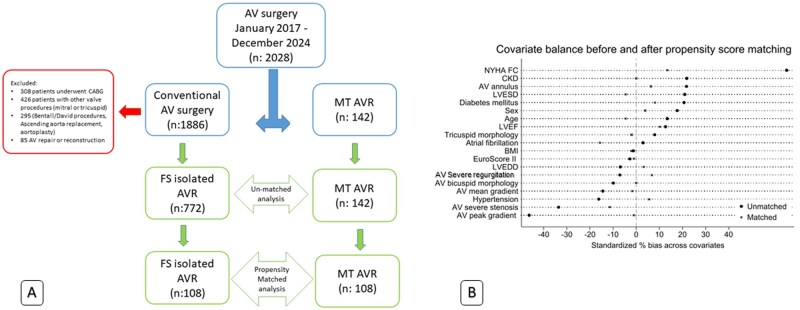 Figure 1
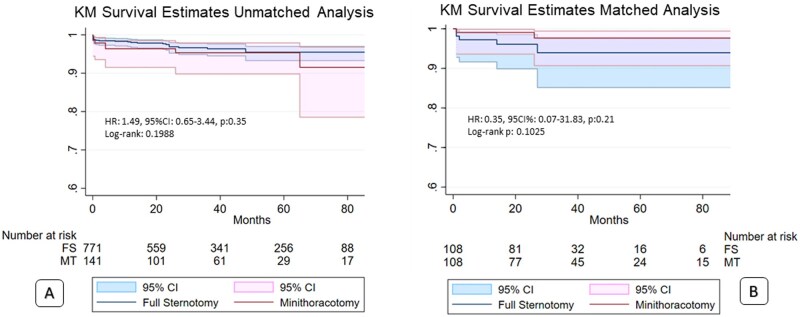 Figure 2
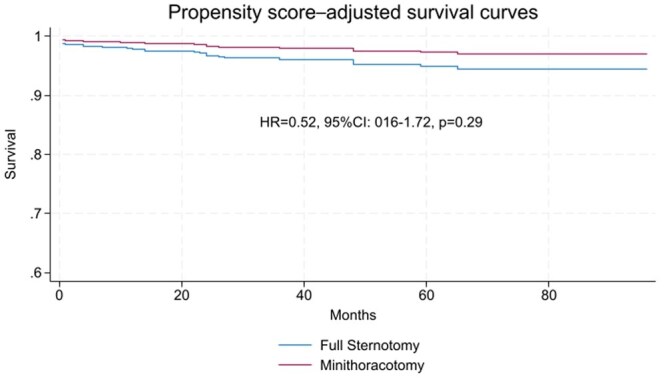 Figure 3
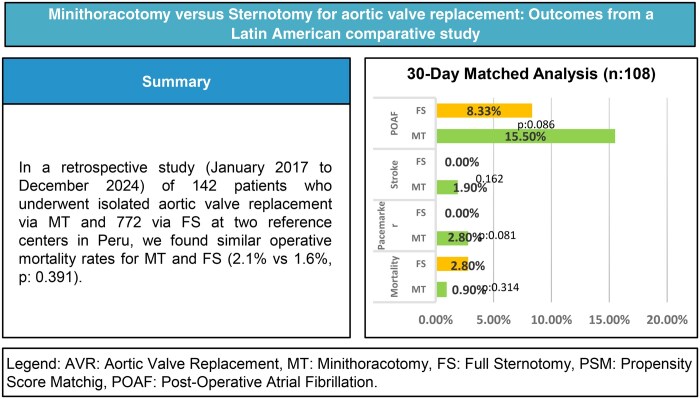 Figure 4
Peer Reviews
No public reviews on file for this paper yet. If you reviewed it on a platform where reviews are public (OpenReview, ICLR, NeurIPS, ICML), you can paste yours below so the community can read it here.
Videos
No videos yet. Explain this paper in a talk, walkthrough, or lecture? Add one.
Taxonomy
TopicsCardiac and Coronary Surgery Techniques · Cardiac Valve Diseases and Treatments · Aortic Disease and Treatment Approaches